
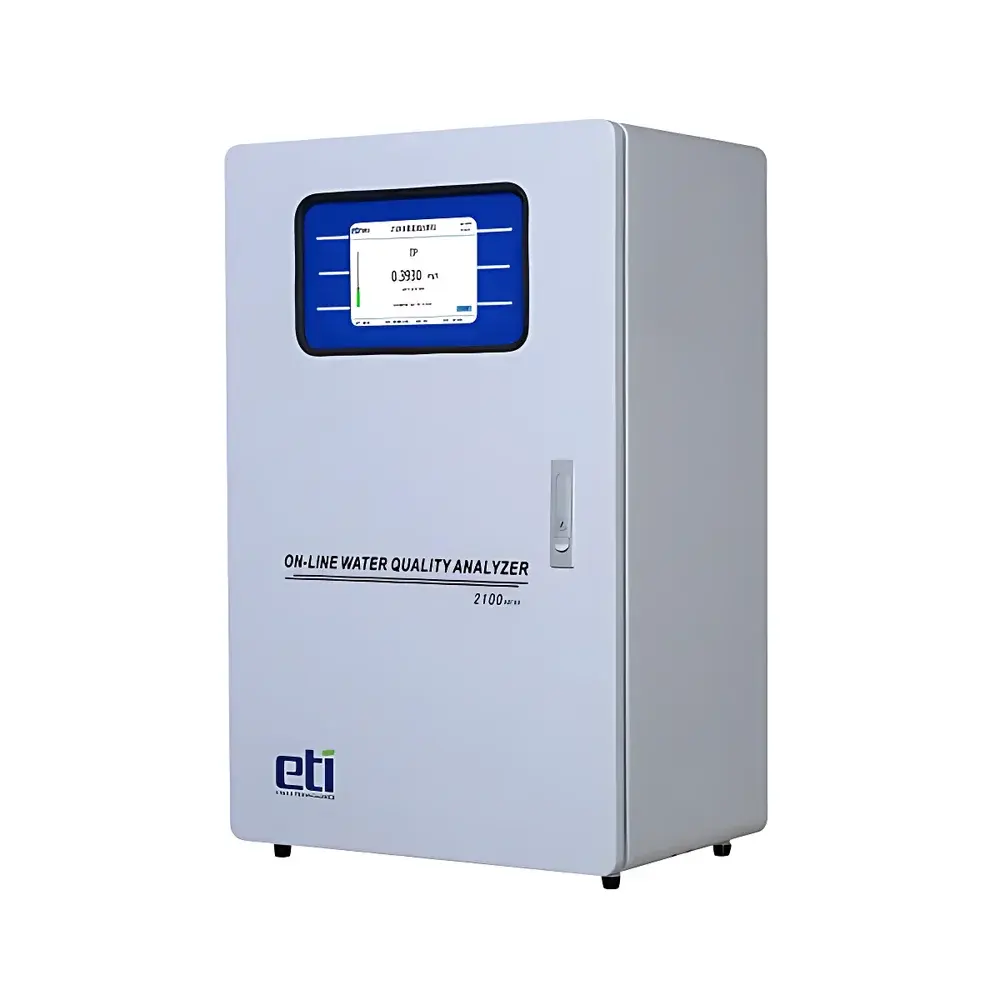
ETI 2100Plus Online Ammonia Nitrogen Analyzer
| Brand | ETI |
|---|---|
| Origin | Guangdong, China |
| Manufacturer Type | Authorized Distributor |
| Country of Origin | China |
| Model | 2100Plus |
| Instrument Type | Online Analyzer |
| Measurement Principle | Ammonia Gas-Sensing Electrode Method (Primary), Salicylate Spectrophotometry & Nessler Reagent Spectrophotometry (Optional) |
| Measurement Range | 0–1000 mg/L NH₃–N (electrode mode) |
| Accuracy | ±3% of reading or ±0.05 mg/L (whichever is greater) |
| Detection Limit | 0.001 mg/L |
| Analysis Time | 10–15 min per cycle |
| Sample Throughput | Continuous unattended operation |
| Calibration & QC Modes | Automatic, remote, and manual verification (standard addition, blank check, reference standard validation) |
| Output Signals | 4–20 mA analog output |
| Power Supply | 220 ± 22 VAC, 50 ± 0.5 Hz |
| Enclosure Dimensions | 520 mm (W) × 380 mm (D) × 800 mm (H) |
| Weight | ~45 kg (excluding reagents) |
Overview
The ETI 2100Plus Online Ammonia Nitrogen Analyzer is an industrial-grade, multi-principle water quality monitoring system engineered for continuous, real-time quantification of ammonia nitrogen (NH₃–N) in diverse aqueous matrices. It operates primarily on the ammonia gas-sensing electrode principle—a potentiometric method grounded in the Nernst equation—where ammonium ions (NH₄⁺) are converted to gaseous NH₃ under controlled alkaline conditions (pH > 11.5), diffusing across a hydrophobic membrane to generate a stable, logarithmically proportional electrode potential. This electrochemical architecture ensures high selectivity against common interferents (e.g., K⁺, Na⁺, Ca²⁺, Cl⁻) and eliminates optical path fouling risks associated with photometric methods. Complementary spectrophotometric options—salicylate and Nessler-based—are available for laboratories requiring trace-level sensitivity or regulatory alignment with standardized wet-chemistry protocols (e.g., ISO 7150-1, ASTM D1426). Designed for unattended deployment in demanding environmental and process environments, the 2100Plus delivers long-term stability, minimal drift (<2% FS/month), and compliance-ready data integrity.
Key Features
- Triple-method flexibility: Switch between ammonia gas-sensing electrode, salicylate, and Nessler spectrophotometry via software configuration—enabling method validation, cross-verification, and regulatory adaptability.
- Patented intelligent dilution module: Automatically selects optimal dilution factors based on real-time signal response, extending dynamic range without manual intervention.
- High-precision microfluidic injection: Dual-syringe pump system with <±0.5% volumetric repeatability ensures stoichiometric reagent dosing and sample metering—critical for reproducible calibration curves and low-concentration accuracy.
- Robust power management: Integrated UPS-compatible circuitry with non-volatile memory preserves calibration coefficients, method parameters, and historical logs during grid interruption; auto-resumes analysis upon power recovery.
- Modular hardware architecture: Field-replaceable sensor cartridges, reagent reservoirs, and waste modules reduce mean time to repair (MTTR) and support GLP-compliant maintenance logging.
- Configurable operational modes: Supports scheduled periodic analysis, event-triggered sampling (e.g., flow pulse or level threshold), fixed-interval measurement, continuous flow-through monitoring, and manual override—all programmable via embedded web interface.
Sample Compatibility & Compliance
The 2100Plus is validated for direct analysis of raw and treated waters including surface water, drinking water sources, municipal wastewater influent/effluent, industrial discharge streams (e.g., food processing, semiconductor rinse water, fertilizer production), and recirculating aquaculture systems. Its electrochemical core meets ISO 15839:2012 requirements for performance evaluation of online water analyzers. Spectrophotometric configurations align with EPA Method 350.1 (salicylate) and EPA Method 350.2 (Nessler), while data handling supports audit trails compliant with FDA 21 CFR Part 11 when deployed with optional secure authentication and electronic signature modules. All firmware revisions undergo traceable version control, and calibration records include timestamped operator ID, standard lot numbers, and environmental metadata (temperature, pressure, pH).
Software & Data Management
Embedded Linux-based firmware provides local web server access (HTTPS-enabled) for real-time status visualization, method editing, and diagnostic reporting. The analyzer exports time-stamped measurement data (NH₃–N concentration, temperature, electrode potential, absorbance, QC flag status) via Modbus TCP or ASCII over RS485 to SCADA, DCS, or LIMS platforms. Internal storage retains ≥6 months of 15-minute interval data with cyclic overwrite protection. Remote QC functions—including automated standard addition recovery tests, blank subtraction routines, and multi-point calibration validation—generate ISO/IEC 17025-aligned reports. Audit logs record all user actions, parameter changes, and alarm events with immutable timestamps—supporting GLP/GMP documentation requirements.
Applications
- Municipal water utilities: Real-time monitoring at intake points, treatment plant headworks, and distribution system nodes to ensure compliance with WHO and EU Drinking Water Directive limits (0.5 mg/L NH₃–N).
- Wastewater treatment plants: Feedback control of nitrification/denitrification basins, effluent compliance reporting under NPDES permits, and early detection of process upsets (e.g., sludge bulking, anoxic zone failure).
- Industrial pretreatment systems: Monitoring of ammonia-laden discharges from chemical manufacturing, textile dyeing, and meat processing facilities to verify adherence to local sewer use ordinances.
- Environmental surveillance networks: Long-term trend analysis in rivers, lakes, and estuaries—particularly where agricultural runoff or landfill leachate poses eutrophication risk.
- Research & education: Method comparison studies, sensor fouling resistance evaluation, and development of adaptive control algorithms for smart water infrastructure.
FAQ
What measurement principles does the 2100Plus support, and how do they differ in application?
The primary mode is the ammonia gas-sensing electrode method—ideal for continuous online use due to its speed, robustness, and immunity to turbidity. Salicylate and Nessler spectrophotometry offer higher sensitivity at sub-0.1 mg/L levels and are preferred where regulatory submissions require classical wet-chemistry validation.
Does the system comply with international calibration traceability standards?
Yes—calibration standards are traceable to NIST SRM 2162 (ammonium sulfate) or equivalent national metrology institute references. Certificate of analysis accompanies each certified standard batch.
Can the 2100Plus integrate with existing plant SCADA systems?
It supports native Modbus RTU/TCP, ASCII serial protocols, and 4–20 mA analog output with HART capability—enabling seamless integration with Siemens Desigo, Honeywell Experion, Emerson DeltaV, and similar platforms.
How often is maintenance required, and what consumables are needed?
Electrode membranes and reference electrolyte require replacement every 6–12 months depending on matrix fouling potential. Spectrophotometric modules need reagent replenishment every 2–4 weeks at typical 15-min cycle intervals. Preventive maintenance is guided by onboard diagnostics and scheduled alerts.
Is remote firmware update supported?
Yes—secure OTA (over-the-air) updates are delivered via HTTPS with SHA-256 signature verification and rollback capability to ensure system integrity and cybersecurity compliance (IEC 62443-3-3 Level 1).
Related Products







