
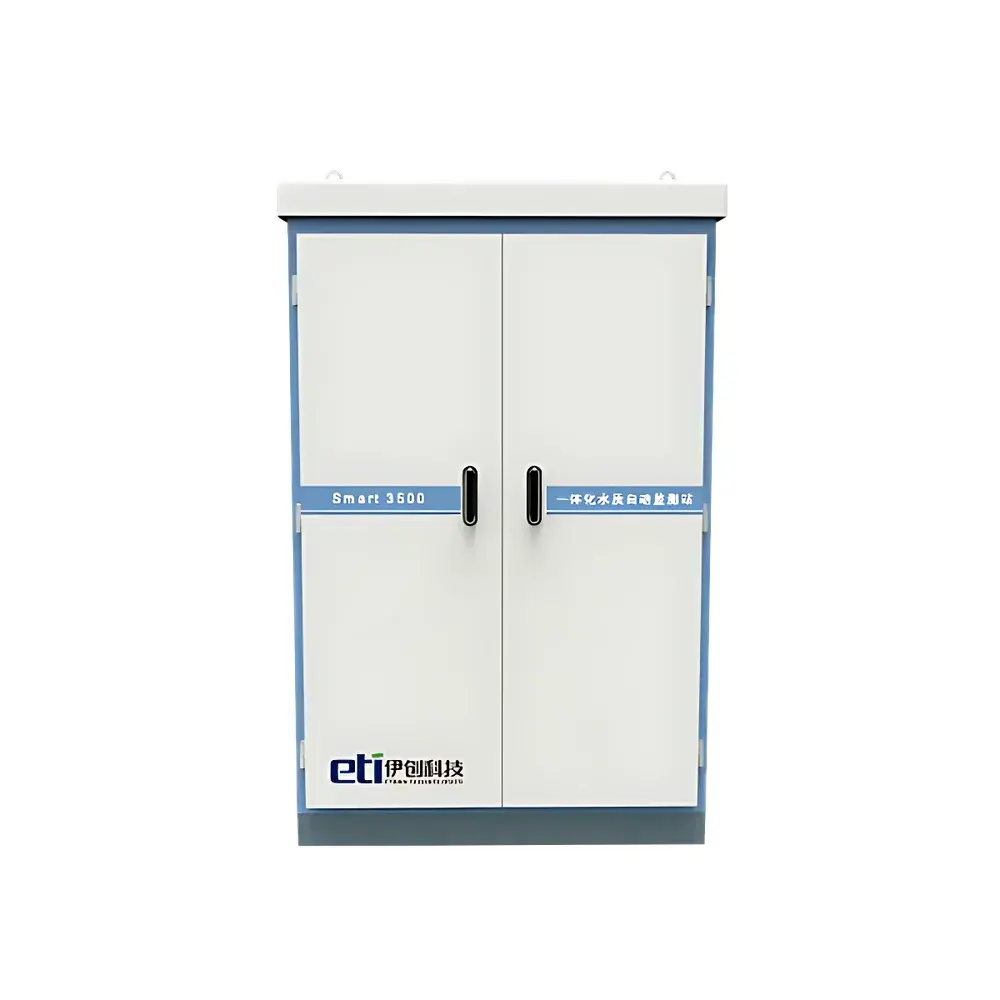
ETI Smart3500 Integrated Online Water Quality Monitoring Station
| Brand | ETI |
|---|---|
| Origin | Guangdong, China |
| Manufacturer Type | Authorized Distributor |
| Country of Origin | China |
| Model | Smart3500 |
| Price | Upon Request |
| Footprint | < 1 m² |
| Installation | Skid-mounted, plug-and-play with power & water connection |
| Enclosure Dimensions | 900 mm (W) × 750 mm (D) × 1750 mm (H) |
| Weight | ~380 kg |
| Analytical Methods | Electrode-based and Spectrophotometric |
| Measurement Modes | Cyclic, Triggered (Event/Threshold), Continuous, Manual, Scheduled Check |
| Verification Modes | Remote, Manual, Auto-Triggered (Time-Based or Exceedance-Based) |
| Output | Wired (RS485/Modbus, Ethernet) and Wireless (4G LTE, optional NB-IoT) |
| Power Supply | 220 ± 22 VAC, 50 ± 0.5 Hz |
| Environmental Control | Integrated HVAC system |
| Module Architecture | Drawer-type, hot-swappable analytical units |
| Compliance | Designed to support ISO 5667, ASTM D1129, EPA 160.1/166.1, and GB/T 32207–2015 (Chinese Standard for Online Water Quality Monitors) |
Overview
The ETI Smart3500 Integrated Online Water Quality Monitoring Station is an engineered solution for continuous, multi-parameter surveillance of surface water, drinking water sources, wastewater effluents, and industrial process streams. Built upon a modular, skid-mounted architecture, it integrates standardized analytical modules—each compliant with nationally recognized reference methods—into a single, compact footprint (<1 m²). The system operates on dual analytical principles: potentiometric and amperometric electrode sensing for real-time parameters (pH, dissolved oxygen, conductivity, temperature, ammonium), and spectrophotometric detection (using LED-based optical cells and stable reagent chemistries) for nutrient and trace metal quantification (e.g., total phosphorus, nitrate, hexavalent chromium, lead, cadmium, copper, zinc). Its design eliminates the need for civil construction or dedicated sheltering; deployment requires only utility-grade AC power and potable water supply for reagent dilution and system flushing. The integrated HVAC subsystem maintains internal thermal stability (±2 °C) across ambient ranges from −10 °C to +50 °C, ensuring metrological consistency in unconditioned outdoor installations.
Key Features
- Drawer-type modular instrumentation: Enables tool-free removal and replacement of analytical modules without system shutdown—reducing mean time to repair (MTTR) to under 15 minutes per module.
- Multi-mode operational flexibility: Supports cyclic measurement (user-defined intervals from 30 min to 24 h), event-triggered sampling (e.g., DO drop >1 mg/L), continuous analog output streaming, manual override, and scheduled calibration verification.
- Automated quality assurance: Implements three-tiered verification—remote operator-initiated checks, technician-performed manual validation, and autonomous auto-checks triggered either by time schedule or parameter exceedance (e.g., Cr(VI) >0.05 mg/L).
- Low-reagent consumption architecture: Optimized fluidic pathways and micro-dosing pumps reduce reagent usage by up to 40% versus conventional benchtop analyzers—lowering long-term operational cost and hazardous waste generation.
- Dual-path communication stack: Native RS485/Modbus RTU and TCP/IP Ethernet interfaces for SCADA integration; optional 4G LTE cellular modem with TLS 1.2 encryption for remote telemetry in low-infrastructure zones.
- Self-diagnostics and predictive maintenance alerts: Embedded firmware monitors pump stroke count, valve actuation cycles, optical path absorbance drift, and temperature variance—flagging potential degradation prior to performance deviation.
Sample Compatibility & Compliance
The Smart3500 is validated for use with raw surface water, clarified effluent, groundwater, and treated municipal supply—covering turbidity up to 100 NTU and suspended solids ≤150 mg/L. All wetted materials comply with NSF/ANSI Standard 61 for potable water contact. Analytical modules adhere to method equivalency requirements per ISO 7027 (turbidity), ISO 5814 (dissolved oxygen), ISO 15839 (ammonia nitrogen), and GB/T 32207–2015 (integrated online water quality monitoring systems). Data integrity meets ALCOA+ principles (Attributable, Legible, Contemporaneous, Original, Accurate, Complete, Consistent, Enduring, Available) and supports audit-ready export for GLP/GMP-regulated environments. While not FDA 21 CFR Part 11 certified out-of-the-box, the system’s role-based access control, electronic signature log, and immutable audit trail (retained ≥18 months) provide foundational infrastructure for validation under regulated water utilities.
Software & Data Management
ETI’s AquaView™ Station Manager software (v4.2+) provides web-based configuration, real-time dashboarding, alarm management (email/SMS push), and historical trend analysis. Data are stored locally in SQLite with automatic daily encrypted backup to network-attached storage or cloud endpoints (AWS S3, Azure Blob). The platform exports time-stamped CSV/JSON files compatible with LIMS (e.g., Thermo Fisher SampleManager, LabVantage) and regulatory reporting tools (EPA STORET, China’s National Surface Water Monitoring Platform). Firmware updates are delivered via signed OTA packages with SHA-256 verification, ensuring chain-of-custody integrity.
Applications
- River and reservoir early-warning networks for eutrophication, heavy metal contamination, or accidental spills.
- Municipal drinking water intake monitoring—compliant with WHO Guidelines and China’s GB 3838–2002 Class II/III criteria.
- Industrial park effluent compliance tracking per local discharge permits (e.g., China’s HJ 353–2019).
- Wastewater treatment plant influent/effluent QC—supporting ISO 9001 process control objectives.
- Research-grade longitudinal studies requiring high-temporal-resolution datasets across seasonal hydrological cycles.
FAQ
What analytical standards does the Smart3500 reference for heavy metal detection?
It implements spectrophotometric protocols aligned with ISO 11969 (Cr(VI)), ISO 11968 (Cu, Zn, Pb, Cd), and GB/T 7475–1987, using colorimetric reagents traceable to NIST SRMs.
Can the system operate without internet connectivity?
Yes—local data logging, alarm triggering, and cyclic operation continue autonomously; connectivity is required only for remote access, firmware updates, or cloud sync.
Is third-party calibration verification supported?
All modules accept certified reference materials (CRMs) per ISO Guide 34; built-in spike recovery and standard addition routines facilitate independent lab validation.
How is cybersecurity addressed in remote data transmission?
4G LTE traffic uses TLS 1.2 with device-authenticated MQTT; Modbus TCP includes configurable firewall rules and disabled default credentials.
What is the expected service life of optical components in high-humidity environments?
LED light sources and silicon photodiode detectors are sealed within IP66-rated optical cartridges, rated for ≥30,000 hours MTBF under continuous operation at 85% RH.
Related Products







