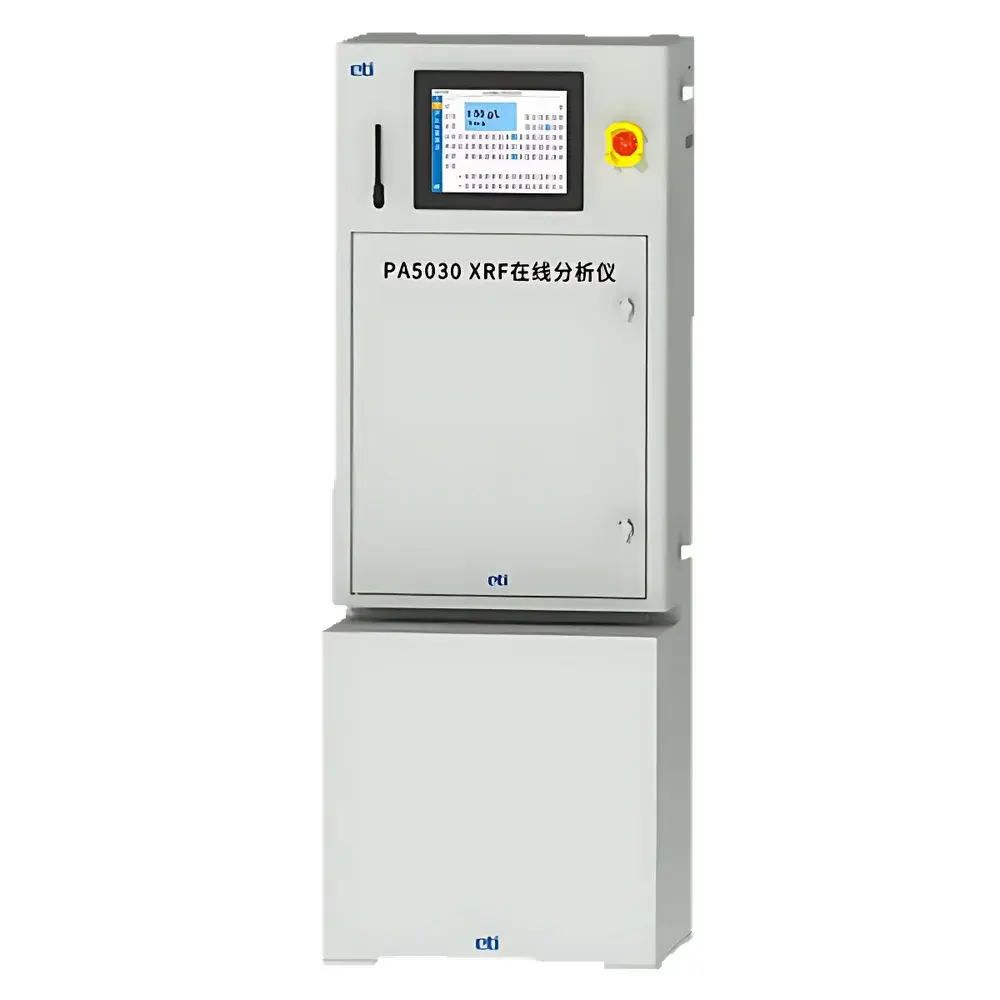
ETI PA5030 Online XRF Analyzer
| Brand | ETI |
|---|---|
| Origin | Guangdong, China |
| Manufacturer Type | Authorized Distributor |
| Country of Origin | China |
| Model | PA5030 |
| Price | Upon Request |
| Measurement Principle | Energy-Dispersive X-Ray Fluorescence (ED-XRF) |
| Sample Throughput | Up to 12 sample positions (configurable) |
| Elemental Range | Z = 14 (Si) to 92 (U) |
| Analysis Time per Sample | ≤ 300 s |
| Detection Geometry | Fixed vertical beam path with automated sample positioning |
| Power Supply | 198–242 V AC, 50 Hz ± 0.5 Hz, 100 W |
| Operating Temperature | 15–30 °C |
| Relative Humidity | 45–85 % RH (non-condensing) |
| Enclosure Dimensions | Approx. 800 mm (W) × 820 mm (D) × 1710 mm (H) |
| User Interface | 15″ capacitive touch display running Windows 10 IoT Enterprise |
| Communication Protocols | RS-485 (Modbus RTU), TCP/IP (Ethernet), OPC UA optional |
| Compliance | CE, RoHS, IEC 61000-6-3/6-4, ISO 21043 (XRF performance verification guidelines), ASTM E1621–22 (Standard Guide for XRF Analysis of Ceramic Whiteware) |
Overview
The ETI PA5030 Online XRF Analyzer is an industrial-grade, energy-dispersive X-ray fluorescence (ED-XRF) system engineered for continuous, non-destructive elemental analysis in real-time process control environments. Unlike benchtop or handheld XRF instruments, the PA5030 integrates directly into production lines—enabling automated, unattended monitoring of incoming raw materials, intermediate process streams, and final product composition. Its core measurement principle relies on excitation of atomic inner-shell electrons by a high-stability X-ray tube (Pd anode, 50 kV max), followed by detection of characteristic secondary X-rays emitted during electron relaxation. The resulting spectrum is resolved by a silicon drift detector (SDD) with <135 eV Mn Kα resolution at 0°C, allowing precise identification and quantification of elements from silicon (Z=14) through uranium (Z=92). Designed for long-term stability under factory conditions, the system employs active temperature stabilization of the detector and optical path, minimizing spectral drift and ensuring repeatability better than ±0.5% RSD for major constituents over 72-hour continuous operation.
Key Features
- Real-time elemental monitoring with cycle times ≤ 300 seconds per sample—optimized for high-throughput manufacturing environments.
- Multi-position sample carousel supporting up to 12 standardized sample cups or custom fixtures; compatible with liquid cells, solid discs, and coated substrates.
- Embedded matrix correction engine implementing fundamental parameter (FP) modeling combined with empirical calibration libraries to mitigate inter-element absorption/enhancement effects.
- Automated quality control routines including daily drift correction using internal reference standards, blank subtraction, and peak shape validation against NIST-traceable spectra.
- Ruggedized industrial enclosure rated IP54, with vibration-dampened optical mount and sealed X-ray chamber meeting IEC 61010-1 safety requirements for Class I equipment.
- Integrated Windows 10 IoT Enterprise platform with local data storage (256 GB SSD), remote diagnostics via TLS-secured VNC, and audit trail logging compliant with FDA 21 CFR Part 11 Annex 11 requirements.
Sample Compatibility & Compliance
The PA5030 accommodates heterogeneous sample forms typical in electroplating baths, semiconductor slurry feeds, catalyst pellets, and refinery stream fractions. It supports both pressed powder pellets (≥13 mm diameter) and liquid samples in quartz or PTFE cuvettes (path length 1–10 mm). For surface-coating applications—such as Au/Ni/Cu layers on PCBs or connector pins—the system provides depth-resolved analysis via variable voltage excitation (15–50 kV) and multi-angle geometry optimization. All analytical methods are developed and validated in accordance with ISO/IEC 17025:2017 general requirements for competence of testing and calibration laboratories. Method transfer documentation includes uncertainty budgets per ISO/IEC Guide 98-3 (GUM), linearity verification across 0.1–100 wt% ranges, and detection limit reporting per ISO 11885. The analyzer is certified for use in Zone 2 hazardous areas when equipped with optional ATEX-compliant purge module (not included standard).
Software & Data Management
ETI’s proprietary AnalytiX™ software suite provides full lifecycle method management—from initial calibration curve development using CRM standards (e.g., NIST SRM 2782, BAM BCR-681) to routine batch reporting with customizable pass/fail logic. All spectral acquisitions are time-stamped, digitally signed, and stored with full metadata (operator ID, instrument configuration, ambient sensor logs). Data export supports CSV, XML, and ASTM E1382-compliant .xrf formats. Native OPC UA server enables seamless integration into DCS/SCADA systems (e.g., Siemens PCS7, Emerson DeltaV) and enterprise MES platforms (SAP PI, Rockwell FactoryTalk). Audit trails record all user actions—including method edits, calibration updates, and result overrides—with immutable timestamps and role-based access control (RBAC) aligned with GMP Annex 11 and GLP principles.
Applications
The PA5030 delivers validated elemental composition data across regulated and high-precision sectors: In semiconductor wafer fabrication, it monitors plating bath concentrations (Cu, Ni, Co, Pd) and detects trace contaminants (Fe, Cr, Zn) in rinse water effluents. Within printed circuit board manufacturing, it verifies gold thickness (0.05–2.0 µm) and alloy ratios (Au/Ni/Pd) on edge connectors without destructive cross-sectioning. In metal finishing plants, it controls chromate conversion coating stoichiometry (Cr:Fe:Al ratios) and quantifies hexavalent chromium residuals per ISO 3613. Refineries deploy it for sulfur speciation in diesel streams (ASTM D7039), while chemical producers use it to track catalyst deactivation via Pt/Pd/Rh leaching kinetics. Each application includes pre-validated SOPs with documented LOD/LOQ, recovery studies (>95% for spiked matrices), and long-term stability assessments per ISO 80000-1.
FAQ
Does the PA5030 require radioactive sources?
No. It uses a fully shielded, air-cooled X-ray tube with programmable kV/mA settings—eliminating licensing, transport restrictions, and disposal concerns associated with isotopic sources.
Can it analyze light elements such as sodium or magnesium?
Yes, down to silicon (Z=14); detection of Na (Z=11) and Mg (Z=12) is possible with helium purge or vacuum path options (available as field-upgrade kits).
How is calibration maintained during extended unattended operation?
The system performs automatic daily recalibration using onboard ceramic reference tiles and triggers alarm events if spectral resolution or peak intensity deviates beyond user-defined thresholds.
Is third-party software integration supported?
Yes—via native Modbus TCP, OPC UA, and RESTful API endpoints. Pre-built connectors exist for LabVantage LIMS, Thermo Fisher SampleManager, and Honeywell Experion PKS.
What maintenance intervals are recommended?
Detector window inspection every 6 months; X-ray tube replacement at 15,000 hours; annual full performance verification per ISO/IEC 17025 clause 6.5.2.
Related Products