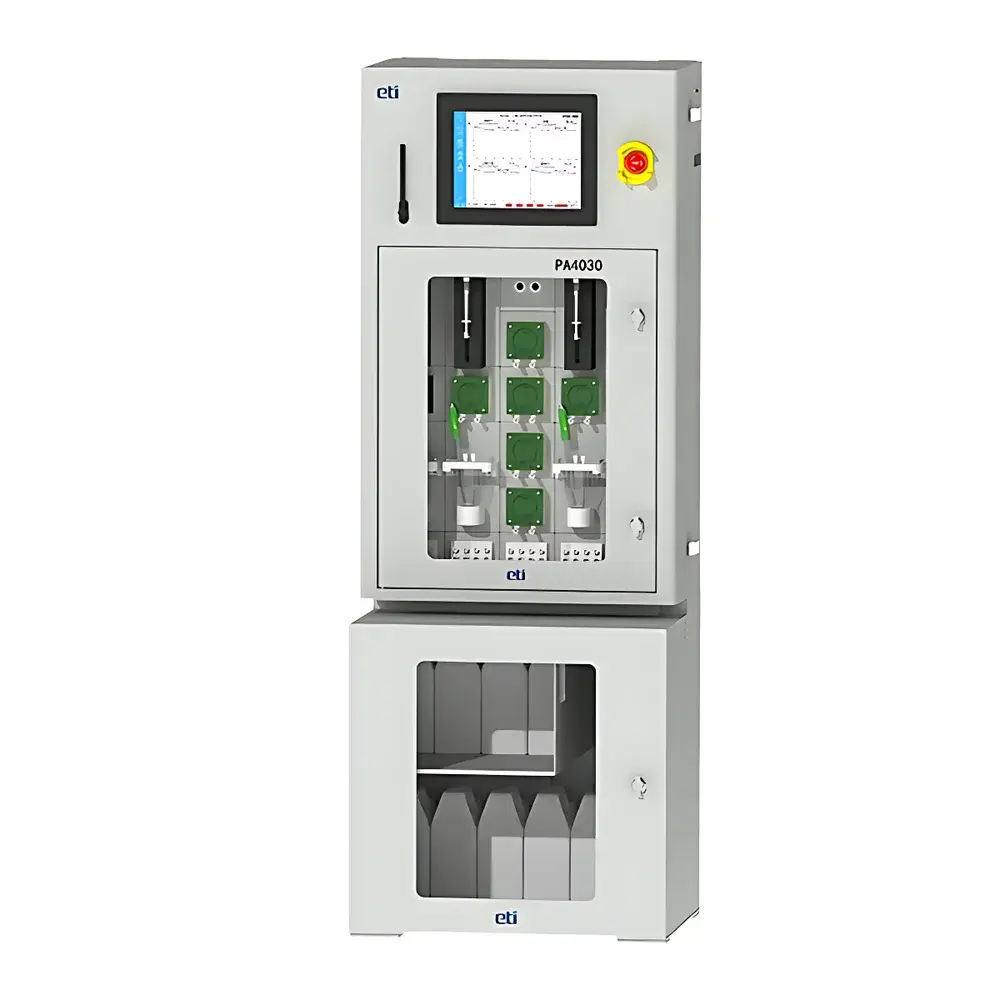
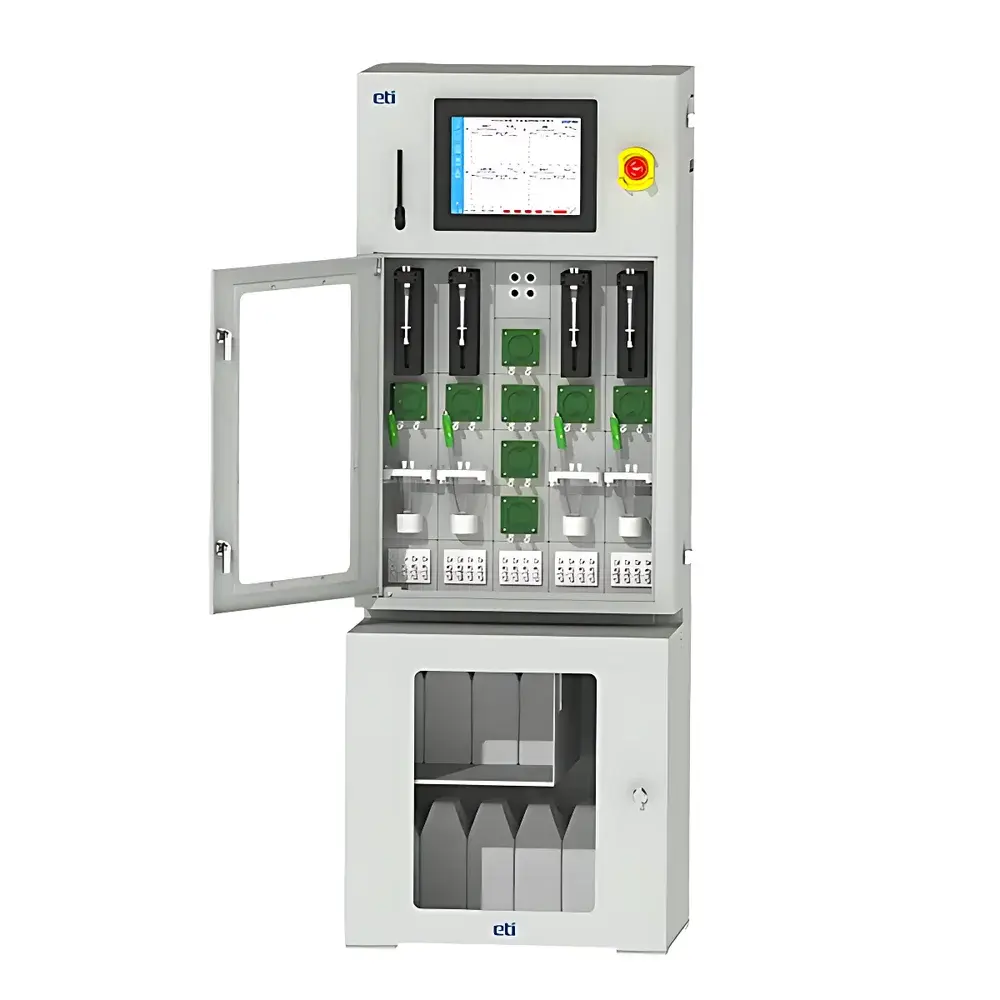
ETI PA4030 Industrial Online Process Analyzer
| Brand | ETI |
|---|---|
| Origin | Guangdong, China |
| Manufacturer Type | Authorized Distributor |
| Country of Origin | China |
| Model | PA4030 |
| Price | Upon Request |
| Analyte Range | Nitric Acid, Hydrochloric Acid, Sulfuric Acid, Sodium Hydroxide, Carbonates, Nitrates, Phosphates, Free Ammonia, Chlorides, Fluorides, Hypochlorites, Persulfates, Hydrogen Peroxide, and more |
| Dimensions | 620 mm (W) × 550 mm (D) × 1850 mm (H) |
| Power Supply | 198–242 V, 50 Hz ± 0.5 Hz, 350 W |
| Operating Environment | 15–30 °C, RH 65 % ± 20 % (max. daily temp. swing ≤5 °C) |
| Display | 12-inch full-color touchscreen (serial interface) |
| Communication | RS485 or TCP/IP |
| Detection Methods | Potentiometric Titration, Photometric Titration, Direct Electrode Measurement (pH, Conductivity, Refractometry), Ion-Selective Electrode (ISE) with Standard Addition, UV-Vis Absorbance-based Quantification |
| Workflow Modes | Manual, Scheduled, Continuous, Triggered |
| Data Management | Audit-trail-enabled logging, QC flagging, concentration limit alerts, reagent level monitoring, sample absence detection, leak detection |
| Cabinet Type | Freestanding floor-mounted enclosure |
Overview
The ETI PA4030 Industrial Online Process Analyzer is an integrated, modular analytical platform engineered for continuous, real-time chemical composition monitoring in demanding industrial process streams. Unlike conventional grab-sample laboratory analyzers, the PA4030 performs automated, in-line quantitative analysis using multiple orthogonal detection principles—including potentiometric titration, photometric endpoint detection, ion-selective electrode (ISE) measurement, and direct sensor interfacing (pH, conductivity, refractometry). Its architecture adheres to the functional requirements of ASTM D1129 (Standard Terminology Relating to Water), ISO 5725 (Accuracy and Precision of Measurement Methods), and supports alignment with GLP and GMP data integrity expectations through configurable audit trails and electronic record retention. Designed for 24/7 operation in controlled plant environments, the system delivers reproducible results across complex matrices encountered in semiconductor wet benches, metal finishing lines, fine chemical synthesis reactors, and refinery effluent treatment units—without requiring manual intervention or off-site lab correlation.
Key Features
- Multi-method analytical engine supporting acid-base, redox, complexometric, and precipitation titrations with programmable endpoint detection (fixed potential, derivative, or photometric color transition)
- Modular detection architecture enabling concurrent operation of up to four independent analytical modules (e.g., titration + ISE + photometry + direct sensor input)
- Configurable workflow engine with editable sequences for analysis, calibration, system cleaning, and quality control checks—each step timestamped and logged
- 12-inch industrial-grade touchscreen HMI with intuitive drag-and-drop method builder, real-time trend visualization, and alarm status dashboard
- Comprehensive system diagnostics including reagent volume tracking, sample flow verification, liquid leak detection, and sensor health monitoring
- Embedded data security features: user role-based access control (RBAC), encrypted local storage, and optional TLS-enabled TCP/IP communication for secure integration into enterprise MES/SCADA systems
Sample Compatibility & Compliance
The PA4030 accommodates aqueous process streams with suspended solids content ≤50 mg/L and viscosity <10 cP, operating within pH 0.5–14 and temperature range 15–30 °C. It complies with IEC 61000-6-2 (Electromagnetic Immunity) and IEC 61000-6-4 (Emission Standards) for industrial environments. Method validation documentation supports compliance with USP (Analytical Instrument Qualification), FDA 21 CFR Part 11 (electronic records/signatures), and ISO/IEC 17025 (competence of testing laboratories) when deployed under documented IQ/OQ/PQ protocols. Regulatory traceability is maintained via configurable audit logs capturing operator actions, parameter changes, calibration events, and result modifications—with immutable timestamps and user identification.
Software & Data Management
Firmware v3.2+ provides a web-accessible configuration portal and local SQLite database with structured query support. All measurements are stored with metadata: sample ID, method version, instrument state flags, raw sensor outputs, and final calculated concentrations. Data export supports CSV, PDF report generation, and OPC UA server integration for seamless transfer to PI System, Ignition, or custom LIMS platforms. Built-in QC routines include bracketing standards, duplicate analysis, and spike recovery checks—all automatically flagged against user-defined acceptance criteria (e.g., ±5 % recovery, RSD <3 %). Alarm conditions (e.g., out-of-range concentration, low reagent level, flow interruption) trigger visual alerts, audible tones, and configurable digital output signals (dry contact or Modbus register write).
Applications
The PA4030 serves as a validated analytical node across regulated and high-precision manufacturing sectors. In semiconductor fabrication, it monitors sulfuric-peroxide mixtures (SPM), copper plating bath additives, and trace metal contaminants (Cu²⁺, Ni²⁺, Fe²⁺) in rinse waters. For electroplating and anodizing lines, it controls acid concentration, free cyanide, and heavy metal ion ratios in real time. In specialty chemical synthesis, it tracks reaction stoichiometry via titrimetric endpoint shifts during neutralization or oxidation steps. Refineries deploy it for alkalinity profiling in desalter water, sulfide scavenger dosing control, and hydrogen fluoride concentration surveillance in alkylation units. Environmental applications include continuous monitoring of total oxidant demand (TOD), residual chlorine speciation, and phosphate load in tertiary wastewater streams.
FAQ
What titration modes does the PA4030 support?
It supports fixed-endpoint, dynamic-volume (drift-controlled), and equivalence-point detection via potentiometric, photometric, or amperometric signal processing.
Can the system validate its own calibration?
Yes—built-in calibration verification routines compare standard reference material (SRM) responses against stored calibration curves and log deviations exceeding user thresholds.
Is remote firmware update supported?
Firmware updates may be performed locally via USB or remotely over TCP/IP with authenticated HTTPS session and SHA-256 signature verification.
How is data integrity ensured during power interruption?
Non-volatile memory preserves method configurations, calibration coefficients, and last 72 hours of measurement logs; critical alarms activate on UPS-backed circuits.
Does the PA4030 meet explosion-proof requirements for hazardous areas?
The base unit is rated for Zone 2/Class I Division 2 environments; intrinsic safety barriers and ATEX-certified external sampling manifolds are available as optional accessories.
Related Products