
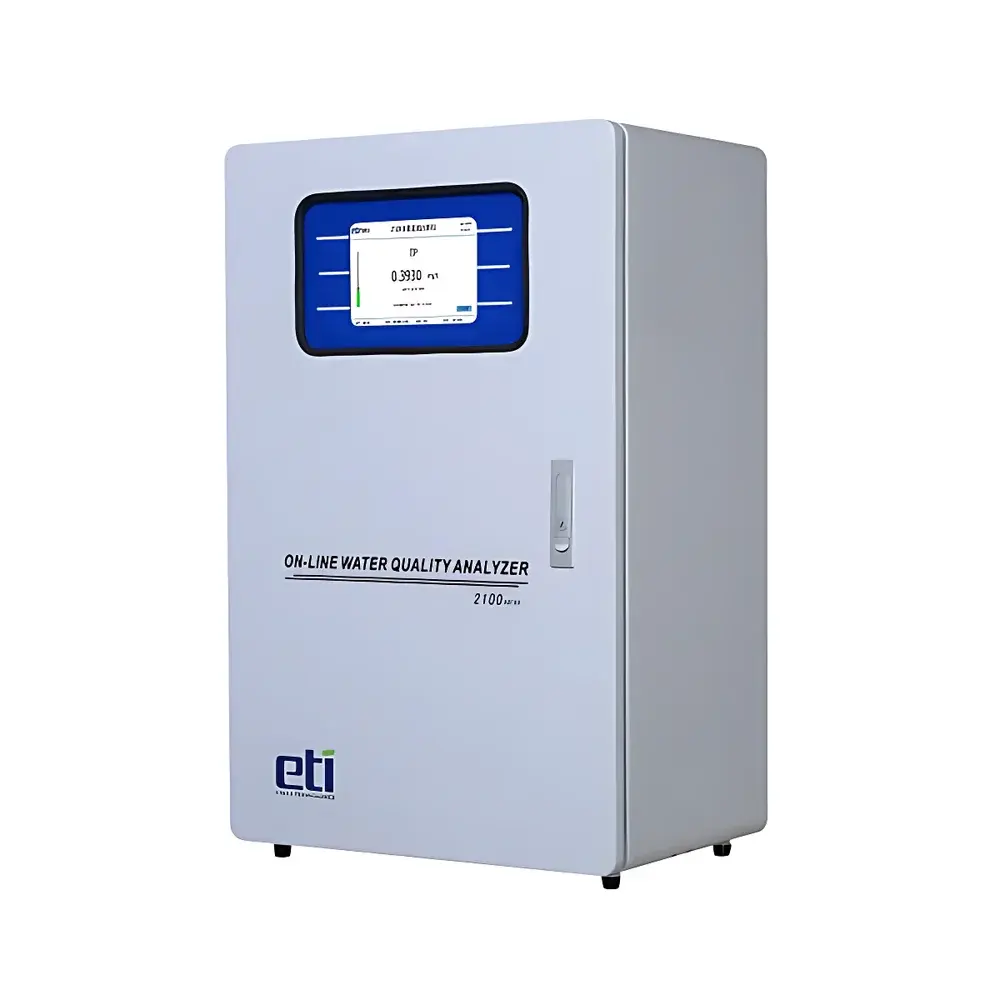
ETI 2100Plus Hexavalent Chromium Online Water Analyzer
| Brand | ETI |
|---|---|
| Origin | Guangdong, China |
| Manufacturer Type | Authorized Distributor |
| Country of Manufacture | China |
| Model | 2100Plus Hexavalent Chromium |
| Instrument Type | Online Analyzer |
| Detection Principle | Photometric Method (Diphenylcarbazide Colorimetry) |
| Target Analyte | Chromium(VI) |
| Analysis Time | 10 min per cycle |
| Accuracy | ±5% of reading |
| Resolution | 0.001 mg/L |
| Detection Range | 0–2 mg/L and 0–5 mg/L (selectable) |
| Measurement Modes | Cyclic, Trigger-Controlled, Point-in-Time, Continuous, Manual |
| Verification Modes | Remote Verification, Manual Verification, Automated Verification (time-based or alarm-triggered) |
| Output Signals | 4–20 mA analog output |
| Power Supply | 220 ± 22 VAC, 50 ± 0.5 Hz |
| Enclosure Dimensions | 520 mm (W) × 380 mm (D) × 800 mm (H) |
| Net Weight | ~45 kg (excluding reagents) |
Overview
The ETI 2100Plus Hexavalent Chromium Online Water Analyzer is a fully automated, laboratory-grade photometric analyzer engineered for continuous, unattended monitoring of Cr(VI) concentration in diverse aqueous matrices. It operates on the internationally standardized diphenylcarbazide colorimetric method (ASTM D5281, ISO 11339), where Cr(VI) in acidified sample water reacts quantitatively with 1,5-diphenylcarbazide to form a stable violet-colored complex. Absorbance is measured at 540 nm using a high-stability LED light source and precision optical path, ensuring trace-level sensitivity and long-term baseline stability. Designed for deployment in regulatory-compliant environments—including drinking water treatment plants, surface water monitoring stations, industrial effluent discharge points, and municipal wastewater facilities—the 2100Plus delivers real-time data with metrological rigor suitable for environmental reporting and process control.
Key Features
- Patented intelligent dilution system with automatic range switching—enables seamless transition between low- and high-concentration measurement modes without manual intervention.
- High-precision syringe pump architecture with sub-microliter volumetric repeatability—guarantees accurate metering of sample, reagent, and standard solutions across all operational cycles.
- Integrated power-fail protection with non-volatile memory and auto-resume functionality—preserves calibration history, method parameters, and pending analysis queues during unexpected outages.
- Modular fluidic design with tool-free access to reaction cell, peristaltic tubing, and reagent reservoirs—reduces mean time to repair (MTTR) and supports field maintenance by certified technicians.
- Configurable operational logic—supports five distinct measurement modes (cyclic, trigger-controlled, point-in-time, continuous, manual) and three verification strategies (remote, manual, automated), aligning with site-specific sampling protocols and regulatory audit requirements.
- Low reagent consumption architecture—typical reagent usage ≤ 2.5 mL per analysis cycle—minimizes consumables cost and hazardous waste generation over extended deployments.
Sample Compatibility & Compliance
The 2100Plus is validated for direct analysis of raw and treated water samples including natural surface water, groundwater, potable water, industrial process water, and municipal wastewater influent/effluent. Sample turbidity up to 100 NTU and suspended solids ≤ 50 mg/L are accommodated via integrated filtration and auto-zero compensation routines. All analytical procedures conform to EPA Method 7196A and ISO 11339 for hexavalent chromium determination. The instrument’s firmware and data handling architecture support GLP/GMP-aligned operation, including full electronic audit trail, user-access logging, and secure method version control—facilitating compliance with ISO/IEC 17025, EU WFD (2000/60/EC), and China’s HJ 636-2012 standard for online heavy metal monitoring.
Software & Data Management
The embedded Linux-based controller runs ETI’s proprietary Analytical Runtime Environment (ARE v4.2), providing local touchscreen operation, remote web-based configuration (HTTPS/TLS), and OPC UA-compatible data export. All measurement events—including sample acquisition, calibration, spike recovery checks, and verification results—are timestamped and stored with full metadata (operator ID, method revision, ambient temperature, optical path integrity status). Data export formats include CSV, XML, and Modbus TCP payloads for integration into SCADA, LIMS, or centralized environmental data platforms. Optional FDA 21 CFR Part 11 compliance package enables electronic signatures, role-based access control, and immutable record retention for regulated users.
Applications
- Real-time compliance monitoring at industrial discharge points subject to local and national Cr(VI) limits (e.g., electroplating, leather tanning, pigment manufacturing).
- Early-warning detection in drinking water distribution networks following source contamination incidents.
- Performance verification of Cr(VI)-specific removal technologies (e.g., ion exchange, reduction-precipitation units).
- Long-term trend analysis in watershed-scale environmental surveillance programs.
- Automated quality assurance for laboratories performing batch validation of offline ICP-MS or AAS measurements.
FAQ
What regulatory standards does the 2100Plus meet for Cr(VI) measurement?
It complies with ASTM D5281, ISO 11339, EPA Method 7196A, and China’s HJ 636-2012. Optional firmware modules support EU WFD and US Clean Water Act reporting requirements.
Can the analyzer operate without continuous network connectivity?
Yes—local storage retains ≥30 days of high-resolution data and full audit logs. All configurations and methods are preserved in non-volatile memory.
Is on-site calibration required after installation?
Initial calibration is performed using NIST-traceable Cr(VI) standards prior to commissioning. Subsequent calibrations are fully automated and scheduled per user-defined intervals or event triggers.
How is reagent stability managed during extended unattended operation?
Reagents are housed in temperature-stabilized compartments (±2°C), and the system monitors reagent shelf-life via barcode scanning and usage-based expiry calculation.
Does the 2100Plus support third-party SCADA integration?
Yes—via native Modbus TCP, OPC UA, or configurable 4–20 mA outputs with HART-enabled signal mapping for legacy DCS environments.







