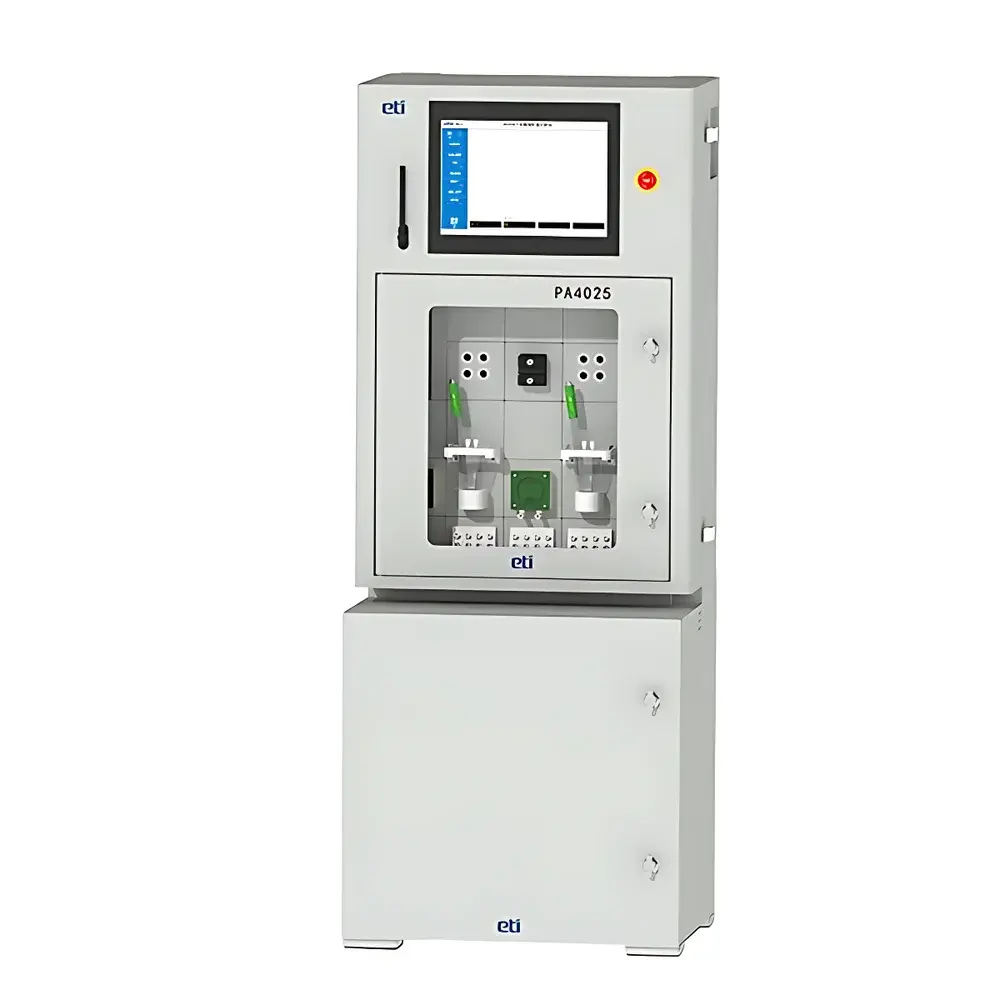
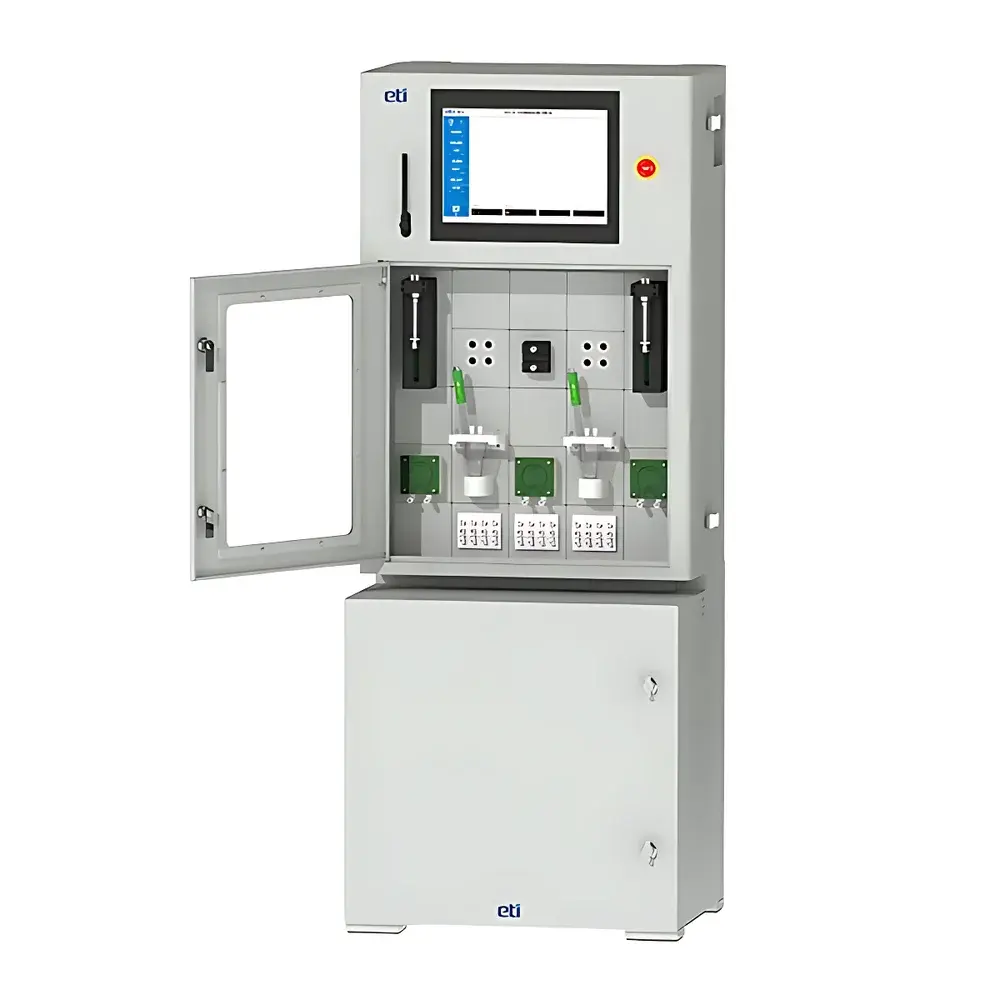
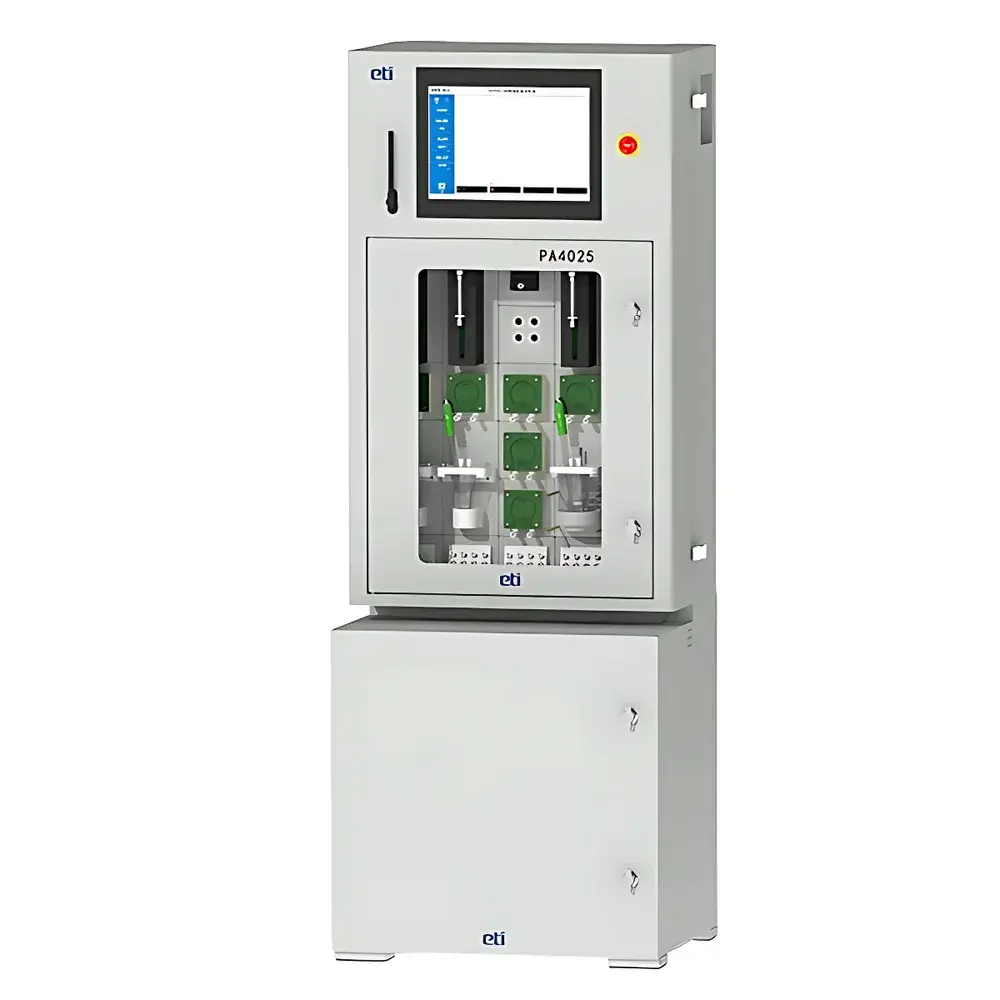
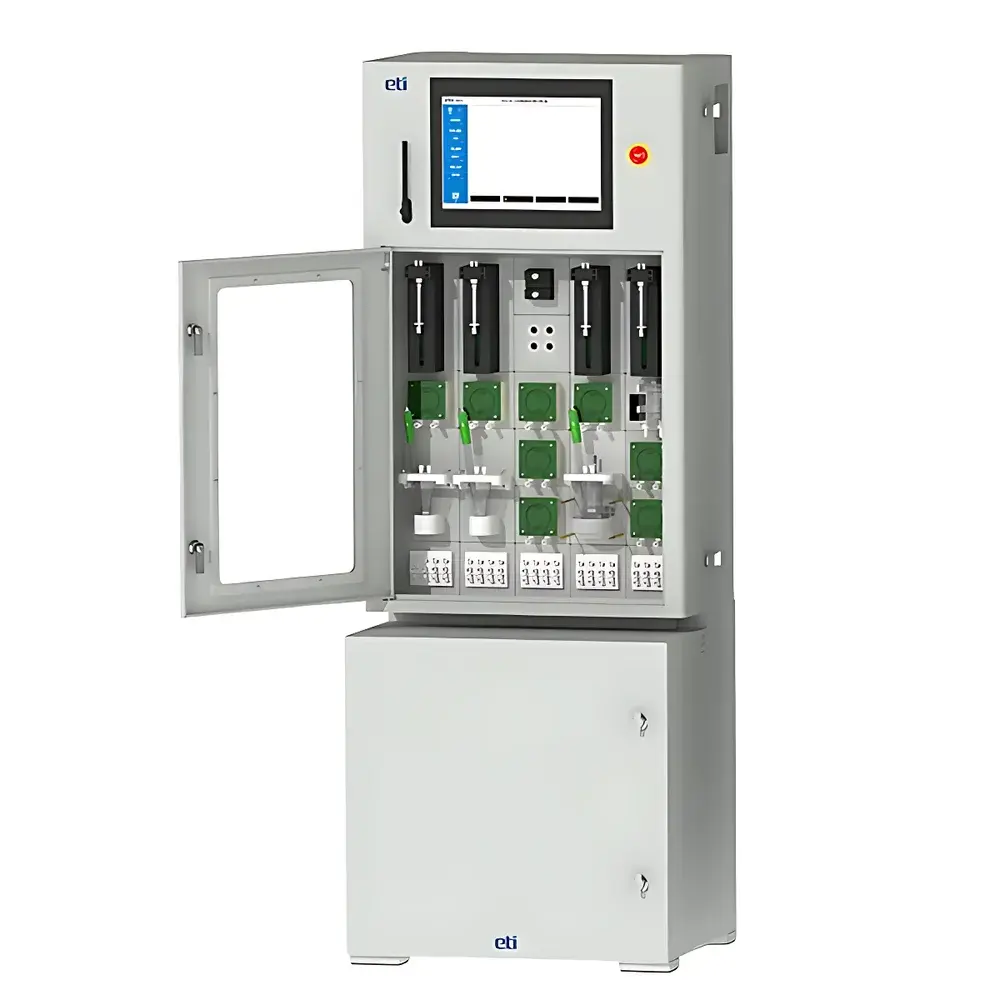
ETI PA4025 Industrial Online Process Analyzer
| Brand | ETI |
|---|---|
| Model | PA4025 |
| Origin | Guangdong, China |
| Type | Online Reaction Analysis System |
| Measurement Principles | Potentiometric Titration, Photometric Detection, Ion-Selective Electrode (ISE), Direct Sensor Measurement (pH, Conductivity, Refractometry) |
| Sample Compatibility | Aqueous acidic/alkaline process streams containing HNO₃, HCl, H₂SO₄, NaOH, Na₂CO₃, NH₃ (free), Cl⁻, F⁻, ClO⁻, S₂O₈²⁻, H₂O₂, PO₄³⁻, NO₃⁻, Cu²⁺, Fe²⁺/³⁺, Ni²⁺, Cr³⁺/⁶⁺, Zn²⁺, Ag⁺, Cd²⁺, Mn²⁺, Co²⁺, Li⁺, SO₄²⁻, CN⁻, EDTA, etc. |
| Cabinet Dimensions | ~620 mm (W) × 550 mm (D) × 1735 mm (H) |
| Power Supply | 198–242 V AC, 50 Hz ±0.5 Hz |
| Operating Environment | 15–35 °C, RH ≤95% (non-condensing) |
| Interface | 15″ color touchscreen (Windows OS) |
| Communication | RS232, RS485, 4–20 mA analog outputs, Ethernet |
| Programmability | Up to 15 customizable analysis workflows |
| Compliance Support | ASTM D129, ISO 9297, USP <731>, EPA Method 300.0, GLP/GMP-ready audit trail logging (via optional software module) |
Overview
The ETI PA4025 Industrial Online Process Analyzer is a modular, multi-technology analytical platform engineered for continuous, real-time monitoring of critical chemical species in demanding industrial process streams. It integrates four complementary analytical methodologies—potentiometric titration, photometric detection, ion-selective electrode (ISE) measurement, and direct sensor-based quantification (pH, conductivity, refractometry)—within a single robust cabinet architecture. Unlike fixed-function analyzers, the PA4025 is designed around method flexibility: users select and configure analytical protocols based on matrix composition, concentration range, and regulatory requirements—not hardware replacement. Its core application domain spans semiconductor wet benches, metal surface treatment lines, bulk chemical synthesis reactors, petroleum refining effluent streams, mining leachate circuits, environmental compliance monitoring points, food-grade cleaning-in-place (CIP) validation, and pulp & paper bleach plant control loops. The system operates under ISO/IEC 17025-aligned principles, with traceable calibration routines, documented method validation templates, and configurable data integrity controls supporting FDA 21 CFR Part 11 readiness when deployed with certified software modules.
Key Features
- Multi-principle analytical engine: Simultaneous or sequential deployment of titration (acid-base, complexometric, redox, precipitation), photometry (absorbance-based quantification using pre-defined calibration curves), ISE (for low-concentration ions such as F⁻, CN⁻, Ag⁺, Cd²⁺), and direct sensor inputs (pH, conductivity, refractive index).
- Configurable workflow architecture: Up to 15 independent analysis programs, each defining sample handling sequence, reagent dosing logic, endpoint detection criteria (e.g., pH inflection, absorbance slope, potential drift), calibration frequency, and QC check intervals.
- Comprehensive system diagnostics: Real-time monitoring of reagent levels, sample flow integrity, tubing occlusion, liquid leakage (via capacitive sensors), electrode response stability, and photometric cell cleanliness—each triggering configurable alerts or automated recovery sequences.
- Industrial-grade enclosure: NEMA 4X-rated cabinet (optional hazardous area certification available), supporting wall-mount, floor-stand, benchtop, or custom analyzer shelter integration; ambient operating range 15–35 °C, RH ≤95% non-condensing.
- Open communication framework: Native support for RS232, RS485, 4–20 mA analog outputs, and TCP/IP Ethernet; protocol-agnostic Modbus RTU/TCP and OPC UA interfaces enable seamless integration into DCS, SCADA, MES, and LIMS environments.
Sample Compatibility & Compliance
The PA4025 is validated for aqueous process liquors across pH 0–14 and conductivity up to 200 mS/cm. It accommodates suspended solids ≤50 mg/L and particulates <50 µm without filtration—achievable via integrated peristaltic pumping and pulse-dampened flow cells. Analyte coverage includes strong acids (H₂SO₄, HNO₃, HCl), alkalis (NaOH, Na₂CO₃), oxidants (H₂O₂, NaOCl, (NH₄)₂S₂O₈), complexing agents (EDTA), heavy metals (Cu²⁺, Ni²⁺, Cr³⁺/⁶⁺, Zn²⁺, Cd²⁺, Ag⁺), halides (Cl⁻, F⁻, Br⁻), oxyanions (NO₃⁻, PO₄³⁻, SO₄²⁻), and organic additives (formaldehyde, brown oxide agents). Method configurations align with ASTM D129 (sulfur in petroleum), ISO 9297 (titrimetric determination of acidity), USP (peroxide value), and EPA Method 300.0 (anions by ion chromatography—complementary ISE validation). Audit trail, electronic signature, and data retention settings comply with GLP and GMP documentation requirements when paired with ETI’s validated Data Management Suite.
Software & Data Management
The embedded Windows-based HMI provides full local control via a 15″ capacitive touchscreen, supporting manual operation, scheduled auto-runs, and remote supervision via VNC or RDP. All analysis events—including raw sensor signals, titrant volume dispensed, photometric absorbance traces, ISE potential readings, calibration logs, QC results, and alarm timestamps—are time-stamped and stored in SQLite format with SHA-256 hashing for integrity verification. Historical data export supports CSV, PDF, and XML formats; filterable by date range, parameter, program ID, or pass/fail status. Optional cloud synchronization enables centralized fleet monitoring and predictive maintenance analytics. Software updates are delivered via signed firmware packages with cryptographic signature verification.
Applications
In semiconductor manufacturing, the PA4025 monitors sulfuric-peroxide mixtures (SPM), copper plating bath additives, and trace metal contamination in rinse waters. For electroplating facilities, it tracks free acid concentration, metal ion ratios (Ni²⁺/Co²⁺ in alloy baths), and oxidant residuals in passivation lines. In chemical production, it validates stoichiometric balance in neutralization reactors and detects catalyst poisons (e.g., chloride in nitric acid synthesis). Refineries deploy it for caustic wash efficiency assessment and sour water stripper overhead monitoring. Mining operations use it for real-time cyanide destruction endpoint detection and heap leach solution optimization. Environmental labs apply it to wastewater discharge compliance (e.g., total residual chlorine, fluoride, ammonia nitrogen) and drinking water disinfection byproduct control.
FAQ
What titration modes does the PA4025 support?
It supports fixed-endpoint, dynamic-volume (slope/derivative-based), and time-controlled titrations, including acid-base, redox (e.g., permanganate, iodometric), complexometric (EDTA), and precipitation (argentometric) methods.
Can the system analyze samples with high turbidity or particulates?
Yes—integrated flow conditioning, pulsation dampening, and optical path design allow reliable photometric and potentiometric measurements in streams with ≤50 mg/L suspended solids and particles <50 µm; optional inline filtration is available for higher loadings.
Is method validation documentation provided?
ETI supplies IQ/OQ protocol templates, performance qualification checklists, and calibration certificate traceability to NIST standards; full validation support is available under consultancy agreement.
How is data security and integrity ensured?
Role-based access control, encrypted local storage, immutable audit trails with operator ID and timestamp, and optional 21 CFR Part 11-compliant electronic signatures via third-party validation packages.
What maintenance intervals are recommended?
Daily visual inspection; monthly electrode cleaning and calibration verification; quarterly pump tube replacement and photometric cell decontamination; annual full system verification using certified reference materials.
Related Products