
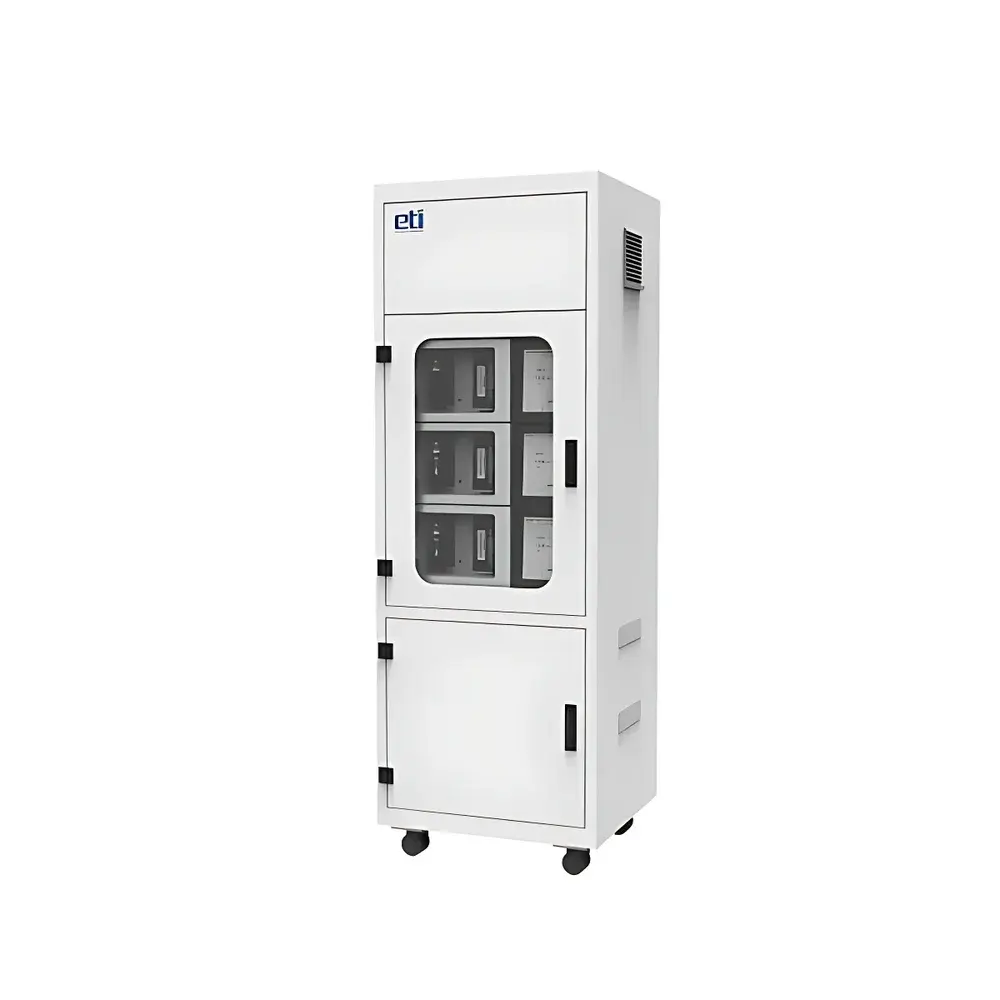
ETI 2020 Permanganate Index Online Water Quality Analyzer
| Brand | ETI |
|---|---|
| Origin | Guangdong, China |
| Manufacturer Type | Authorized Distributor |
| Country of Manufacture | China |
| Model | 2020 Permanganate Index Analyzer |
| Pricing | Available Upon Request |
| Detection Principle | Potassium Permanganate Oxidation–Redox Potential Titration or Spectrophotometric Method |
| Measurement Range | 0–20 mg/L O₂ (extendable) |
| Measurement Modes | Cyclic, Controlled, Point, Continuous, Manual |
| Verification Modes | Remote, Manual, Automatic (time-triggered & limit-exceeded) |
| Output Signals | 4–20 mA, RS232/RS485 |
| Power Supply | 220 ± 22 VAC, 50 ± 0.5 Hz |
| Module Dimensions | 490 × 400 × 210 mm (W×D×H) |
| Cabinet Dimensions | 600 × 550 × 1750 mm (W×D×H) |
Overview
The ETI 2020 Permanganate Index Online Water Quality Analyzer is an industrial-grade, fully automated instrument engineered for continuous, unattended monitoring of the permanganate index (CODMn) in natural and potable water systems. CODMn serves as a critical surrogate parameter for low-to-moderate organic pollution load—particularly relevant for surface water, source water protection zones, and municipal drinking water intake monitoring. The analyzer implements one of two standardized chemical oxidation methodologies: (1) redox potential titration following potassium permanganate digestion, or (2) spectrophotometric quantification based on residual oxidant depletion. Both methods conform to ISO 8467:1993 and GB/T 5750.7–2006, ensuring regulatory alignment with national and international water quality assessment frameworks. The system operates under controlled thermal digestion (typically at 100 °C for 30 min), followed by precise reagent dosing and endpoint detection via high-stability reference electrodes or dual-wavelength photometry (525 nm and 600 nm), minimizing interferences from turbidity or colored matrices.
Key Features
- Patented intelligent dilution algorithm enabling dynamic range adaptation—automatically selects optimal sample dilution ratio to maintain measurement integrity across 0–20 mg/L O₂, with optional extended ranges up to 50 mg/L O₂ upon configuration.
- Ultra-precision peristaltic and syringe injection pumps (±0.5% volumetric accuracy) calibrated traceably to NIST-traceable standards, ensuring reproducible reagent and sample delivery.
- Multi-port rotary valve manifold with chemically inert PTFE/PEEK fluid path—reducing carryover, minimizing reagent consumption (<1.2 mL/cycle), and eliminating cross-contamination between samples.
- Integrated power-loss recovery: retains calibration coefficients, method sequences, and real-time log buffers during unexpected outages; resumes operation within ≤90 s after power restoration without manual intervention.
- Modular architecture supporting co-location of up to four independent analytical modules (e.g., NH₃-N, NO₃⁻, TP, CODMn) within a single 1750 mm cabinet—optimized for space-constrained telemetry stations and centralized water quality control rooms.
Sample Compatibility & Compliance
The ETI 2020 analyzer is validated for use with raw surface water (turbidity ≤100 NTU), finished drinking water (pH 6.5–8.5), and groundwater with low suspended solids (<50 mg/L). It meets EN 14181:2014 requirements for automated water analyzers regarding QA/QC frequency and data integrity. All calibration and verification events—including standard solution checks (e.g., 2.0 mg/L KHP), spike recovery tests (≥85–115% recovery), and blank verification—are logged with timestamp, operator ID (if authenticated), and audit trail metadata. Data records comply with GLP principles and support 21 CFR Part 11–compatible electronic signatures when integrated with validated LIMS platforms.
Software & Data Management
Embedded firmware (v3.2+) provides web-based configuration via HTTPS-secured interface (TLS 1.2), supporting remote firmware updates and method version control. Measurement data—including raw sensor outputs, titration curves, absorbance spectra, and QC flags—are stored locally (8 GB internal flash) for ≥90 days and transmitted via Modbus TCP or MQTT to SCADA or cloud-based dashboards. All export files adhere to CSV/JSON schema aligned with WQDML (Water Quality Data Markup Language) v2.0. Audit logs record every user action (login, method edit, calibration execution) with immutable timestamps and IP origin—enabling full traceability during regulatory inspections.
Applications
- Real-time surveillance of river and reservoir inflow points to detect upstream organic loading events (e.g., agricultural runoff, wastewater bypass).
- Compliance monitoring at drinking water treatment plant intakes per China’s “Sanitary Standard for Drinking Water” (GB 5749–2022), where CODMn ≤3 mg/L is mandated.
- Early warning integration with hydrological models—correlating CODMn spikes with rainfall intensity and flow rate to improve predictive capability.
- Long-term trend analysis for watershed management programs, supporting annual reporting to provincial ecological environment departments.
- Validation of advanced oxidation process (AOP) efficiency in pilot-scale water reuse facilities.
FAQ
What regulatory standards does the ETI 2020 comply with for CODMn determination?
It adheres to ISO 8467:1993, GB/T 5750.7–2006, and supports method validation per EPA Method 410.4 for permanganate oxidizability.
Can the analyzer operate unattended for extended periods?
Yes—designed for 30-day autonomous operation with onboard reagent reserves, self-diagnostic routines, and alarm-triggered SMS/email notifications via optional GSM module.
Is remote calibration verification supported?
Yes—remote standard addition, blank verification, and recovery testing can be initiated via encrypted API commands or web UI, with full audit trail generation.
How is interference from chloride ions mitigated?
The system includes optional chloride compensation mode: pre-treatment with AgNO₃ precipitation (for Cl⁻ >300 mg/L) or algorithmic correction using dual-endpoint titration profiles.
What cybersecurity protocols are implemented?
Role-based access control (RBAC), TLS 1.2 encryption for all network traffic, disabled default credentials, and configurable password policies meeting IEC 62443-3-3 SL2 requirements.







