
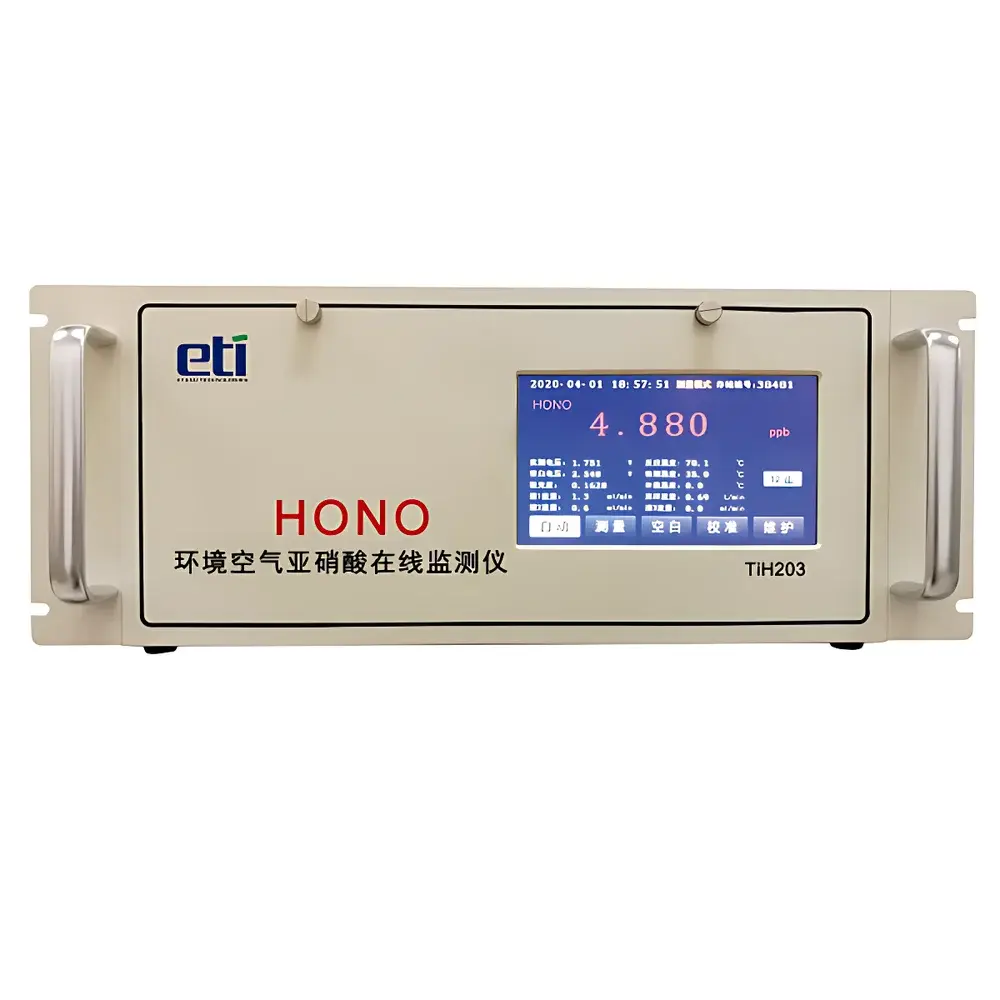
ETI TiH203 Online Nitrous Acid (HONO) Analyzer
| Brand | ETI |
|---|---|
| Origin | Guangdong, China |
| Manufacturer Type | Authorized Distributor |
| Country of Origin | China |
| Model | TiH203 |
| Pricing | Available Upon Request |
Overview
The ETI TiH203 Online Nitrous Acid (HONO) Analyzer is a field-deployable, continuous-monitoring instrument engineered for high-sensitivity, real-time quantification of gaseous nitrous acid (HONO) in ambient air. HONO is a critical atmospheric precursor to hydroxyl (OH) radicals—the primary daytime oxidant in the troposphere—contributing up to 60% of total OH production in urban and suburban environments. Its photolysis initiates photochemical smog formation, influences ozone dynamics, and participates directly in nitrogen cycling. Accurate, long-term HONO measurements are therefore indispensable for validating chemical transport models (CTMs), constraining OH budgets, and diagnosing discrepancies between modeled and observed oxidative capacity. The TiH203 employs a wet-chemical conversion coupled with long-path optical absorption detection: sampled air is drawn through a humidified denuder or mist chamber where HONO is selectively absorbed and converted to stable azide ion (N₃⁻); the resulting solution is then analyzed via UV-Vis spectrophotometry at 267 nm, leveraging the strong molar absorptivity of the azide chromophore. This method ensures high selectivity against interferences such as NO₂, NO, HNO₃, and organic nitrates under typical ambient conditions.
Key Features
- Continuous, unattended operation with sub-minute time resolution (typical averaging interval: 60–120 s)
- Lower detection limit (LDL) of ≤5 pptv (1σ, 10-min average) in ambient air, traceable to NIST-traceable calibration standards
- Integrated humidity and temperature-controlled sampling line to minimize wall losses and ensure quantitative HONO transfer
- Automated daily zero/span verification using certified gas standards and reagent blank cycles
- Ruggedized enclosure rated IP54 for outdoor deployment; operational range: −10 °C to +40 °C, 20–90% RH (non-condensing)
- Modular design enabling field maintenance of liquid handling components (pump tubing, reaction coil, optical flow cell) without optical realignment
Sample Compatibility & Compliance
The TiH203 is validated for direct measurement of HONO in ambient air, stack emissions (post-scrubber), and indoor air environments. It complies with recommended practices for reactive nitrogen speciation outlined in the European Monitoring and Evaluation Programme (EMEP) Quality Assurance/Quality Control (QA/QC) guidelines and aligns with methodological frameworks referenced in ISO 11843-7 (capability of detection) and ASTM D6300 (precision and bias of instrumental methods). Data output supports GLP-compliant workflows, including timestamped raw absorbance spectra, conversion efficiency logs, and diagnostic flags for pump pressure, reagent depletion, and optical path integrity. While not FDA 21 CFR Part 11-certified out-of-the-box, audit trails and user-access controls can be configured to meet GMP-aligned data governance requirements upon system integration.
Software & Data Management
The analyzer operates under ETI’s proprietary HONO-View™ software suite (v3.2+), running on an embedded Linux platform. Real-time concentration data are output via RS-232, Ethernet (TCP/IP), and optional Modbus RTU/ASCII protocols. Software features include automated baseline drift correction, dual-wavelength ratio referencing to compensate for turbidity and lamp aging, and configurable alarm thresholds with relay outputs. All raw spectral scans and processed results are stored locally (8 GB internal flash) with automatic rollover and remote retrieval via secure FTP or HTTPS. Export formats include CSV, NetCDF4 (CF-compliant), and EPA-compatible .dat files. Remote diagnostics, firmware updates, and method parameter adjustments are supported over TLS-encrypted connections.
Applications
- Tropospheric chemistry field campaigns (e.g., NASA AEROMMA, EU PEGASOS, CAAQS)
- Urban air quality monitoring networks requiring speciated nitrogen oxide data
- Indoor air studies assessing HONO emission from cooking, heating, and surface photolysis
- Chamber experiments evaluating heterogeneous HONO formation on soot, mineral dust, and building materials
- Validation of satellite-based HONO retrievals (e.g., TROPOMI, GEMS) through ground-truth collocation
- Source apportionment modeling integrating HONO fluxes with eddy covariance or gradient methods
FAQ
What is the typical sample flow rate and required inlet conditioning?
Standard operating flow is 1.2 L/min; heated inlet line (maintained at 40 °C) with Nafion dryer optional for high-humidity environments.
How frequently must reagents be replenished during continuous operation?
Sulfanilamide and sodium nitrite reagent solutions require replacement every 7 days at 120-s cycle time; azide stabilization buffer lasts 14 days.
Does the TiH203 measure particulate-phase nitrite or only gaseous HONO?
It is calibrated and validated exclusively for gaseous HONO; co-located PM₂.₅ filters are recommended if particulate nitrite assessment is needed.
Can the system be integrated into existing air quality data acquisition platforms?
Yes—native support for EPA AQS, EN 14211, and WMO GAW metadata schemas is available via configuration module.
Is external power conditioning required for stable operation?
A 100–240 VAC, 50/60 Hz input with surge protection and <5% voltage ripple is sufficient; no UPS is mandatory but recommended for unattended sites.
Related Products







