
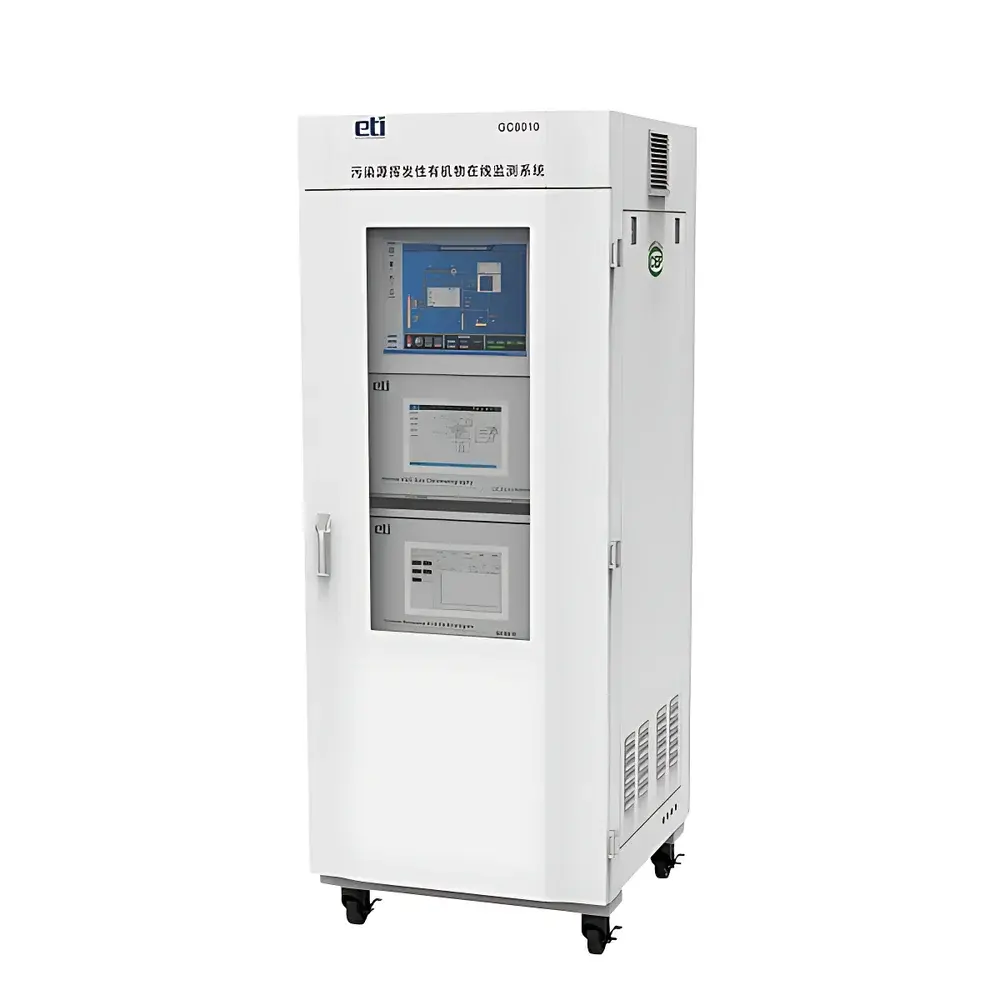
ETI GC6010 Online NMHC and BTEX Monitoring System
| Brand | ETI |
|---|---|
| Origin | Guangdong, China |
| Manufacturer Type | Authorized Distributor |
| Origin Category | Domestic (China) |
| Model | GC6010 |
| Pricing | Available Upon Request |
| Measurement Principle | Gas Chromatography with Flame Ionization Detection (GC-FID) |
| Analytes | Non-Methane Hydrocarbons (NMHC), Benzene-Toluene-Ethylbenzene-Xylenes (BTEX) |
| Column Configuration | One Packed Column + One Empty Column (for THC) + One Dedicated Packed Column (for BTEX) |
| Detector | Dual FID Units (Dedicated or Shared via Valve Switching) |
| Oven Temperature Control | 120 °C (BTEX), 150 °C (NMHC), ±0.5 °C Stability |
| Carrier Gas | Hydrocarbon-Free Air |
| Analysis Cycle | < 120 s (NMHC), < 180 s (BTEX) |
| Response Time (T90) | < 20 s |
| Signal Output | RS-232 / RS-485 (Modbus RTU) |
| Power Supply | 220 ± 22 VAC, 50 ± 0.5 Hz |
| Operating Ambient | 0–50 °C |
| Sample Line Heating | Full High-Temperature Zone (≥150 °C), No Cold Spots |
| Valving | 5-Position, 10-Port Rotary Valve with Patented Back-Flush Capability |
| Compliance | GB/T 39786–2021, HJ 1012–2018, HJ 1078–2019 |
Overview
The ETI GC6010 Online NMHC and BTEX Monitoring System is an industrial-grade continuous emission monitoring solution engineered for regulatory-compliant quantification of non-methane hydrocarbons (NMHC) and aromatic volatile organic compounds (VOCs), including benzene, toluene, ethylbenzene, and xylenes (BTEX). It operates on the principle of gas chromatography coupled with flame ionization detection (GC-FID), a reference method recognized under Chinese national standards GB/T 39786–2021, HJ 1012–2018, and HJ 1078–2019 for stationary source VOC emissions. The system employs dual parallel analysis paths: one bypasses chromatographic separation to deliver total hydrocarbon (THC) signal directly to the FID; the other routes sample through a dedicated packed column where methane elutes first and is quantified independently, while remaining NMHC components are retained and subsequently back-flushed into the detector using a patented 5-position, 10-port rotary valve. NMHC concentration is derived by arithmetic subtraction (THC − CH₄), ensuring traceable, stoichiometrically sound results without calibration drift from hydrocarbon speciation assumptions.
Key Features
- Patented high-temperature back-flush GC architecture eliminates cold spots—entire sample path, including valves, columns, and transfer lines, is maintained at ≥150 °C, preventing condensation, adsorption loss, or crystallization in high-humidity, high-oil, or high-concentration exhaust streams.
- Dual-mode operation: simultaneous NMHC and BTEX measurement in a single instrument platform, configurable via software-selectable column routing and temperature zoning (120 °C for BTEX, 150 °C for NMHC).
- Robust FID detection with linear dynamic range spanning 0.05–10,000 ppmC, optimized for both low-level ambient monitoring and high-concentration stack applications.
- Integrated hydrocarbon-free air supply system ensures stable baseline and eliminates interference from carrier gas impurities.
- Automated calibration capability supports multi-point span checks using certified gas standards (CH₄, propane, benzene), with audit-trail logging compliant with GLP data integrity requirements.
- Self-diagnostic firmware continuously monitors detector status, column pressure, valve actuation timing, and oven temperature stability, triggering event-based alerts via Modbus or relay outputs.
Sample Compatibility & Compliance
The GC6010 is validated for direct sampling from industrial flue gas, wastewater treatment off-gas, chemical reactor vents, and landfill/leachate collection systems. Its heated inlet manifold (150 °C) and corrosion-resistant stainless-steel flow path tolerate water vapor content up to 40% v/v, particulate loading ≤5 mg/m³, and oil aerosol concentrations ≤100 mg/m³ without pre-filtration or condensate traps. Unlike chilled-mirror or permeation-based analyzers, it avoids analyte loss due to solubility or adsorption. Regulatory alignment includes full traceability to Chinese EPA Method HJ 1012–2018 (NMHC) and HJ 1078–2019 (BTEX), with optional configuration supporting ISO 11843-7:2020 (detection limit validation) and ASTM D6348–22 (gas chromatographic determination of VOCs in gaseous matrices).
Software & Data Management
The embedded Linux-based controller runs ETI’s EMonitor™ v4.2 firmware, providing real-time chromatogram visualization, peak integration, and automatic NMHC/BTEX calculation per standard protocols. Data export supports CSV, XML, and PDF report generation with embedded metadata (instrument ID, operator, calibration history, environmental conditions). All raw chromatographic data, system logs, and user actions—including method changes, calibration events, and alarm acknowledgments—are timestamped and stored locally for ≥90 days. Optional Ethernet connectivity enables remote access via HTTPS-secured web interface and integration into SCADA or DCS environments using Modbus TCP or OPC UA. Audit trail functionality satisfies 21 CFR Part 11 requirements when paired with role-based user authentication and electronic signature modules.
Applications
- Continuous compliance monitoring of NMHC emissions from petrochemical refineries, paint manufacturing, and coating facilities under China’s “Three-Year Action Plan for VOCs Control”.
- Real-time BTEX tracking at municipal wastewater treatment plants to assess odor control efficiency and fugitive emission hotspots.
- Process optimization in pharmaceutical drying ovens and solvent recovery units, where rapid (<3 min) turnaround enables closed-loop feedback control.
- Stack testing support for environmental consultancies performing Method 18 or HJ 1012–2018 field validations.
- Research-grade VOC profiling in laboratory-scale catalytic oxidation studies, leveraging reproducible retention times and FID response factors.
FAQ
What regulatory standards does the GC6010 meet for NMHC reporting?
It complies with GB/T 39786–2021, HJ 1012–2018, and HJ 1078–2019—China’s mandatory methods for NMHC and BTEX measurement in stationary sources.
Can the system operate unattended for extended periods?
Yes—designed for 7×24 operation with automated zero/span checks, thermal stabilization, and self-diagnostics; mean time between maintenance exceeds 1,500 hours under typical industrial conditions.
Is external gas supply required for carrier or detector operation?
No—integrated hydrocarbon-free air generator eliminates dependency on bottled gases; only electrical power (220 VAC) is required for full functionality.
How is data integrity ensured during long-term deployment?
All measurements include embedded timestamps, method version IDs, and hardware status flags; local storage retains raw chromatograms and audit logs for ≥90 days with SHA-256 hash verification.
Does the system support third-party calibration gas cylinders?
Yes—it accepts standard 10 L aluminum or stainless-steel cylinders with CGA-600 or DIN 477 connections; calibration gas concentrations must be certified per ISO 6141:2015.







