
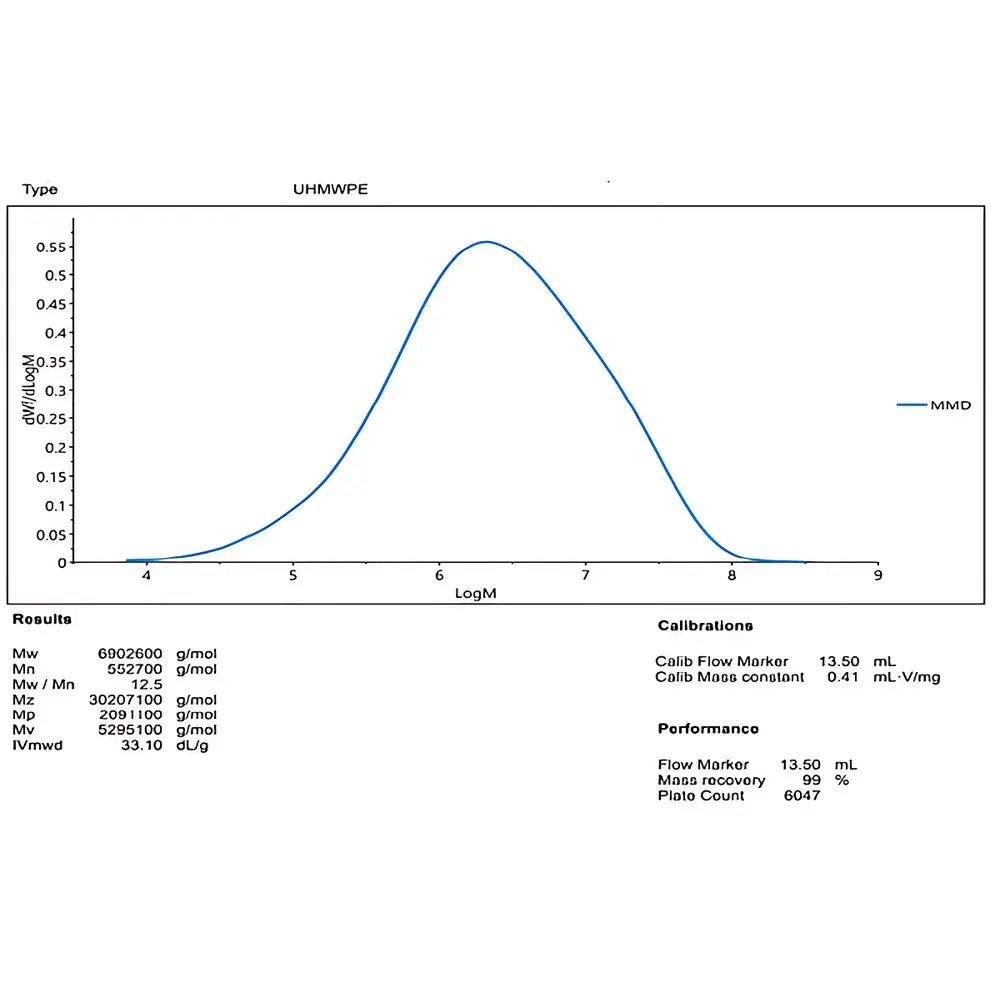
Polymer Char GPC-IR5 High-Temperature Gel Permeation Chromatography System for Ultra-High Molecular Weight Polyolefins
| Brand | Polymer Char |
|---|---|
| Origin | Spain |
| Model | GPC-IR5 |
| Temperature Range | 160 °C (max) |
| Detection | Dual IR5 Infrared Detectors (CH₂/CH₃ channels) |
| Columns | PL-PEG 10⁶–10⁷ Da & HT-Mixed-B for UHMW polyolefins |
| Solvent Compatibility | 1,2,4-Trichlorobenzene (TCB) |
| Flow Rate | 0.5–1.0 mL/min |
| Calibration Standards | Narrow-distribution polyethylene standards (NIST-traceable) |
| Software | Cirrus GPC/SEC v5.x with ASTM D6474 & ISO 16014-4 compliant reporting |
| Data Security | FDA 21 CFR Part 11–ready audit trail, electronic signatures, and user access levels |
Overview
The Polymer Char GPC-IR5 is a high-temperature gel permeation chromatography (GPC), also known as size-exclusion chromatography (SEC), system specifically engineered for the precise molecular weight characterization of ultra-high molecular weight (UHMW) polyolefins—including UHMWPE, metallocene-catalyzed LLDPE, and ethylene–octene copolymers—under fully stabilized thermal conditions up to 160 °C. Unlike conventional room-temperature GPC systems, which fail to dissolve or elute UHMW species due to excessive solution viscosity and column clogging, the GPC-IR5 integrates thermally robust instrumentation, solvent pre-heating modules, and proprietary high-temperature columns capable of resolving molar masses from 10⁷ Da. Its core measurement principle relies on hydrodynamic volume separation in dilute polymer solutions, where retention time correlates with hydrodynamic radius via universal calibration. This enables accurate determination of number-average (Mₙ), weight-average (M_w), z-average (M_z), and dispersity (Đ = M_w/Mₙ) — parameters critical for predicting melt rheology, mechanical toughness, and processing stability.
Key Features
- Integrated dual-channel IR5 infrared detector with simultaneous CH₂ and CH₃ absorption measurement, enabling concentration-independent quantification and direct calculation of short-chain branching (SCB) frequency (branches/1000C) when coupled with calibrated polyolefin standards.
- Dedicated high-temperature separation platform: stainless-steel fluidic path, oven-stabilized columns (±0.1 °C), and TCB-compatible autosampler with inert gas purging to prevent oxidation during dissolution and analysis.
- Pre-packed PL-PEG 10⁶–10⁷ Da and HT-Mixed-B mixed-bed columns optimized for UHMW polyolefins; column lifetime validated for >500 injections under routine use at 150 °C.
- Automated solvent degassing, temperature ramping, and system equilibration protocols reduce operator dependency and improve inter-laboratory reproducibility.
- Compliant with ASTM D6474 (Standard Test Method for Molecular Weight Averages of Polyethylene by High-Temperature Gel Permeation Chromatography) and ISO 16014-4 (Plastics — Determination of average molecular parameters of polymers by size-exclusion chromatography — Part 4: Universal calibration method).
Sample Compatibility & Compliance
The GPC-IR5 accommodates polyolefin samples requiring dissolution in hot 1,2,4-trichlorobenzene (TCB) at 145–150 °C for ≥3 hours under nitrogen. Sample concentration range: 0.5–2.0 mg/mL. It supports native (non-derivatized) UHMWPE, HDPE, LLDPE, and ethylene–α-olefin copolymers. All hardware components meet CE and UL safety standards. The system architecture adheres to GLP/GMP requirements through configurable user roles, full audit trail logging, electronic signature support, and secure data archiving—fully aligned with FDA 21 CFR Part 11 for regulated environments.
Software & Data Management
Cirrus GPC/SEC v5.x provides automated baseline correction, multi-detector overlay, universal calibration curve generation, and branching index calculation using third-order polynomial fitting of IR response ratios. Raw data (.chd, .dat) and processed reports (.pdf, .xlsx) are stored in a relational database with version-controlled metadata (sample ID, operator, instrument log, calibration history). Export options include ASTM-compliant summary tables, cumulative distribution curves, and batch comparison overlays. Data integrity safeguards include write-protected archives, timestamped modifications, and role-based access control (administrator, analyst, reviewer).
Applications
- Quantitative assessment of M_w and Đ shifts following catalytic process optimization in Ziegler–Natta or single-site polyolefin synthesis.
- Correlation of SCB distribution with film clarity, impact strength, and environmental stress crack resistance (ESCR) in packaging-grade LLDPE.
- Stability monitoring of UHMWPE resin during extrusion compounding or radiation crosslinking.
- Supporting regulatory submissions for medical-grade UHMWPE orthopedic implants per ISO 5834-1 and ASTM F648.
- Root-cause analysis of melt fracture or die swell anomalies in blown film lines via molecular weight tail analysis.
FAQ
What solvents are compatible with the GPC-IR5 system?
1,2,4-Trichlorobenzene (TCB) is the primary solvent; o-dichlorobenzene (ODCB) may be used with column compatibility verification.
Can the system quantify long-chain branching (LCB)?
Yes—when combined with a triple-detection configuration (IR5 + viscometer + light scattering), LCB content can be derived via the branching ratio (g′) method per ISO 11830.
Is method transfer possible between different Polymer Char GPC platforms?
Yes—Cirrus software supports cross-platform method import/export and maintains identical calibration and integration settings across GPC-IR, GPC-IR5, and GPC-QC systems.
How often must the IR5 detector require recalibration?
Factory calibration is stable for ≥12 months under normal operation; annual verification using NIST-traceable PE standards is recommended.
Does the system support unattended overnight runs?
Yes—integrated autosampler with 48-position vial capacity, programmable solvent flush cycles, and real-time pressure/temperature monitoring enable fully autonomous sequences.



