
Polymer Char CFC Microstructural Differentiation Analyzer
| Brand | Polymer Char |
|---|---|
| Origin | Spain |
| Manufacturer Type | Authorized Distributor |
| Origin Category | Imported |
| Model | CFC Microstructural Differentiation Analyzer |
| Pricing | Available Upon Request |
Overview
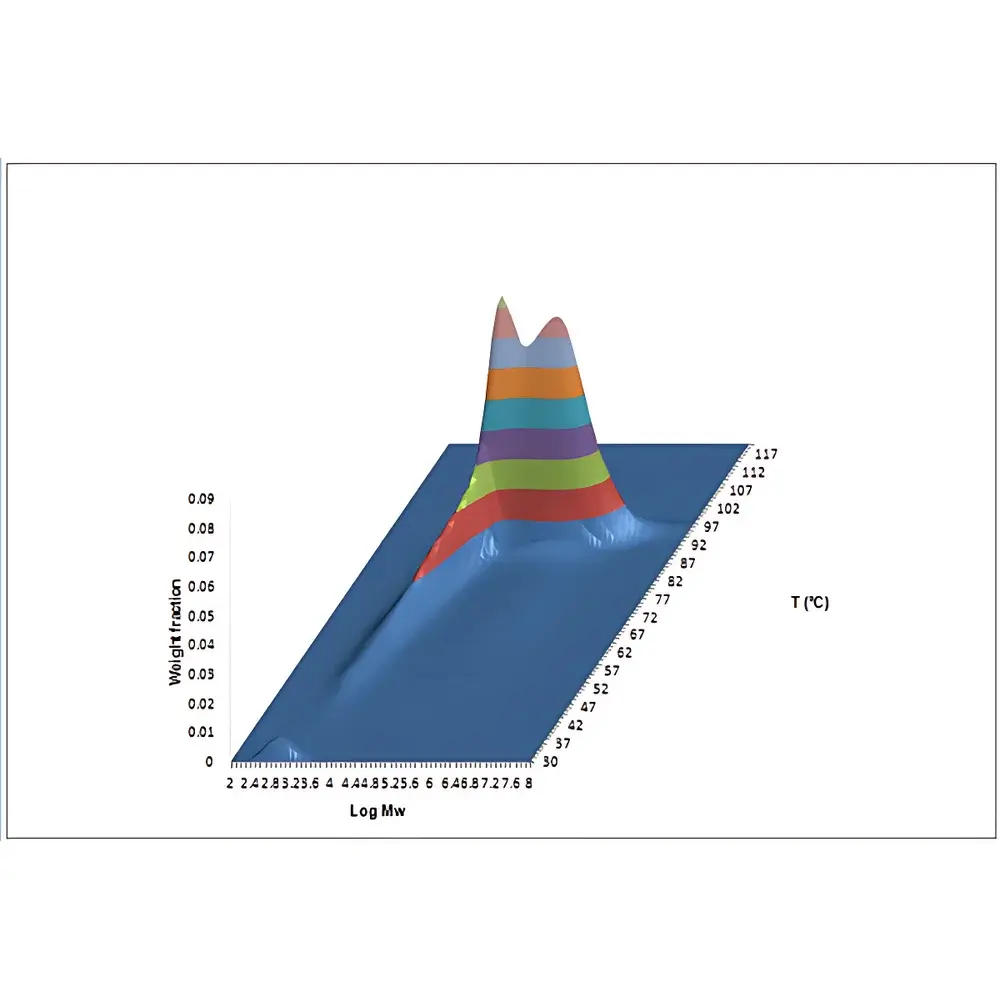
The Polymer Char CFC Microstructural Differentiation Analyzer is a specialized, high-resolution analytical platform engineered for the compositional and microstructural characterization of polyolefin polymers—particularly polyethylene (PE) and polypropylene (PP)—via temperature-rising elution fractionation (TREF) coupled with online infrared (IR) and/or crystallinity detection. Unlike conventional tensile testing or DSC-based methods, the CFC system quantifies microstructural heterogeneity—including comonomer distribution, short-chain branching (SCB) content, crystallinity gradients, and ethylene/propylene sequence distribution—across molecular weight fractions. This capability directly addresses the root cause of variability in elongation at break: non-uniform microstructure arising from reactor kinetics, catalyst asymmetry, or blending inconsistencies. The instrument operates on the principle of selective solvent crystallization under controlled thermal gradients, enabling reproducible separation of polymer fractions based on lamellar thickness and branch density—parameters that govern ductility, melt strength, and mechanical anisotropy.
Key Features
- Integrated TREF–FTIR dual-detection architecture with real-time spectral acquisition during fraction collection
- Automated, programmable temperature ramping (0.1–2.0 °C/min) and precise solvent crystallization control (±0.05 °C stability)
- High-sensitivity IR detector (MCT, 4000–600 cm⁻¹) for quantitative comonomer mapping (e.g., butene, hexene, octene incorporation)
- Optional inline differential scanning calorimetry (DSC) module for simultaneous crystallinity profiling per fraction
- Modular design supporting method transfer between R&D, QC, and regulatory laboratories
- Robust fluidic system compliant with chlorinated solvents (e.g., trichlorobenzene) and fully inert wetted path (Hastelloy, sapphire, PFA)
Sample Compatibility & Compliance
The CFC analyzer accommodates standard polyolefin samples (0.5–5.0 mg) dissolved in high-purity 1,2,4-trichlorobenzene (TCB), including HDPE, LDPE, LLDPE, metallocene-catalyzed PE, isotactic PP, and reactor-blended copolymers. It supports ASTM D6964 (Standard Test Method for Determination of Comonomer Distribution in Polyolefins by TREF), ISO 16152 (Plastics — Polyolefins — Determination of compositional distribution), and aligns with IUPAC recommendations for polymer microstructure analysis. All hardware and software components meet CE marking requirements and are designed to support GLP-compliant workflows, including audit trails, electronic signatures, and raw data integrity per FDA 21 CFR Part 11 when deployed with validated software configurations.
Software & Data Management
Control and analysis are performed using Polymer Char’s proprietary CFC Software Suite (v5.x), a Windows-based application featuring intuitive method setup, real-time chromatogram visualization, peak deconvolution, and multivariate calibration for SCB quantification. The software exports fully annotated reports in PDF and CSV formats, with embedded metadata (instrument ID, operator, date/time, calibration history). Raw IR spectra and TREF elution profiles are stored in vendor-neutral HDF5 format, ensuring long-term archival compatibility. For enterprise integration, the system supports OPC UA connectivity and optional LIMS interfacing via RESTful API—enabling traceability across sample lifecycle management systems in regulated manufacturing environments.
Applications
- Root-cause analysis of batch-to-batch elongation at break variation in film-grade LLDPE production
- Verification of catalyst performance consistency across pilot and commercial reactors
- Microstructural fingerprinting of recycled polyolefin streams to assess blend homogeneity and degradation extent
- Supporting material selection for medical-grade tubing where ductility and kink resistance are critical
- Correlating TREF-derived branching distribution with rheological behavior (e.g., strain hardening, melt fracture onset)
- Accelerated development of new polyolefin grades targeting specific toughness–stiffness trade-offs
FAQ
What distinguishes the CFC from conventional DSC or GPC in microstructural analysis?
DSC provides bulk crystallinity; GPC yields only molecular weight distribution. The CFC delivers orthogonal, fraction-resolved data on both composition (branching) and crystallizability—essential for understanding localized ductility mechanisms.
Can the CFC analyze polypropylene copolymers with ethylene content?
Yes—the system quantifies ethylene incorporation in iPP and impact copolymers via characteristic IR absorbance ratios (e.g., 730 cm⁻¹ vs. 973 cm⁻¹) and correlates ethylene distribution with rubber-phase morphology.
Is method validation required for regulatory submissions?
While the CFC itself is not a compendial instrument, its TREF–IR methodology is widely accepted in regulatory filings (e.g., FDA IND/NDA dossiers for polymer-based devices); full validation per ICH Q2(R2) is recommended for QC release testing.
What maintenance is required to ensure long-term precision?
Annual calibration of temperature sensors and IR detector response; quarterly verification of solvent delivery accuracy and fraction collector positioning; routine cleaning of crystallization columns with hot TCB flushes.




