
Polymer Char PREP C20 Fractionation System for Polyolefins
| Brand | Polymer Char |
|---|---|
| Origin | Spain |
| Model | PREP C20 |
| Application | Automated Temperature Rising Elution Fractionation (TREF) and Crystallization Analysis Fractionation (CRYSTAF) of Polyolefins |
| Throughput | 10–20 g per run |
| Fraction Number | Up to 9 discrete fractions |
| Cycle Time | ~60 hours per full fractionation sequence |
| Compliance | Designed for ASTM D6964 (TREF), ASTM D7282 (CRYSTAF), ISO 16152, ISO 16014-3 |
Overview
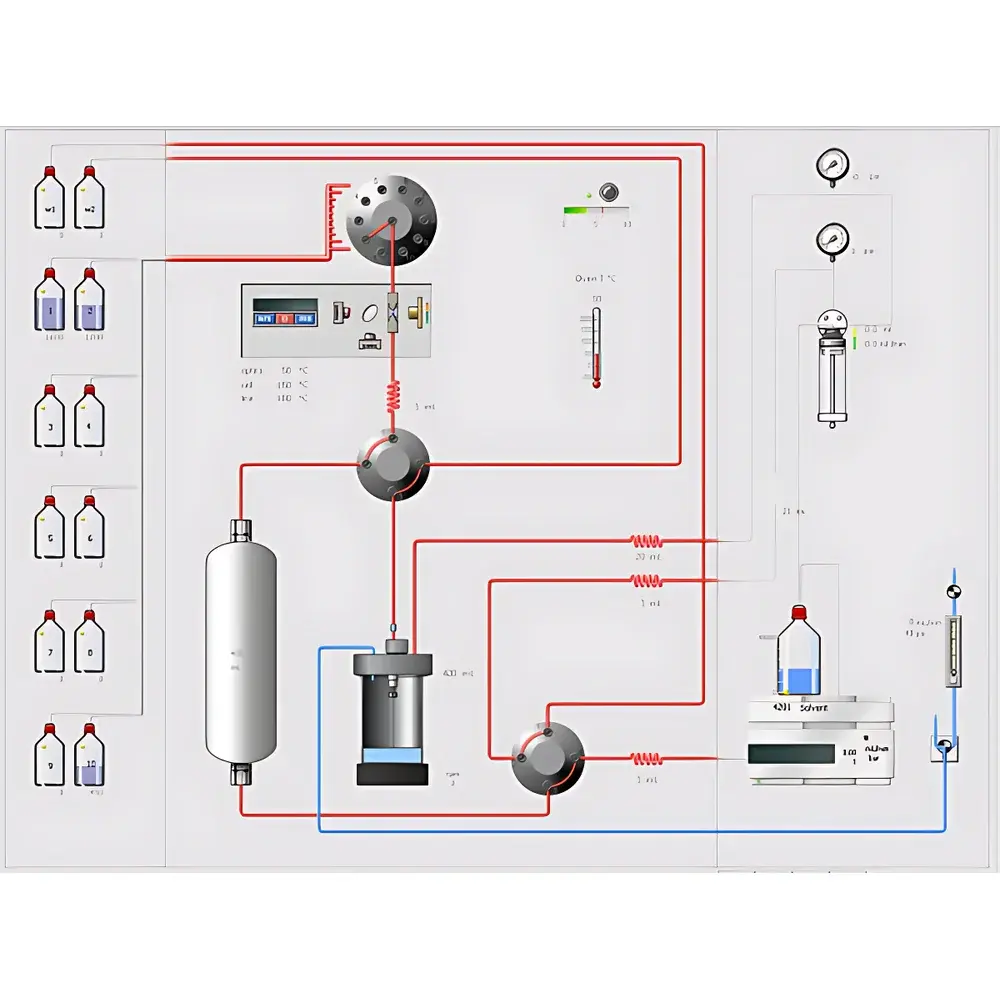
The Polymer Char PREP C20 is a fully automated, benchtop-scale fractionation system engineered for the precise, reproducible separation of polyolefin heterogeneity based on crystallizability. It implements two orthogonal thermal fractionation principles—Temperature Rising Elution Fractionation (TREF) and Crystallization Analysis Fractionation (CRYSTAF)—enabling researchers to isolate compositionally and microstructurally distinct fractions from complex polyethylene (PE) and polypropylene (PP) samples. Unlike manual or semi-automated approaches, the PREP C20 integrates solvent handling, temperature-programmed elution/crystallization, fraction collection, and solvent recovery into a single unattended workflow. Its core architecture adheres to the thermodynamic foundation of polymer crystallization kinetics: differences in ethylene/propylene comonomer distribution, branching density, and stereoregularity govern solubility and crystallization onset temperatures in specific solvents (e.g., 1,2,4-trichlorobenzene). By exploiting these intrinsic physical properties, the system delivers chemically resolved fractions suitable for downstream characterization (e.g., NMR, DSC, GPC, FTIR) and structure–property correlation studies.
Key Features
- Fully automated TREF and CRYSTAF operation with programmable temperature ramps (0.1–2.0 °C/min), dwell times, and elution/crystallization hold steps
- Integrated solvent management system including high-precision syringe pumps, inert gas purging, and closed-loop solvent recovery to minimize operator exposure and waste generation
- Robust fraction collector with 12-position vial carousel and gravimetric feedback control for accurate mass-based fraction cutoffs
- Patented column oven design ensuring ±0.1 °C temperature uniformity across the entire separation bed, critical for reproducible crystallization profiles
- Compliance-ready architecture supporting audit trails, user access levels, and electronic signatures per FDA 21 CFR Part 11 requirements when paired with optional LIMS integration
Sample Compatibility & Compliance
The PREP C20 accommodates standard polyolefin samples ranging from 10 to 20 g per run—including HDPE, LDPE, LLDPE, metallocene-catalyzed PE, isotactic and syndiotactic PP, and ethylene–propylene copolymers. Sample dissolution occurs in 1,2,4-trichlorobenzene at 160 °C under nitrogen, followed by controlled cooling (CRYSTAF) or stepwise solvent elution (TREF) across a defined temperature gradient (typically 30–110 °C). All operational protocols align with internationally recognized standards: ASTM D6964 for TREF, ASTM D7282 for CRYSTAF, ISO 16152 (polyolefin compositional distribution), and ISO 16014-3 (GPC calibration traceability). The system’s mechanical and software design supports GLP and GMP environments, with configurable data integrity controls for regulated R&D and quality assurance laboratories.
Software & Data Management
Control and data acquisition are managed via Polymer Char’s proprietary PREPware software, a Windows-based platform offering real-time monitoring of temperature, pressure, flow rate, and fraction mass. The software enables method development through intuitive graphical programming of multi-step thermal profiles, automatic calibration routines for column and detector response, and batch processing of sequential runs. Raw data—including chromatograms, crystallization curves, and fraction mass logs—are stored in vendor-neutral ASCII formats (.csv, .txt) and structured HDF5 files compliant with FAIR data principles. Optional integration with laboratory information management systems (LIMS) allows metadata tagging (e.g., sample ID, operator, instrument calibration status) and automated report generation aligned with internal SOPs or regulatory submissions.
Applications
- Resolving short-chain branching (SCB) distribution in LLDPE to correlate with film toughness and seal initiation temperature
- Isolating low-crystallinity fractions from reactor-grade PP to quantify atactic content affecting clarity and stiffness
- Validating catalyst performance by comparing compositional heterogeneity across pilot-scale polymerization batches
- Preparing reference fractions for calibrating online process analyzers (e.g., NIR, Raman) in polyolefin production units
- Supporting failure analysis of molded parts by tracing phase-separated domains back to feedstock fractionation profiles
FAQ
What solvents are compatible with the PREP C20?
The system is validated for use with 1,2,4-trichlorobenzene (TCB) as the primary solvent. Other high-boiling aromatic solvents may be evaluated subject to compatibility testing with pump seals and column packing materials.
Can the PREP C20 perform both TREF and CRYSTAF in a single instrument?
Yes—the system is field-configurable for either mode via software-defined protocol selection and minor hardware reconfiguration (e.g., column orientation, detector path). No hardware modification is required to switch between methods.
How is fraction purity verified post-separation?
Fraction purity is assessed offline using orthogonal techniques: differential scanning calorimetry (DSC) for melting point distribution, 13C NMR for comonomer sequence distribution, and high-temperature gel permeation chromatography (HT-GPC) for molar mass dispersion within each fraction.
Does the system support method transfer from research to QC environments?
Yes—PREPware includes IQ/OQ documentation templates, version-controlled method libraries, and electronic signature workflows designed to meet ICH Q5, Q7, and ISO/IEC 17025 requirements for method validation and transfer.





