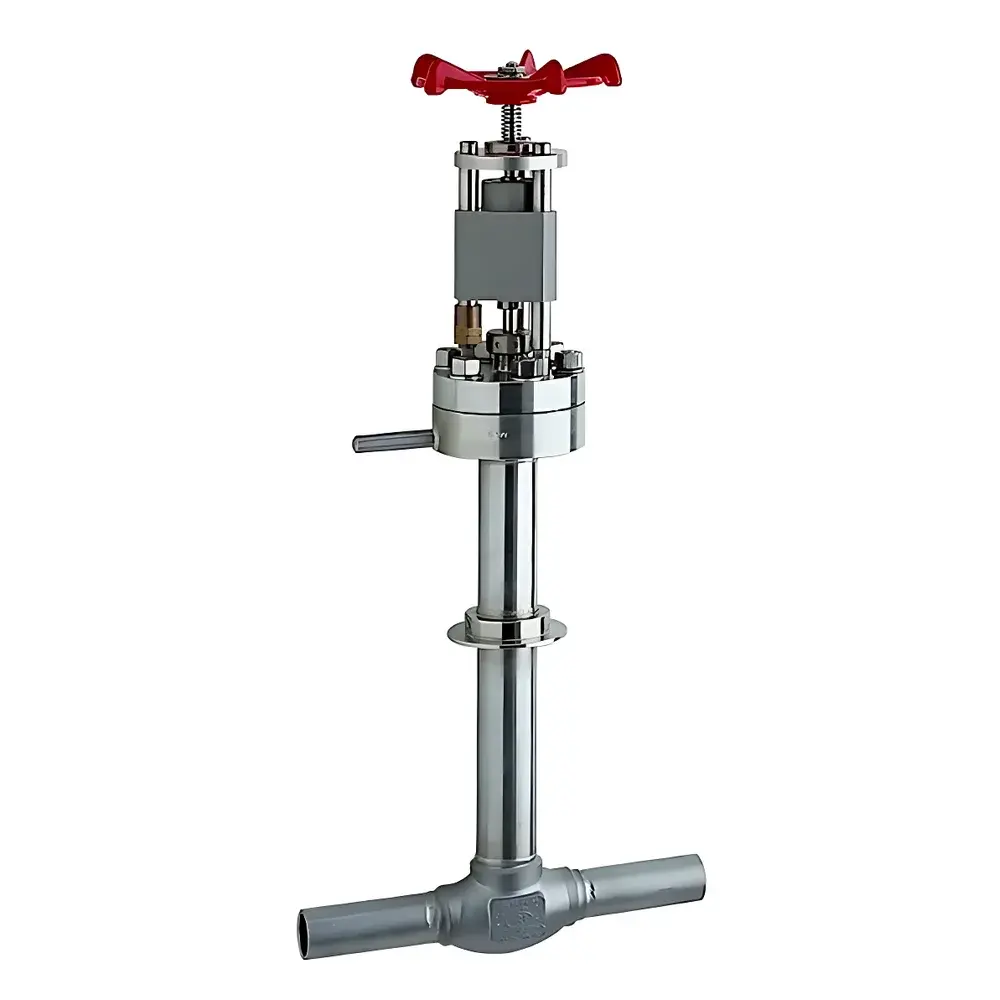
Top-Mounted Stainless Steel Cryogenic Globe Valve
| Brand | IRELAND |
|---|---|
| Origin | France |
| Model | 190700 |
| Body Material | 304L Stainless Steel |
| End Connection | Butt-Weld (BW) |
| Seat Design | Integral Seat with Reusable Soft Seal Disc |
| Temperature Range | –220 °C to +200 °C |
| Pressure Rating | PN16 to PN100 |
| Nominal Size | DN15 to DN200 |
| Cryogenic Extension | Extended Bonnet with Bolted Construction |
| Vacuum Jacket Compatibility | Disc-Integrated Welding Pad on Upper Stem |
| Compliance | Designed for ASME B16.34, EN 1515-1, ISO 15848-1 (fugitive emissions), and applicable cryogenic service standards |
Overview
The IRELAND 190700 top-mounted stainless steel cryogenic globe valve is engineered for reliable shutoff and throttling control in ultra-low-temperature process environments. Its design adheres to the fundamental thermodynamic and mechanical requirements of cryogenic service—specifically, minimizing heat leak into the fluid path while maintaining structural integrity, sealing performance, and operational safety under thermal cycling between –220 °C and +200 °C. The valve employs a top-entry, bolted extended bonnet configuration that physically separates the packing chamber from the cryogenic medium, thereby reducing conductive heat transfer from ambient to the stem seal zone. This architecture ensures consistent packing compression and long-term leak-tightness—critical for applications involving liquid nitrogen, liquid oxygen, liquid argon, LNG, and other liquefied industrial gases.
Key Features
- Extended Bonnet Construction: Precision-machined 304L stainless steel bonnet with calibrated length per ISO 2852 and EN 1515-1 guidelines—optimized to maintain packing temperature above –20 °C during continuous operation at –196 °C.
- Copper-Free Materials System: All external surfaces and wetted components—including body, disc, stem, seat, and gasket seating surfaces—are manufactured without copper or copper alloys, eliminating embrittlement risks in oxygen-rich environments and complying with ASTM G63 and CGA G-4.1 requirements.
- Integral Seat & Reusable Soft Seal: One-piece forged seat integrated into the valve body provides dimensional stability; paired with fluoropolymer-based soft seal discs (e.g., PCTFE or modified PTFE) certified to pass bubble-tight shut-off per ISO 5208 Class A leakage limits.
- Vacuum Jacket Interface: A circumferential disc machined onto the upper stem section enables direct orbital welding to vacuum-insulated piping jackets—ensuring hermetic continuity of the cold box envelope without thermal bridging.
- Robust Mechanical Architecture: Heavy-duty yoke, reinforced stem nut, and high-torque handwheel assembly designed for repeated manual actuation under frost-loaded conditions and glove-compatible operation.
Sample Compatibility & Compliance
This valve is qualified for use with all major air separation plant (ASP) fluids—including LOX, LIN, LAR, and high-purity gaseous O2/N2/Ar—as well as hydrogen, helium, and ethylene in petrochemical and LNG facilities. It conforms to EN 10222-4 (cryogenic-grade stainless steels), EN 1515-1 (flange and valve bolting), and ISO 15848-1 (type testing for fugitive emissions). Optional fire-safe configuration meets API RP 2510 and EN 10204 3.2 material certification requirements. For regulated pharmaceutical or food-grade installations, 316L variants are available with electropolished finishes (Ra ≤ 0.4 µm) and full traceability documentation.
Software & Data Management
As a manually operated mechanical device, the 190700 valve does not incorporate embedded electronics or digital interfaces. However, its design supports integration into digitally monitored process systems via optional position-indicating handwheels or third-party actuator add-ons (e.g., pneumatic spring-return or electric fail-safe actuators). When fitted with an IEC 61508-compliant actuator, full audit trail logging—including valve position timestamps, cycle count, and diagnostic flags—can be synchronized with DCS/SCADA platforms compliant with ISA-84 and IEC 61511 functional safety frameworks. All material certifications, pressure test reports (hydrostatic and pneumatic), and cryogenic performance validation records are supplied in English with EN 10204 3.1 or 3.2 compliance documentation.
Applications
- Air separation units (ASUs): Main cold box isolation, expander bypass, and liquid product take-off lines
- LNG receiving terminals and liquefaction plants: LNG transfer, boil-off gas (BOG) recirculation, and emergency shutdown loops
- Hazardous material transport: Cryogenic tank truck and railcar loading/unloading manifolds
- Hydrogen infrastructure: Liquid hydrogen (LH2) storage, transfer, and fueling station distribution networks
- Research & pilot-scale cryogenics: Superconducting magnet cooling circuits, quantum computing dilution refrigerators, and low-temperature test benches
FAQ
What is the maximum allowable working pressure at –196 °C?
For DN15–DN50 sizes, PN100 rating is maintained down to –196 °C per EN 1515-1 Annex C; larger sizes (DN65–DN200) are rated PN63 at this temperature. Full pressure–temperature ratings are provided in the certified datasheet.
Can this valve be used in oxygen service above 21% O₂ concentration?
Yes—when specified with copper-free construction, cleaned per CGA G-4.1 Level B, and tested with oil-free nitrogen, it is approved for high-pressure gaseous oxygen service up to 20 MPa.
Is vacuum jacket welding support available for all nominal sizes?
Welding pad geometry is standardized for DN15–DN100; for DN125–DN200, custom stem extension machining is required and subject to engineering review.
Does the valve meet FDA or USP Class VI requirements for pharmaceutical applications?
The base 304L model does not carry USP Class VI certification; however, the optional 316L electropolished variant with PTFE-free elastomers can be validated per ISPE Baseline Guide Chapter 7 for clean utility systems.
What documentation accompanies each shipment?
Each unit ships with EN 10204 3.1 Material Test Report, ISO 5208 leakage test certificate, hydrostatic test report, dimensional inspection record, and installation & maintenance manual in English.