Polymer Char GPC-IR Advanced Microstructure Analyzer for Impact-Modified Polypropylene
| Brand | Polymer Char |
|---|---|
| Origin | Spain |
| Model | GPC-IR Advanced |
| Application | Simultaneous Quantification of Xylene Solubles, Ethylene Content, and Intrinsic Viscosity in Impact Polypropylene |
Overview
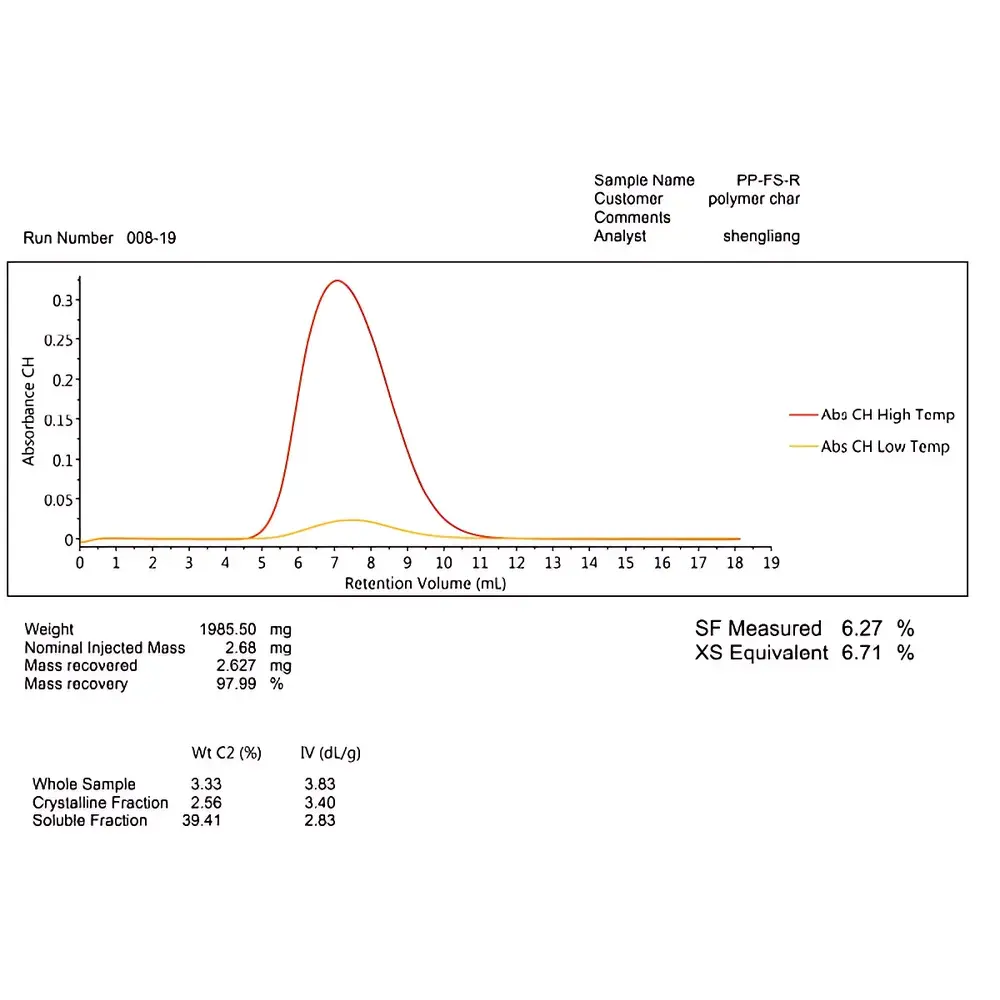
The Polymer Char GPC-IR Advanced Microstructure Analyzer is a fully automated, integrated gel permeation chromatography (GPC) system coupled with Fourier-transform infrared (FTIR) detection, specifically engineered for the comprehensive microstructural characterization of impact-modified polypropylene (IMPP). It operates on the principle of size-exclusion separation followed by real-time, wavelength-specific IR absorbance quantification—enabling simultaneous determination of molecular weight distribution (MWD), xylene solubles content (XS), ethylene comonomer incorporation (in both soluble and insoluble fractions), and intrinsic viscosity (IV) from a single injection. Unlike conventional offline or sequential analytical workflows, this platform delivers complete microstructural fingerprints—including rubber phase composition, crystalline phase ethylene content, and molecular weight heterogeneity—in under 130 minutes per sample. Its design aligns with ASTM D6474 (Standard Test Method for Determination of Ethylene Content in Polyolefins by FTIR), ISO 1133 (Melt Flow Rate), and ISO 1628-3 (Intrinsic Viscosity of Polypropylenes), supporting method validation in regulated R&D and production environments.
Key Features
- Fully automated GPC-IR platform with integrated solvent handling, column oven, and dual-detector (refractive index + FTIR) configuration
- Simultaneous quantification of xylene solubles (XS), ethylene content (wt%) in both xylene-soluble (amorphous/rubber) and xylene-insoluble (crystalline) fractions, and intrinsic viscosity (dL/g)
- High-resolution molecular weight distribution analysis across 10⁴–10⁷ g/mol range using calibrated SEC columns optimized for polyolefins
- Proprietary IR calibration models validated against NIST-traceable polypropylene reference standards; spectral resolution ≤4 cm⁻¹
- Integrated sample dissolution, filtration, and auto-injection with programmable temperature control (30–160 °C) to ensure complete polymer dissolution without degradation
- Robust architecture compliant with GLP documentation requirements, including full audit trail, electronic signatures, and 21 CFR Part 11–ready software configuration
Sample Compatibility & Compliance
The GPC-IR Advanced accepts standard polypropylene resin pellets, granules, or powder samples (5–20 mg typical mass). It is validated for heterogeneous impact copolymers containing ethylene-propylene rubber (EPR) or ethylene-propylene-diene monomer (EPDM) phases, as well as reactor-grade IMPP produced via multi-reactor or loop/slurry processes. All analytical procedures comply with ISO 17987 (Plastics — Polyolefin Copolymers — Determination of Composition by FTIR), ASTM D5296 (GPC Molecular Weight of Polymers), and USP Chromatography guidelines. Data outputs meet traceability requirements for internal quality audits and external regulatory submissions, including FDA pre-submission reviews for medical-grade polymer formulations.
Software & Data Management
Control and analysis are executed via Polymer Char’s proprietary IRBench™ software, a Windows-based application featuring modular workflow scripting, automated baseline correction, peak deconvolution for overlapping ethylene/propylene C–H bands (720 cm⁻¹ vs. 841 cm⁻¹), and fraction-specific MWD reconstruction. Raw chromatograms, IR spectra, and calculated parameters (XS%, IV, Mw/Mn, ethylene wt% in soluble/insoluble fractions) are stored in vendor-neutral .csv and .pdf formats. The system supports LIMS integration via ASTM E1394-compliant data export and includes built-in reporting templates aligned with ICH M4 Q5 analytical procedure documentation standards. Audit trails record all user actions, parameter changes, and calibration events with time-stamped, immutable logs.
Applications
- Rapid root-cause analysis of impact strength variability during IMPP grade transitions in production plants
- Correlation of rubber-phase molecular weight and ethylene content with Izod/Charpy impact test results
- Optimization of Ziegler–Natta or metallocene catalyst systems based on real-time microstructural feedback
- Validation of reactor blending strategies in multi-stage polymerization processes
- Supporting technical service responses for customer complaints related to brittleness or stress cracking
- Accelerated development of new IMPP grades targeting automotive interior trim, battery housing, or medical packaging applications
FAQ
How does the GPC-IR Advanced differentiate ethylene content in soluble versus insoluble fractions?
It combines selective solvent extraction (xylene reflux per ASTM D5492) with online GPC fraction collection, followed by FTIR quantification of each isolated fraction’s characteristic C=C and CH₂/CH₃ absorbance ratios.
Can the system analyze degraded or thermally stressed IMPP samples?
Yes—its low-temperature dissolution protocol (≤140 °C) and inert nitrogen purge minimize thermal oxidation, preserving native microstructure integrity for accurate MWD and comonomer mapping.
Is method transfer possible between different GPC-IR Advanced units?
Yes—calibration files, IR spectral libraries, and analysis methods are portable across instruments; inter-unit reproducibility for XS% and ethylene content is ≤±0.3% (RSD, n=6) when operated under identical SOPs.
Does the system support regulatory submission packages?
Yes—IRBench™ generates IQ/OQ/PQ documentation templates and complies with ALCOA+ data integrity principles required for FDA, EMA, and PMDA submissions.