
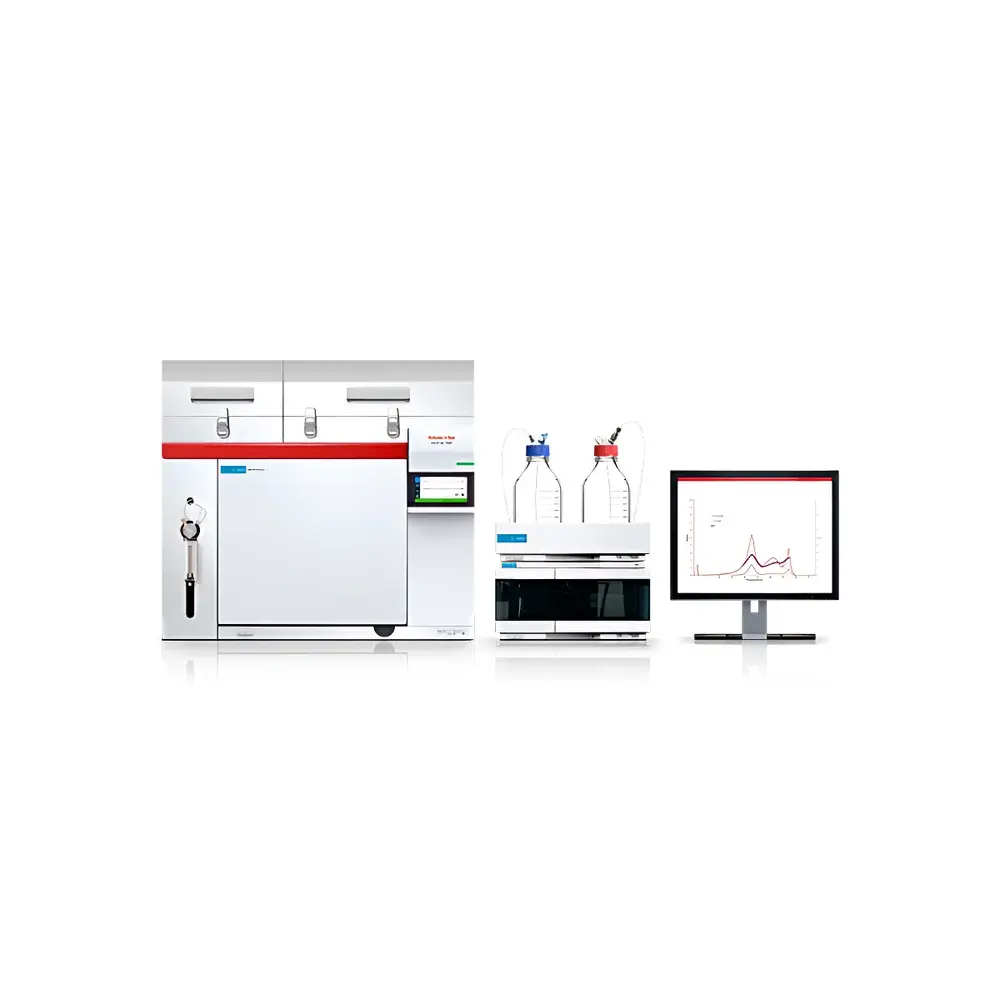
Polymer Char CRYSTAF-TREF Polyolefin Chemical Composition Distribution Analyzer
| Brand | Polymer Char |
|---|---|
| Origin | Spain |
| Model | CRYSTAF-TREF |
| Technique | Dual-Mode (Crystallization Analysis Fractionation & Temperature Rising Elution Fractionation) |
| Sample Capacity | 5 samples per run |
| Analysis Time | ≤6 h/sample (TREF mode), ≤8 h for 5 samples (CRYSTAF mode) |
| Minimum Operating Temperature | −20 °C |
| Detector Options | IR4 Fourier-transform infrared detector, Differential Viscometer, Multi-Angle Light Scattering (MALS) |
| Automation Level | Fully automated solvent handling, fraction collection, and system cleaning |
| Software Compliance | Audit-trail enabled, user access control, 21 CFR Part 11–ready configuration available |
| Regulatory Alignment | Designed to support ASTM D7943, ISO 16152, and ISO 16014–4 workflows |
Overview
The Polymer Char CRYSTAF-TREF is a dual-mode, benchtop polyolefin characterization platform engineered for high-reproducibility measurement of Chemical Composition Distribution (CCD) in ethylene–propylene copolymers, polyethylene (PE), polypropylene (PP), and their blends. It integrates two complementary separation principles—Crystallization Analysis Fractionation (CRYSTAF) and Temperature Rising Elution Fractionation (TREF)—within a single, unified hardware architecture. CRYSTAF separates polymer fractions based on crystallizability under controlled cooling and isothermal crystallization, while TREF relies on differential solubility during programmed temperature ramping in a saturated solvent environment. This orthogonal combination enables comprehensive CCD profiling where either technique alone may yield incomplete or ambiguous resolution—particularly critical for complex systems such as PP/PE blends, HDPE/Ziegler–Natta PP homopolymers, or ethylene–propylene rubber (EPR). The instrument operates fully automatically: from sample dissolution and column loading to fraction elution, detection, data acquisition, and post-run solvent recovery and system rinse—minimizing operator intervention and reducing analytical variability.
Key Features
- Fully integrated dual-mode operation: switch between CRYSTAF and TREF protocols via software without hardware reconfiguration
- Automated 5-sample carousel with programmable sequence execution and real-time status monitoring
- Extended low-temperature capability down to −20 °C for characterization of low-crystallinity polyolefins (e.g., plastomers, elastomeric copolymers)
- Standard IR4 Fourier-transform infrared detector for quantitative comonomer composition (e.g., propylene content in PE, ethylene content in PP)
- Optional differential viscometer and multi-angle light scattering (MALS) modules for concurrent molar mass distribution (MMD) trend analysis across CCD fractions
- Sealed solvent handling system minimizing exposure, evaporation loss, and manual contact with chlorinated solvents (e.g., 1,2,4-trichlorobenzene)
- Self-cleaning protocol using heated solvent flushes and inert gas purge cycles between runs
- Remote diagnostics and control interface compatible with enterprise laboratory networks and LIMS integration
Sample Compatibility & Compliance
The CRYSTAF-TREF accommodates standard polyolefin samples (10–50 mg) dissolved in high-purity 1,2,4-trichlorobenzene (TCB) at 140–160 °C. It supports routine analysis of HDPE, LDPE, LLDPE, isotactic and syndiotactic PP, ethylene–propylene diene monomer (EPDM), and reactor-grade blends. Method development aligns with internationally recognized standards including ASTM D7943 (Standard Test Method for Chemical Composition Distribution of Polyolefins by CRYSTAF), ISO 16152 (Plastics — Polyolefins — Determination of chemical composition distribution by TREF), and ISO 16014–4 (Determination of molar mass distribution by size-exclusion chromatography — Part 4: Light scattering detection). When configured with audit trail, electronic signatures, and role-based access control, the system meets GLP and GMP documentation requirements and supports FDA 21 CFR Part 11 compliance for regulated environments.
Software & Data Management
Polymer Char’s proprietary ChromCal software provides end-to-end control—from method setup and instrument calibration to raw signal processing, baseline correction, and CCD curve generation. Each run generates temperature-resolved chromatograms with absolute weight fraction (%) vs. elution temperature (°C), alongside derivative curves (dW/dT) for peak deconvolution. IR4 spectral data are processed using multivariate calibration models to report comonomer content per fraction. All raw and processed data are stored in vendor-neutral HDF5 format with embedded metadata (operator ID, timestamp, method version, instrument configuration). Version-controlled method templates ensure inter-laboratory reproducibility, while export modules support CSV, Excel, and ASTM-compatible XML output for QA/QC reporting and regulatory submission.
Applications
- Correlating catalyst design (e.g., metallocene vs. Ziegler–Natta) with CCD breadth and heterogeneity in industrial polyolefin production
- Quality control of reactor-grade PP/PE blends where TREF resolves overlapping crystallinity windows but CRYSTAF discriminates kinetic crystallization behavior
- Studying long-chain branching effects in LLDPE via combined CCD + intrinsic viscosity trends
- Failure analysis of molded parts exhibiting inconsistent mechanical performance due to compositional segregation
- Supporting patent documentation with orthogonal CCD evidence for novel copolymer architectures
- Accelerating R&D screening of new comonomer feeds or hydrogen modulation strategies
FAQ
What distinguishes CRYSTAF from TREF in practice?
CRYSTAF separates fractions based on crystallization kinetics under controlled cooling; it excels for samples with broad crystallinity distributions (e.g., PP/PE blends). TREF separates based on solubility equilibria during heating; it offers superior resolution for polymers with narrow melting ranges (e.g., HDPE vs. Ziegler–Natta PP).
Can both modes be run on the same sample injection?
No—each analysis requires independent sample preparation and thermal protocol selection. However, identical sample solutions can be used for sequential CRYSTAF and TREF runs without re-dissolution.
Is the IR4 detector mandatory?
The IR4 is standard equipment and required for comonomer quantification; its absence limits output to relative CCD profiles only.
How is system validation performed?
Instrument qualification includes temperature calibration (NIST-traceable Pt100 sensors), flow rate verification, detector linearity checks (using certified polystyrene standards), and inter-day repeatability assessment per ASTM D7943 Annex A2.
Does the system support unattended overnight operation?
Yes—fully automated runs, including solvent recovery and cleaning, are scheduled and monitored remotely without manual oversight.
Related Products





