
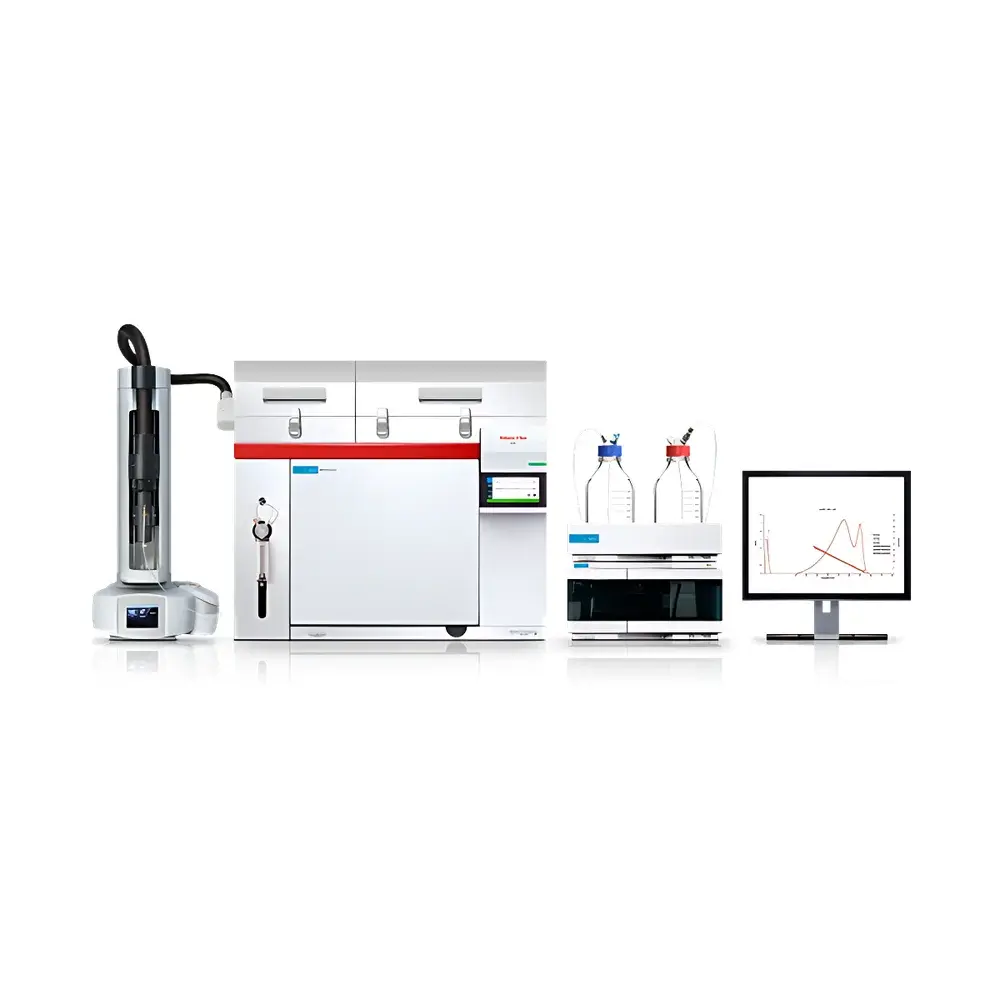
Polymer Char CEF Fast Automated Temperature Rising Elution Fractionation Analyzer
| Brand | Polymer Char |
|---|---|
| Origin | Spain |
| Model | CEF |
| Type | Polyolefin Characterization Analyzer |
| Automation Level | Fully Automated |
| Analysis Time per Sample | ≤25 min |
| Sample Capacity | 42-position autosampler |
| Detection Options | IR4 or IR5 FTIR concentration detectors |
| Optional Detectors | Viscometer, Multi-Angle Light Scattering (MALS) |
| Temperature Range | –20 °C to 160 °C (with low-temp and high-temp accessories) |
| Compliance | Designed for GLP/GMP environments |
| Software | CEF Control & Analysis Suite (21 CFR Part 11 compliant audit trail optional) |
Overview
The Polymer Char CEF is a fully automated, benchtop temperature rising elution fractionation (TREF) system engineered for high-throughput, high-reproducibility chemical composition distribution (CCD) analysis of polyolefins—including linear low-density polyethylene (LLDPE), ethylene–α-olefin copolymers, and metallocene-catalyzed polymers. Unlike conventional TREF instruments relying solely on slow, isothermal crystallization followed by linear temperature ramping, the CEF employs a dynamic crystallization protocol: controlled cooling establishes spatially resolved crystallite formation across the chromatographic column based on polymer chain crystallizability, followed by rapid, programmed升温 elution. This thermodynamic pre-separation mechanism significantly reduces total analysis time while enhancing resolution between fractions differing in comonomer content or short-chain branching (SCB) density. The system operates under inert nitrogen purge (optional) to suppress thermal oxidation during dissolution and elution—critical for preserving molecular integrity in sensitive samples such as ultra-low-density polyethylenes (ULDPE) or highly branched metallocene resins.
Key Features
- Fully automated workflow: From sample weighing to solvent addition, dissolution, filtration, column loading, elution, detector acquisition, and post-run line cleaning—no manual solvent handling required.
- 25-minute cycle time per sample with 42-position robotic autosampler, enabling unattended overnight operation and daily throughput exceeding 60 samples.
- Integrated IR4 or IR5 Fourier-transform infrared (FTIR) concentration detectors provide high-sensitivity, baseline-stable quantification of eluting fractions; dual-wavelength capability enables simultaneous measurement of both polymer concentration and short-chain branching (SCB) index.
- Modular detection architecture supports optional inline viscometer and multi-angle light scattering (MALS) detectors for concurrent determination of intrinsic viscosity, molar mass distribution (MMD), and long-chain branching (LCB) content.
- Programmable dual-zone thermal control: Independent heating zones allow staggered dissolution—while one sample undergoes elution, the next is precisely heated to target dissolution temperature—minimizing thermal history variability and improving inter-run reproducibility.
- Low-temperature accessory extends operational range to –20 °C, enabling robust crystallization of low-crystallinity polyolefins (e.g., plastomers, elastomeric polypropylene copolymers).
- Remote monitoring and diagnostic interface supports real-time instrument status reporting, error logging, and predictive maintenance alerts via secure Ethernet connection.
Sample Compatibility & Compliance
The CEF is validated for use with standard polyolefin solvents (e.g., 1,2,4-trichlorobenzene, TCB) and accommodates solid polymer samples ranging from 5 to 50 mg. Its closed-loop solvent management system meets stringent HSE requirements: total solvent consumption per run is <30 mL, and operator exposure is eliminated through fully enclosed fluidic pathways. Instrument design adheres to IEC 61000-6-3 (EMC) and IEC 61010-1 (safety) standards. Software architecture supports 21 CFR Part 11-compliant electronic records when configured with user authentication, audit trail, and electronic signature modules—making it suitable for regulated QC laboratories operating under ISO/IEC 17025, ASTM D6964, or internal GMP/GLP protocols.
Software & Data Management
The CEF Control & Analysis Suite provides intuitive method setup, real-time chromatogram visualization, and automated peak integration using derivative-based fraction boundary detection. All raw data (absorbance, viscosity, LALS/RALS signals) are stored in vendor-neutral HDF5 format. Batch processing tools enable comparative CCD overlay, statistical repeatability assessment (RSD <1.2% for SCB index across 10 injections), and export to ASTM-compatible CSV or PDF reports. Data integrity safeguards include timestamped method versioning, user-defined calibration curves with uncertainty propagation, and configurable retention of raw detector traces for retrospective reprocessing.
Applications
- Quantitative CCD profiling of bimodal HDPE reactor blends to verify catalyst system performance and residence time distribution.
- Differentiation of metallocene vs. Ziegler–Natta LLDPE grades based on narrow vs. broad SCB distributions—correlating directly with film toughness and seal initiation temperature.
- Stability assessment of polypropylene impact copolymers across accelerated aging cycles via tracking of ethylene-propylene rubber (EPR) phase fraction shifts.
- Supporting R&D of new single-site catalysts by mapping comonomer incorporation kinetics through high-resolution TREF–SEC hyphenation (when coupled with SEC module).
- QC release testing of commercial polyolefin resins against internal specifications for compositional homogeneity and batch-to-batch consistency.
FAQ
How does CEF improve resolution compared to conventional TREF?
CEF’s dynamic crystallization step creates sharper spatial segregation of polymer fractions prior to elution, reducing band broadening and yielding higher peak resolution—particularly for copolymers with subtle comonomer gradient differences.
Can CEF quantify long-chain branching?
Yes—when equipped with an inline viscometer and MALS detector, the system calculates branching frequency and LCB content via the Mark–Houwink–Kuhn–Sakurada relationship and branching ratio analysis.
Is nitrogen purging mandatory?
Not mandatory, but strongly recommended for oxidation-prone samples (e.g., low-MW fractions or highly unsaturated polyolefins); the optional N₂ purge kit maintains O₂ <10 ppm throughout dissolution and elution.
What ASTM or ISO methods does CEF support?
Method development aligns with ASTM D6964 (TREF of polyolefins) and ISO 16014-4 (GPC/SEC with multi-detector systems); custom protocols may be validated for internal QC use.
Does the software support automated pass/fail criteria for release testing?
Yes—user-defined specification limits can be applied to any calculated parameter (e.g., % C2 in first eluting fraction, SCB index RSD), triggering visual alerts and report annotations upon deviation.
Related Products





