
Polymer Char GPC-IR5 High-Temperature Gel Permeation Chromatography System with Integrated Infrared Detection
| Brand | Polymer Char |
|---|---|
| Origin | Spain |
| Manufacturer Type | Authorized Distributor |
| Origin Category | Imported Instrument |
| Model | GPC-IR5 |
| Pricing | Available Upon Request |
Overview
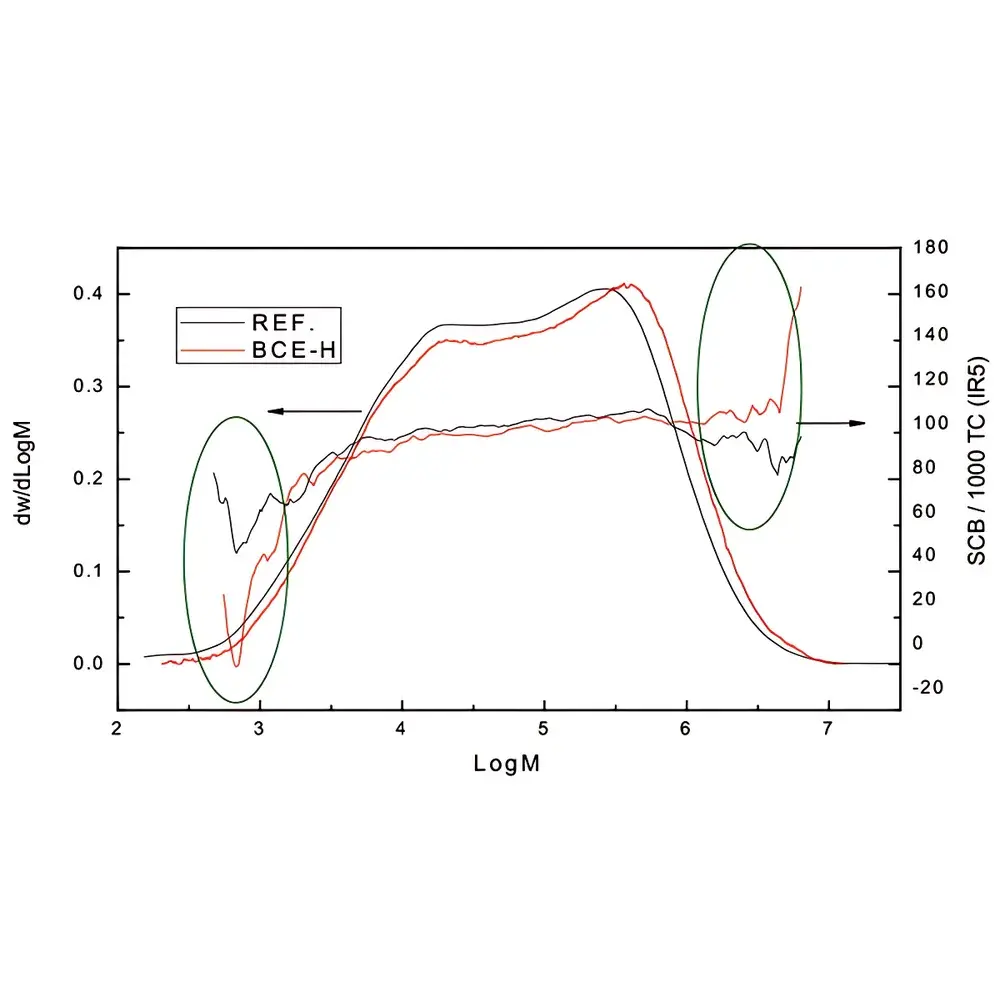
The Polymer Char GPC-IR5 is a high-temperature gel permeation chromatography (HT-GPC) system engineered for comprehensive microstructural characterization of polyolefins, including ultra-tough pipe and film grades. Unlike conventional GPC systems, the GPC-IR5 integrates a high-sensitivity, temperature-stabilized Fourier-transform infrared (FTIR) detector directly into the high-temperature separation flow path—enabling simultaneous, on-line measurement of molecular weight distribution (MWD) and chemical composition distribution (CCD), specifically short-chain branching (SCB) content and its distribution across molar mass fractions. This dual-detection architecture operates at temperatures up to 160 °C using stabilized trichlorobenzene (TCB) as the eluent, ensuring full dissolution and conformational stability of high-melting, long-chain branched polyolefins. The system is fundamentally designed for quantitative structure–property correlation studies, where mechanical toughness in advanced polyolefin applications is governed not only by average molecular weight but critically by the coupling between MWD and SCB heterogeneity.
Key Features
- Integrated high-temperature FTIR detection module with real-time spectral acquisition (4 cm⁻¹ resolution, 1000–800 cm⁻¹ range) optimized for CH₃/CH₂ band ratio quantification—directly correlating to ethyl/butyl branch density
- Triple-detector configuration: differential refractometer (DRI), low-angle laser light scattering (LALLS), and IR—enabling absolute molecular weight calibration without universal calibration assumptions
- Automated, solvent-resistant high-temperature autosampler (up to 120 samples) with inert gas purging and precise temperature control (±0.1 °C)
- Robust high-pressure, high-temperature separation module featuring polymer-stable columns (e.g., Agilent PLgel Mixed-B, 13 µm, 300 × 7.5 mm) rated to 200 bar and 160 °C
- Thermal management system with active column oven and pre-column heat exchangers to minimize thermal gradient-induced band broadening
- Fully compliant with ASTM D6474, ISO 16014-4, and ASTM D5296 for high-temperature GPC of polyolefins
Sample Compatibility & Compliance
The GPC-IR5 accommodates standard polyolefin samples—including HDPE, LLDPE, metallocene-catalyzed PE, and reactor-blend copolymers—with typical mass loading of 5–20 mg per injection. It supports analysis of both solution-processed and melt-processed grades, provided full dissolution is achieved in hot TCB (145–150 °C). The system meets regulatory requirements for quality-controlled environments: data integrity complies with FDA 21 CFR Part 11 via optional audit trail and electronic signature modules; raw spectral and chromatographic data are stored in vendor-neutral .csv and .spc formats. All hardware and software components conform to IEC 61000-6-3 (EMC) and IEC 61010-1 (safety) standards. Routine operation aligns with GLP/GMP documentation workflows, supporting traceable calibration logs, method versioning, and user access controls.
Software & Data Management
Polymer Char’s Cirrus+ software provides unified control, acquisition, and advanced microstructural deconvolution. It includes automated baseline correction, peak identification, and proprietary CCD calculation algorithms that compute branch frequency (branches/1000C) as a function of elution volume—mapped directly onto the MWD curve. Users can export calibrated Mw, Mn, PDI, and branching distribution histograms (BDH), as well as generate 2D contour plots (branching vs. molecular weight). Data export supports integration with third-party statistical packages (e.g., MATLAB, JMP) via ASCII or HDF5. All processing steps are fully scriptable and reproducible; method files embed instrument parameters, calibration history, and analyst metadata for full traceability.
Applications
- Correlating SCB distribution breadth with impact strength and slow-crack growth resistance in pressure pipe resins
- Differentiating reactor-grade LLDPE blends from post-reactor blends via branching heterogeneity signatures
- Monitoring catalyst performance shifts during pilot-scale polyolefin synthesis through real-time CCD tracking
- Supporting failure analysis of film delamination or tear propagation by identifying low-MW, high-branch fractions acting as weak-phase domains
- Validating computational models of chain dynamics (e.g., tube model predictions) with experimental branching–MW coupling data
FAQ
What types of polyolefin samples are compatible with the GPC-IR5?
Standard HDPE, LLDPE, and ethylene–α-olefin copolymers dissolved in trichlorobenzene at 145–150 °C; crosslinked or highly filled grades require prior solvent extraction or fractionation.
Does the system support absolute molecular weight determination?
Yes—via integrated LALLS detection, eliminating reliance on narrow-standard calibration curves and enabling direct measurement of Mw and radius of gyration (Rg).
Can branching data be correlated with mechanical test results?
Yes—Cirrus+ exports branch frequency vs. molecular weight matrices that integrate directly with tensile, Izod, or ESCR datasets for multivariate regression modeling.
Is method validation support available for regulated environments?
Polymer Char provides IQ/OQ documentation templates and assists with PQ protocols aligned with ISO/IEC 17025 and ASTM D6474 Annex A.
What maintenance intervals are recommended for the IR flow cell?
The sapphire-window IR flow cell requires quarterly inspection and cleaning with spectroscopic-grade TCB; no consumable replacement is needed under normal operation.




