
Polymer Char Microstructural Differentiation Analyzer for Polyolefin Films and Fish-Eye Defects
| Brand | Polymer Char |
|---|---|
| Origin | Spain |
| Model | Microstructural Differentiation Analyzer for Polyolefin Films and Fish-Eye Defects |
| Application Domain | Polyolefin Film Quality Control & Defect Root-Cause Analysis |
| Compliance Framework | ASTM D1238, ISO 1133, ISO 1628-1, ISO 15270, USP <1058> Analytical Instrument Qualification |
Overview
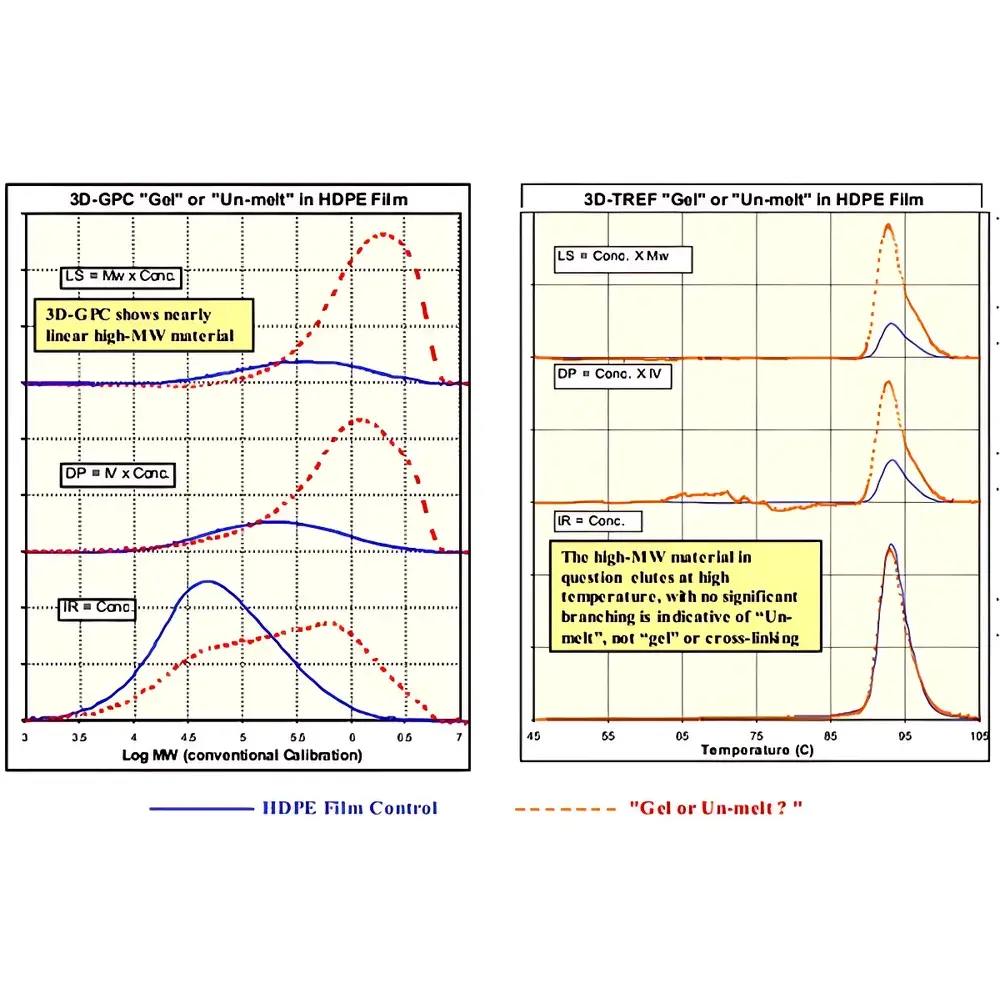
The Polymer Char Microstructural Differentiation Analyzer for Polyolefin Films and Fish-Eye Defects is a purpose-built analytical platform designed to resolve the root causes of fish-eye defects in polyolefin-based thin films—commonly observed during blown film extrusion, cast film production, or lamination processes. Unlike generic imaging or thermal analysis tools, this system integrates orthogonal characterization modalities—including high-resolution gel permeation chromatography (GPC/SEC), temperature-rising elution fractionation (TREF), crystallization analysis by differential scanning calorimetry (DSC), and micro-scale Fourier-transform infrared spectroscopy (μ-FTIR)—to deliver spatially resolved, chemically informed structural comparisons between bulk film matrix and isolated fish-eye inclusions. The analyzer operates on the principle that fish eyes arise from localized heterogeneities in molecular weight distribution (MWD), comonomer incorporation, crystallinity gradients, or residual catalyst fragments—each leaving distinct signatures across complementary analytical dimensions. By correlating these signatures quantitatively, the system enables traceable attribution of defect origin to upstream process variables (e.g., reactor fouling, additive segregation, or melt homogenization inefficiency).
Key Features
- Multi-modal correlative workflow: Synchronized acquisition of GPC-MWD, TREF compositional distribution, DSC-derived crystallinity profiles, and μ-FTIR chemical mapping on sub-100 µm fish-eye particles extracted via cryo-microtomy.
- Automated comparative analytics engine: Proprietary software aligns structural parameters (e.g., Mw/Mn, short-chain branching distribution, melting point dispersion) between film matrix and fish-eye regions using statistical process control (SPC)-based deviation thresholds.
- Trace-level contaminant screening: Integrated ICP-MS coupling option for elemental fingerprinting of catalyst residues (e.g., Ti, Zr, Mg) within fish-eye cores—critical for identifying metallocene or Ziegler–Natta catalyst deactivation pathways.
- GLP-compliant data architecture: Full audit trail generation per FDA 21 CFR Part 11 requirements, including electronic signatures, version-controlled method templates, and raw-data immutability locks.
- Sample preparation automation: Robotic cryo-sectioning module ensures reproducible 5–20 µm thick cross-sections from opaque or multilayer films without thermal distortion or mechanical smearing.
Sample Compatibility & Compliance
The analyzer accepts standard polyolefin film specimens (LDPE, LLDPE, HDPE, PP copolymers) in widths up to 300 mm and thicknesses from 12 µm to 250 µm. Fish-eye particles ≥20 µm in diameter are isolatable with >95% recovery efficiency using static electrostatic separation after solvent-assisted delamination. All analytical protocols adhere to internationally recognized standards: GPC calibration traceable to NIST SRM 1475a; DSC measurements compliant with ISO 11357-3 for crystallinity quantification; TREF fractionation validated per ASTM D6474 for ethylene–α-olefin copolymer composition distribution. System qualification follows USP guidelines for analytical instrument lifecycle management, supporting regulatory submissions under ICH Q5E and Q6B frameworks.
Software & Data Management
Polymer Char’s PolySep Suite v5.2 provides integrated data fusion across all modules. The software employs multivariate statistical analysis (PCA and PLS-DA) to identify latent correlations between fish-eye morphology (from optical microscopy), branching density (from FTIR peak ratios at 720 cm−1/730 cm−1), and lamellar thickness distribution (from SAXS-derived long period histograms). All reports export in PDF/A-1b format with embedded metadata (sample ID, operator, instrument serial number, environmental conditions). Raw chromatograms, thermograms, and spectral files are stored in vendor-neutral HDF5 containers, enabling third-party reprocessing via open-source libraries (e.g., SciPy, PyMca). Audit trails include timestamped records of parameter edits, calibration events, and user access logs—fully exportable for internal QA review or external regulatory inspection.
Applications
- Root-cause diagnosis of extrusion-related fish eyes in food packaging films—distinguishing between low-MW polymer bleed versus crosslinked gel formation.
- Validation of catalyst batch consistency by correlating fish-eye frequency with residual Ti content and MWD breadth in pilot-scale reactor samples.
- Assessment of additive migration effects: Quantifying antioxidant or slip agent enrichment at fish-eye interfaces via μ-FTIR line scans.
- Supporting technical service for film converters: Generating comparative reports for customer-facing failure analysis (FA) documentation compliant with ISO/IEC 17025 requirements.
- Accelerating formulation development: Screening new metallocene catalyst systems for reduced heterogeneity-induced defect propensity using accelerated aging + fish-eye enumeration protocols.
FAQ
What sample quantity is required for statistically robust fish-eye characterization?
A minimum of three representative film sections (each 5 × 5 cm) is recommended; fish-eye particles are pooled across sections to ensure ≥50 analyzable inclusions per batch.
Can the system differentiate between fish eyes caused by polymer degradation versus contamination?
Yes—via combined evidence: elevated carbonyl index (FTIR), bimodal MWD shifts (GPC), and absence of foreign elemental signals (ICP-MS) indicate thermal degradation; while discrete elemental spikes without MWD perturbation suggest particulate contamination.
Is method transfer supported for laboratories operating multiple Polymer Char platforms?
All methods are stored as portable XML packages with embedded calibration constants and instrument configuration snapshots—enabling seamless deployment across identical hardware configurations.
Does the system support IQ/OQ/PQ documentation packages for regulated environments?
Yes—validated installation qualification (IQ), operational qualification (OQ), and performance qualification (PQ) protocols are supplied with full test scripts, acceptance criteria, and blank execution worksheets compliant with Annex 15 and ASTM E2500.





