
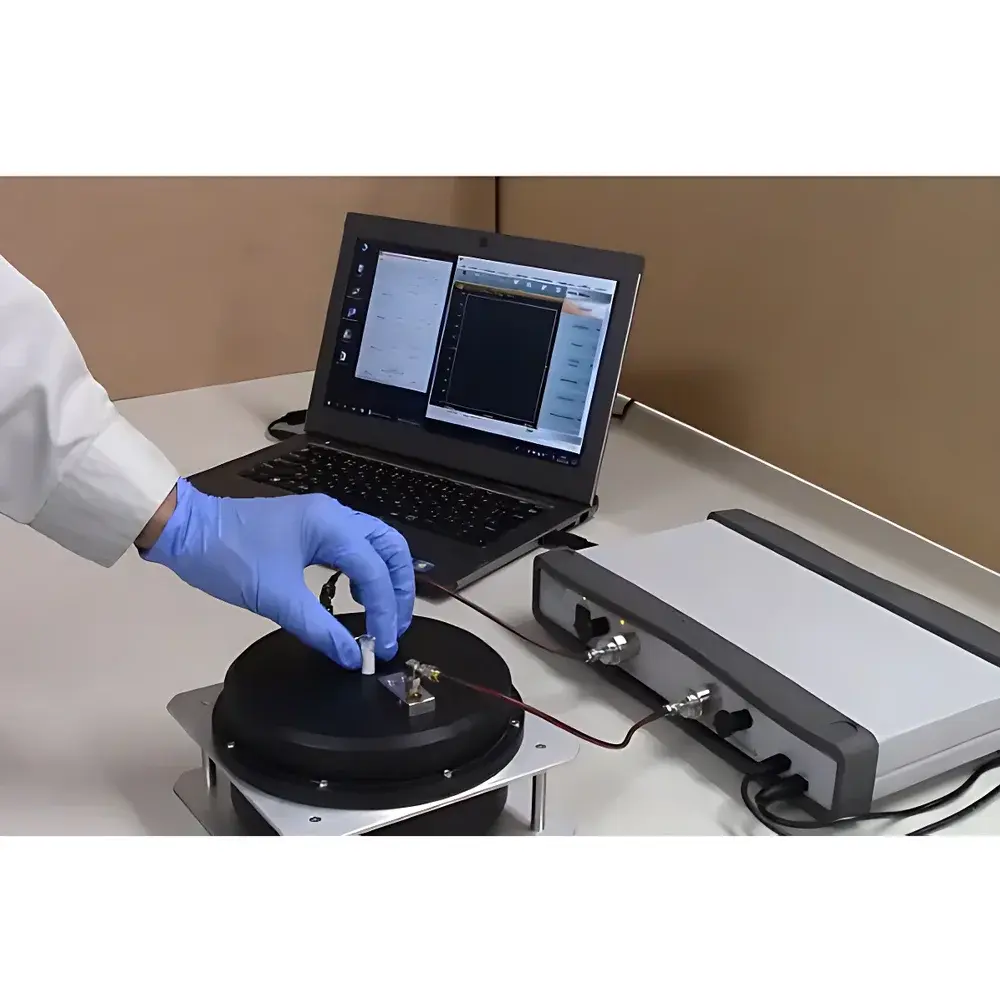
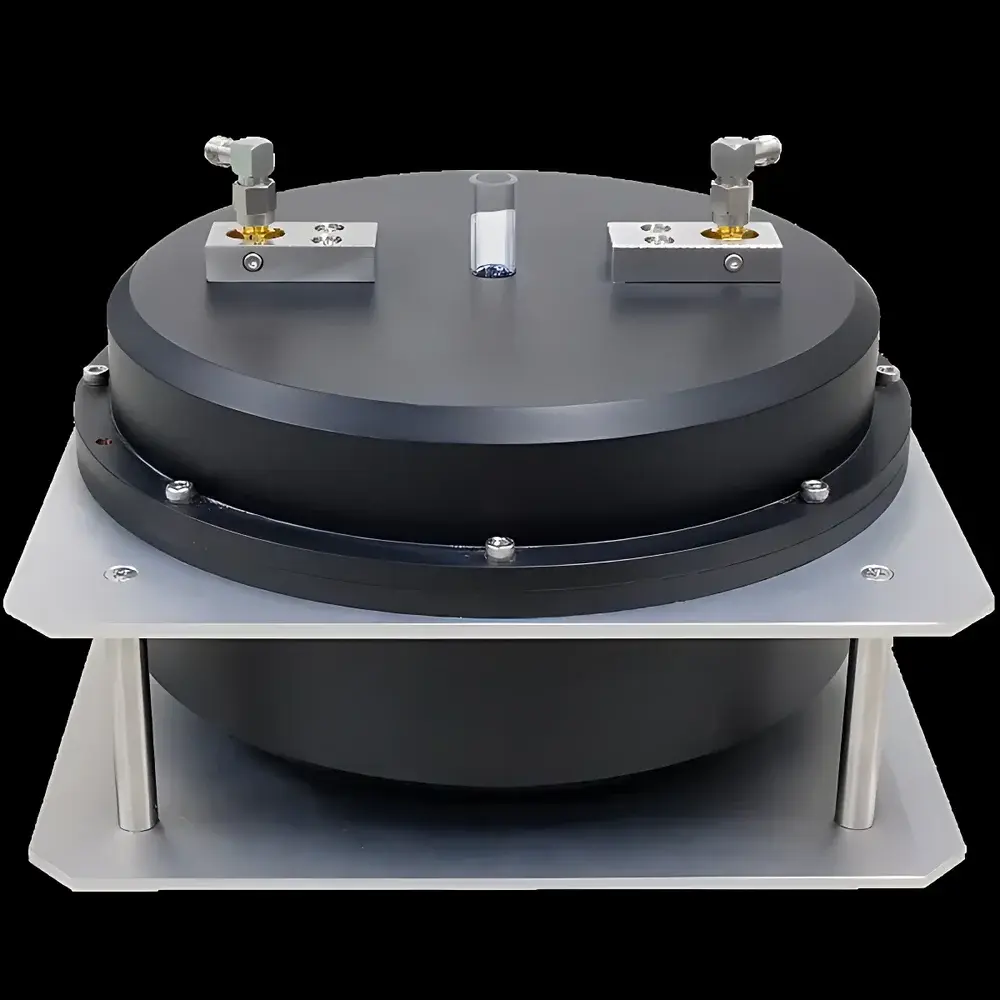
AET Liquid Resonant Cavity Dielectric Constant Analyzer
| Brand | AET |
|---|---|
| Origin | Japan |
| Model | Liquid Resonant Cavity System |
| Frequency Range | 1–10 GHz |
| Permittivity Range | 1–6 |
| Permittivity Accuracy | ±1% |
| Loss Tangent Range | 0.001–0.01 |
| Loss Tangent Accuracy | ±5% |
| Minimum Sample Diameter | >5.5 mm |
Overview
The AET Liquid Resonant Cavity Dielectric Constant Analyzer is a precision microwave characterization instrument engineered for high-frequency dielectric property measurement of liquid-phase materials. It operates on the principle of cavity perturbation theory within a rigorously calibrated resonant waveguide cavity, where the shift in resonant frequency and quality factor (Q) upon sample insertion is used to extract complex permittivity (ε* = ε′ − jε″) at frequencies from 1 GHz to 10 GHz. This method delivers superior sensitivity and reproducibility for low-loss, low-permittivity liquids—particularly non-polar solvents such as hydrocarbons, fluorinated fluids, and silicone oils—where conventional open-ended coaxial or parallel-plate techniques suffer from signal-to-noise limitations and fringing field errors. The system is designed for laboratory-based R&D and QC environments requiring traceable, standards-aligned measurements under controlled temperature and humidity conditions.
Key Features
- High-Q TE011 cylindrical resonant cavity optimized for liquid sample interrogation in the S- to X-band range (1–10 GHz)
- Dedicated low-vibration mechanical stage with micrometer-adjustable sample positioning to minimize cavity mode distortion
- Integrated vector network analyzer (VNA)-based excitation and detection architecture with phase-stable RF coupling
- Automated resonance tracking algorithm that compensates for thermal drift and cavity tuning hysteresis
- Minimal sample volume requirement: cylindrical liquid specimens ≥5.5 mm in diameter and sufficient height to fill the cavity’s electric field maximum region
- Factory-calibrated using NIST-traceable reference liquids (e.g., deionized water, methanol, cyclohexane) across the full frequency band
Sample Compatibility & Compliance
The analyzer accommodates homogeneous, non-conductive liquid samples—including organic solvents, polymer precursors, ionic liquid dilutions, and low-conductivity electrolyte solutions—provided they are free of suspended particulates or bubbles that could perturb field distribution. It is not intended for conductive, corrosive, or volatile samples without appropriate containment and vapor management. The measurement methodology complies with IEEE Std 1711-2018 (Recommended Practice for Microwave Dielectric Measurements) and aligns with ASTM D5564 (Standard Test Method for Determining the Dielectric Properties of Liquid Dielectrics by Resonance Techniques). Full audit trails, user access control, and electronic signature support are available to meet GLP and FDA 21 CFR Part 11 requirements when integrated with optional compliant software modules.
Software & Data Management
The system is operated via AET’s proprietary DielecSoft v4.x platform, a Windows-based application supporting real-time resonance curve acquisition, automatic peak fitting (Lorentzian/Gaussian convolution), and simultaneous ε′ and tan δ calculation with uncertainty propagation. Raw S-parameter data (S11, S21) are exportable in Touchstone (.s1p/.s2p) and CSV formats. Batch processing enables comparative analysis across multiple samples or temperature points. Data integrity safeguards include time-stamped measurement logs, operator ID tagging, and encrypted database storage. Optional integration with LIMS systems is supported through OPC UA and RESTful API interfaces.
Applications
- Development and qualification of low-loss substrate materials for high-speed digital interconnects and millimeter-wave PCB laminates (e.g., PTFE composites, cyanate ester resins)
- Characterization of dielectric ceramics and thin-film coatings for RF filters, antenna substrates, and 5G/6G front-end modules
- Quantitative structure–property relationship (QSPR) studies of solvent polarity in pharmaceutical formulation screening
- Quality control of precursor liquids used in spin-coating, inkjet printing, or atomic layer deposition of functional oxides and perovskites
- Dielectric spectroscopy of nanofluids and colloidal dispersions to assess particle–solvent interface polarization effects
- Validation of electromagnetic simulation models (e.g., CST, HFSS) with experimentally derived material parameters
FAQ
What sample preparation is required for liquid measurements?
Liquid samples must be degassed and loaded into a precision-machined quartz or fused silica cylindrical cell with inner diameter ≥5.5 mm. The cell is sealed and inserted coaxially into the cavity’s E-field maximum zone.
Can the system measure temperature-dependent permittivity?
Yes—when paired with an optional programmable temperature-controlled sample holder (-20 °C to +120 °C), enabling Arrhenius or Vogel–Fulcher–Tammann analysis of relaxation dynamics.
Is calibration transferable between instruments?
No—each resonant cavity exhibits unique electromagnetic boundary conditions; factory calibration is instrument-specific and requires annual verification using certified reference liquids.
Does the system support powder measurements?
Not natively. While the cavity geometry is optimized for liquids, powdered samples require compaction into solid pellets and use of alternative fixtures (e.g., split-cylinder or coaxial line methods), which fall outside this model’s validated scope.
How is measurement uncertainty quantified?
Total uncertainty is calculated per GUM (JCGM 100:2008) guidelines, incorporating contributions from resonance frequency resolution (±10 kHz), Q-factor estimation error, cavity dimension tolerances, and reference liquid property uncertainties—resulting in ±1% for ε′ and ±5% for tan δ at 95% confidence.



