
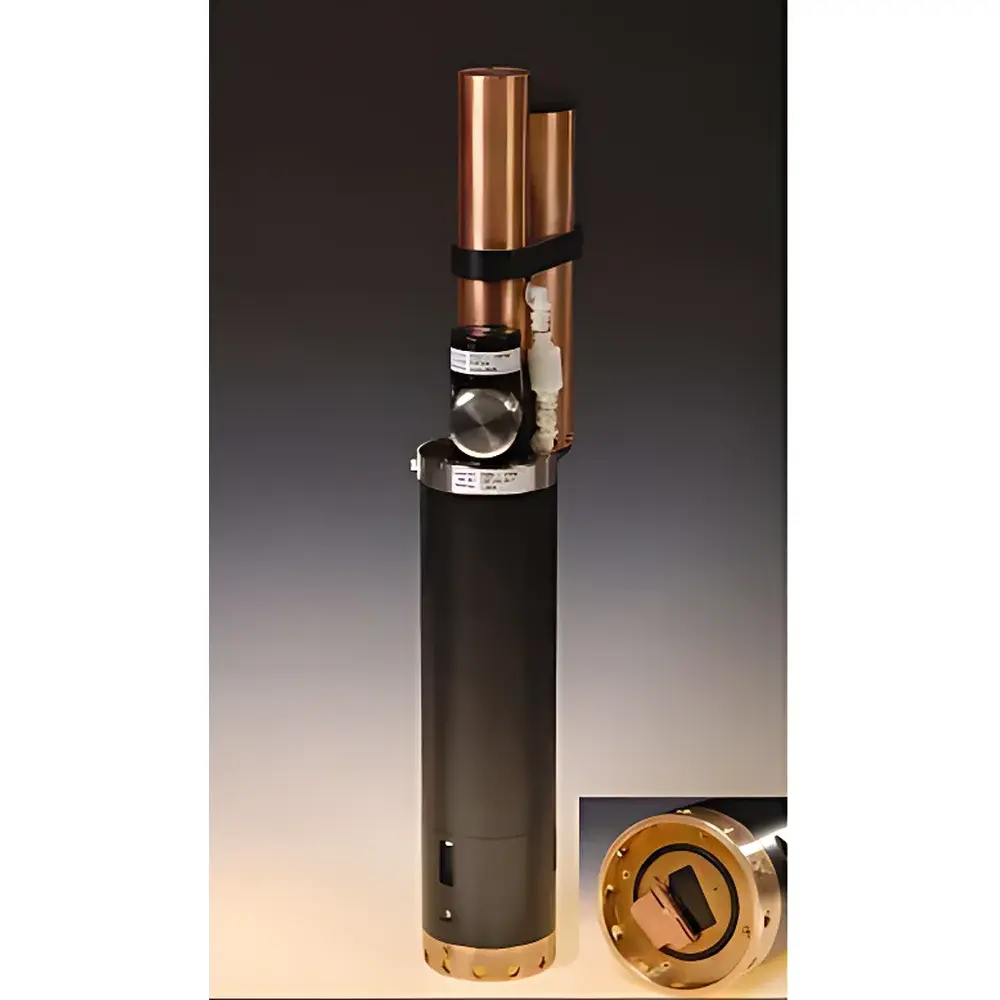
Sea-Bird Scientific WQM Multi-Parameter Water Quality Monitor – Long-Term Maintenance-Free Operation
| Brand | Sea-Bird Scientific |
|---|---|
| Origin | USA |
| Model | WQM |
| Instrument Type | Online Water Quality Analyzer |
| Measured Parameters | CTD (Conductivity, Temperature, Depth), Dissolved Oxygen (DO), Fluorescence (Chlorophyll-a), Turbidity (FLNTU) |
| Optional Parameters | CDOM, PAR, Phycocyanin, Phycoerythrin, pH |
| Conductivity Range | 0–9 S/m |
| Conductivity Accuracy | ±0.003 mS/cm |
| Conductivity Resolution | 0.0005 S/m |
| Temperature Range | −5 to 35 °C |
| Temperature Accuracy | ±0.002 °C |
| Temperature Resolution | 0.001 °C |
| Depth Range | 0–100 m or 0–200 m |
| Depth Accuracy | ±0.1% FS |
| DO Range | 0–120% saturation |
| DO Accuracy | ±2% saturation |
| DO Resolution | ±0.035% saturation |
| Chlorophyll Fluorescence Range | 0–30 µg/L |
| Fluorescence Accuracy | ±0.2% FS |
| Excitation/Emission | 470/695 nm |
| Turbidity Range | 0–25 NTU |
| Turbidity Accuracy | ±0.1 FS NTU |
| Detection Wavelength | 700 nm |
| Biofouling Mitigation | Pump-controlled flow, Copper anti-fouling panel, Light-shielded sample chamber, Rotating copper brush for optical surface cleaning, EPA-certified conductive cell anti-fouling ring, Bleach Injection System (BLIS) for DO and CTD channel protection |
Overview
The Sea-Bird Scientific WQM Multi-Parameter Water Quality Monitor is an integrated, submersible online sensor platform engineered for unattended, long-term (up to 6 months) deployment in coastal and estuarine environments. It combines proven sensor technologies from WET Labs and Sea-Bird Scientific into a single robust housing, delivering synchronized, high-fidelity measurements of core biogeochemical parameters critical to ecosystem health assessment and regulatory monitoring. The WQM operates on the principle of multi-sensor fusion: conductivity, temperature, and pressure (CTD) are measured using calibrated thermistor-based circuits and quartz crystal oscillators; dissolved oxygen is quantified via optical luminescence quenching (optode); chlorophyll-a fluorescence is excited at 470 nm and detected at 695 nm; turbidity is determined via 700 nm near-infrared backscatter. All measurements are time-stamped, temperature-compensated, and internally validated against factory calibration coefficients stored in non-volatile memory.
Key Features
- Integrated CTD + DO + FLNTU sensing architecture with co-located optical and electrochemical measurement zones for spatially consistent data acquisition
- EPA-certified anti-fouling system including copper alloy panels, rotating copper brushes, light-shielded flow cells, and the Bleach Injection System (BLIS) for sustained sensor integrity in high-biofouling conditions
- High-resolution analog-to-digital conversion (24-bit) with real-time internal diagnostics and sensor health flagging
- Modular design supporting field-swappable sensor cartridges—CTD, DO, and FLNTU modules can be serviced independently without full unit recovery
- Low-power consumption (≤1.2 W in continuous mode) enabling extended operation on battery or solar-hybrid platforms
- RS-232/RS-485 and SDI-12 digital interfaces compatible with industry-standard dataloggers (e.g., Campbell Scientific CR1000X, Onset HOBO) and telemetry systems
Sample Compatibility & Compliance
The WQM is validated for use in seawater, brackish water, and freshwater systems across salinity ranges from 0 to 42 PSU. Its pressure housing (rated to 200 m depth) meets IP68 ingress protection standards and complies with ASTM D5173 (Standard Guide for In Situ Monitoring of Aquatic Environments) and ISO 10523 (Water Quality — Determination of pH). Sensor calibrations adhere to NIST-traceable protocols, and the BLIS delivery mechanism satisfies U.S. EPA Method 365.3 requirements for reagent-based sensor maintenance. The instrument’s firmware supports audit-trail logging per GLP/GMP guidelines, with timestamped calibration events, diagnostic logs, and configuration changes stored onboard for regulatory review.
Software & Data Management
Data output is delivered as ASCII-formatted serial packets or binary Seabird .cnv files, fully compatible with Sea-Bird’s SBE Data Processing software suite and third-party tools including MATLAB, Python (via seabirdpy), and QGIS for georeferenced time-series visualization. The WQM supports user-defined sampling intervals (1 sec to 24 hr), burst-mode profiling, and conditional triggering (e.g., initiate high-frequency sampling upon detecting DO 1 TB local archiving. All firmware updates are performed over serial interface with cryptographic signature verification to ensure integrity and traceability.
Applications
- Long-term coastal observatory networks (e.g., IOOS, EuroGOOS) requiring stable, low-maintenance CTD-DO-FLNTU baselines
- Harmful algal bloom (HAB) early-warning systems leveraging real-time chlorophyll fluorescence and turbidity correlation
- Estuarine nutrient loading studies integrating DO dynamics with salinity-driven stratification metrics
- Aquaculture site monitoring where dissolved oxygen thresholds and phytoplankton biomass directly impact stock health
- Regulatory compliance reporting under Clean Water Act Section 303(d) and EU Water Framework Directive (WFD) Annex V parameter sets
- Climate-driven hypoxia research linking temperature-salinity-oxygen relationships across seasonal cycles
FAQ
What is the recommended calibration interval for the WQM in long-term deployments?
Calibration is recommended annually for CTD and DO modules when operated within specification; FLNTU sensors require optical verification every 3–6 months depending on biofouling exposure. Factory calibration certificates include stability drift estimates for each parameter.
Can the WQM operate autonomously on solar power?
Yes—the instrument’s average current draw is 100 mA at 12 VDC, making it compatible with standard marine solar-charged battery banks (e.g., 50 Ah LiFePO₄ with 40 W panel). Duty cycling and sleep-mode optimization extend field life beyond 6 months.
Is the BLIS system compatible with all deployment housings?
The Bleach Injection System is integrated into the WQM’s standard pressure housing and requires no external reservoirs. Sodium hypochlorite concentration is precisely metered at 500 ppm per injection event, with programmable frequency (default: hourly) and duration (10–60 sec).
How does the WQM handle data synchronization across asynchronous sensors?
All sensors share a common internal clock synchronized to GPS time (if external PPS signal is provided) or via NTP over Ethernet. Timestamp jitter is ≤10 ms across all channels, ensuring valid cross-parameter correlation for derivative calculations (e.g., oxygen saturation deficit vs. temperature).







