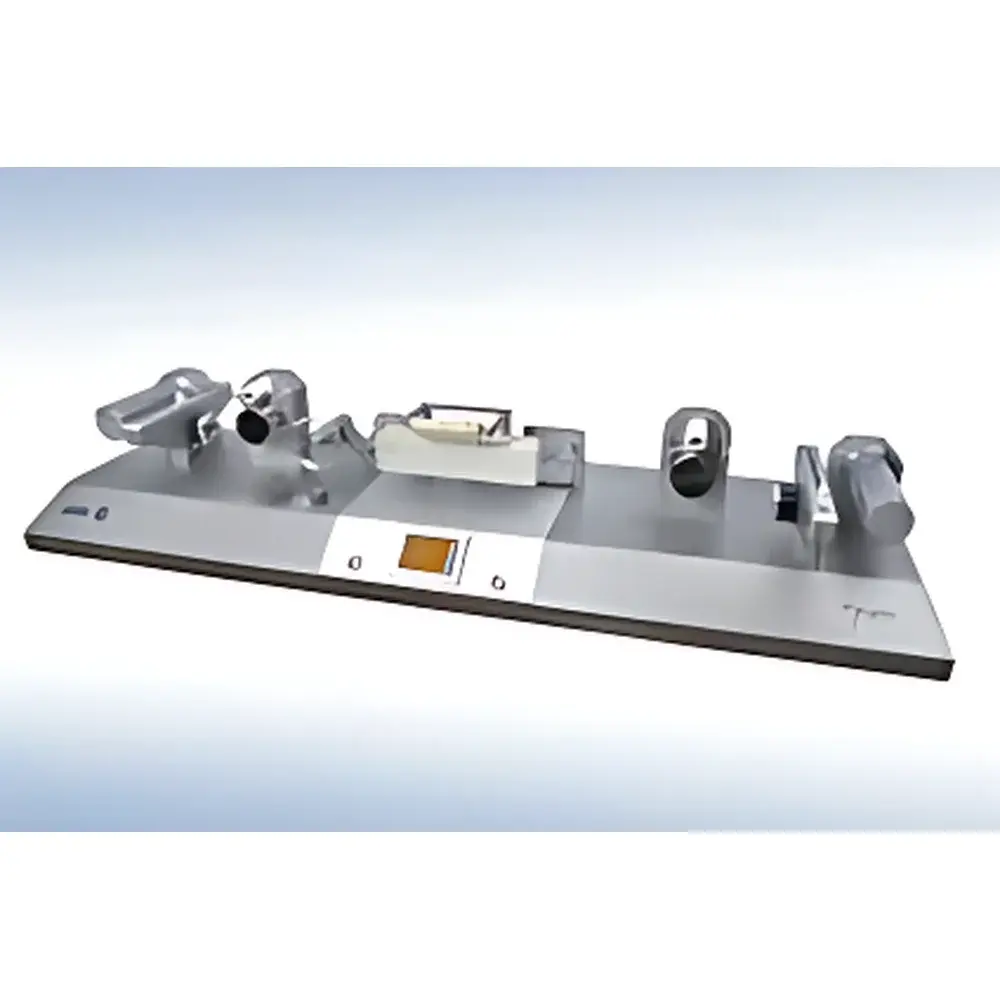
Xplore Fiber Spin Device (FSD) – Miniature Melt Spinning Line
| Brand | Xplore Instruments (Netherlands) |
|---|---|
| Origin | Netherlands |
| Model | FSD |
| Dimensions (Spinning Unit) | 670 × 495 × 450 mm |
| Weight (Spinning Unit) | ~35 kg |
| Bobbin Drum Diameter | 75 mm |
| Winding Width | 10–160 mm (1 mm increments) |
| Winding Speed | up to 200 m/min |
| Traverse Pitch | 0.1–4 mm (0.1 mm increments) |
| Spinneret Orifice Diameter | 0.25–1.5 mm (0.25 mm increments) |
| Control System | Integrated touchscreen GUI |
| Power Supply | 220–240 V AC |
| Dimensions (Drawing Unit) | 1725 × 495 × 450 mm |
| Weight (Drawing Unit) | ~75 kg |
| Drawing Speed | 0.5–90 m/min (0.1 m/min increments) |
| Bobbin Torque Range | −10 to +10 N·m (0.05 N·m resolution) |
| Draw Ratio | Adjustable up to 1:10 |
| Heating Zone Temperature | Up to 300 °C (1 °C resolution) |
| Heating Zone Length | 300 mm |
| Heater Type | Radiant tube heater or conductive metal pin/column heater |
Overview
The Xplore Fiber Spin Device (FSD) is a benchtop-scale melt spinning line engineered for precise, reproducible fabrication of synthetic polymer filaments from gram-scale feedstock. Designed in close integration with the Xplore Micro Compounder (MC), the FSD enables end-to-end thermoplastic fiber development — from compounding and extrusion to controlled drawing, thermal conditioning, and continuous winding — within a single laboratory footprint. Its core operational principle relies on melt extrusion through precision-machined spinnerets, followed by controlled solidification, tensioned drawing, and geometrically defined winding. Unlike conventional pilot-scale spinning lines requiring kilograms of material and dedicated utility infrastructure, the FSD operates at sub-gram per minute throughput levels, making it ideal for rapid formulation screening, high-value additive evaluation (e.g., nanofillers, bioactive agents), and early-stage process parameter mapping under GLP-aligned experimental conditions.
Key Features
- Modular two-unit architecture: independent spinning unit (up to 200 m/min winding) and drawing unit (0.5–90 m/min, adjustable draw ratio up to 1:10), each equipped with integrated touchscreen controllers featuring real-time PID-regulated temperature and speed profiles.
- Precision traverse mechanism with programmable lateral pitch (0.1–4 mm, 0.1 mm resolution) enabling reproducible helical winding patterns, uniform layer deposition, and systematic study of fiber packing density effects.
- Thermally isolated heating zone (300 mm length, max 300 °C, ±0.5 °C stability) offering dual heating modalities: radiant tube heating for uniform bulk filament conditioning, and conductive metal pin/column heating for localized thermal management during necking and strain hardening.
- No external metering pump required: fiber diameter consistency is maintained via synchronized screw speed control in the upstream micro-compounder, eliminating flow pulsation and reducing system complexity.
- “Soft-start” protocol for controlled draw initiation: initial meters of filament are wound into a designated waste zone until steady-state elongational flow is established, minimizing breakage during transition from spinline to drawing zone.
- Interchangeable spinneret plates with standardized orifice diameters (0.25–1.5 mm, 0.25 mm increments) supporting mono-filament, multi-filament, and bicomponent configurations; optional 90° horizontal die adapters for enhanced flow alignment and reduced die swell.
Sample Compatibility & Compliance
The FSD accommodates thermoplastic polymers including but not limited to polypropylene (PP), polyethylene (PE), polyethylene terephthalate (PET), polyamide 6 (PA6), polylactic acid (PLA), and thermoplastic polyurethane (TPU). It supports formulations containing heat-labile additives, nanoparticles, and functional masterbatches — provided thermal degradation onset exceeds 300 °C under inert atmosphere. The system meets CE marking requirements for electrical safety (EN 61000-6-3, EN 61000-6-4) and mechanical design (EN ISO 12100). All controller logs — including temperature setpoints, speed ramps, torque feedback, and alarm events — are timestamped and exportable in CSV format, supporting traceability under ISO/IEC 17025 and FDA 21 CFR Part 11-compliant data integrity frameworks when paired with validated LIMS integration.
Software & Data Management
Each unit features an embedded industrial-grade touchscreen HMI running a deterministic real-time OS. The interface provides simultaneous visualization of up to six process variables (e.g., die temperature, draw roller RPM, bobbin torque, traverse position, heater power, and ambient humidity). All setpoints and profiles are stored as versioned project files with user-defined metadata (e.g., polymer grade, additive concentration, batch ID). Data logging occurs at 10 Hz minimum, with internal non-volatile memory retaining ≥72 hours of continuous operation history. Export options include USB-stick transfer and Ethernet-based OPC UA server connectivity for integration into enterprise MES or statistical process control (SPC) platforms. Audit trails record operator login/logout, parameter changes, and emergency stops — fully compliant with ALCOA+ principles for analytical instrument qualification (AIQ).
Applications
- Rapid prototyping of specialty fibers for filtration membranes, medical sutures, and technical textiles where raw material cost or scarcity limits large-batch trials.
- Correlation studies between melt rheology (measured via Xplore Micro Rheometer), spinline dynamics, and final fiber morphology (crystallinity, orientation, tensile modulus).
- Development of stimuli-responsive fibers (e.g., shape-memory polymers, thermochromic composites) requiring precise thermal history control during solidification and drawing.
- Validation of computational models for extensional viscosity, neck propagation, and crystallization kinetics under uniaxial deformation.
- Training platform for polymer processing fundamentals in academic laboratories — demonstrating coupling between extrusion, quenching, drawing, and winding without hazardous high-pressure or high-volume systems.
FAQ
Can the FSD be used with reactive polymers or moisture-sensitive resins?
Yes — the system is compatible with nitrogen-purged environments via optional gas inlet ports on both the extruder die head and drawing zone enclosure. Resin drying must be performed externally prior to feeding.
Is fiber diameter measurement integrated into the system?
No — inline diameter monitoring is not included, but the FSD’s dimensional repeatability (±2% CV under controlled conditions) allows post-process characterization via laser micrometry or SEM cross-section analysis.
What maintenance intervals are recommended for the traverse mechanism and heating elements?
Lubrication of linear guides every 500 operating hours; thermal sensor calibration annually or after 200 thermal cycles above 250 °C.
Does Xplore provide application support for method development?
Yes — qualified applications engineers offer remote and on-site support packages covering polymer selection, temperature profiling, draw ratio optimization, and failure mode analysis.
Can the drawing unit operate independently of the spinning unit?
Yes — the drawing unit accepts pre-formed filaments (e.g., from capillary rheometers or commercial spools) using its dual-roller tensioning configuration, enabling standalone hot-drawing or annealing studies.
Related Products