
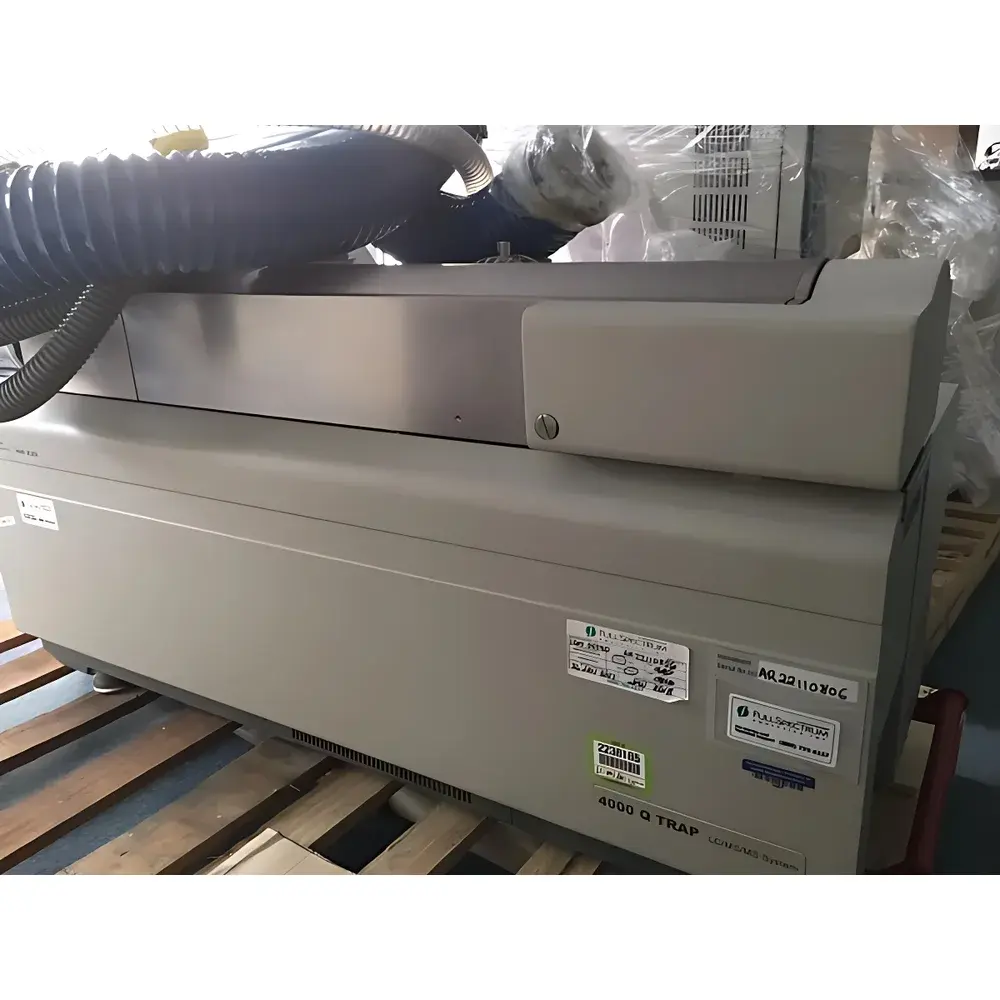
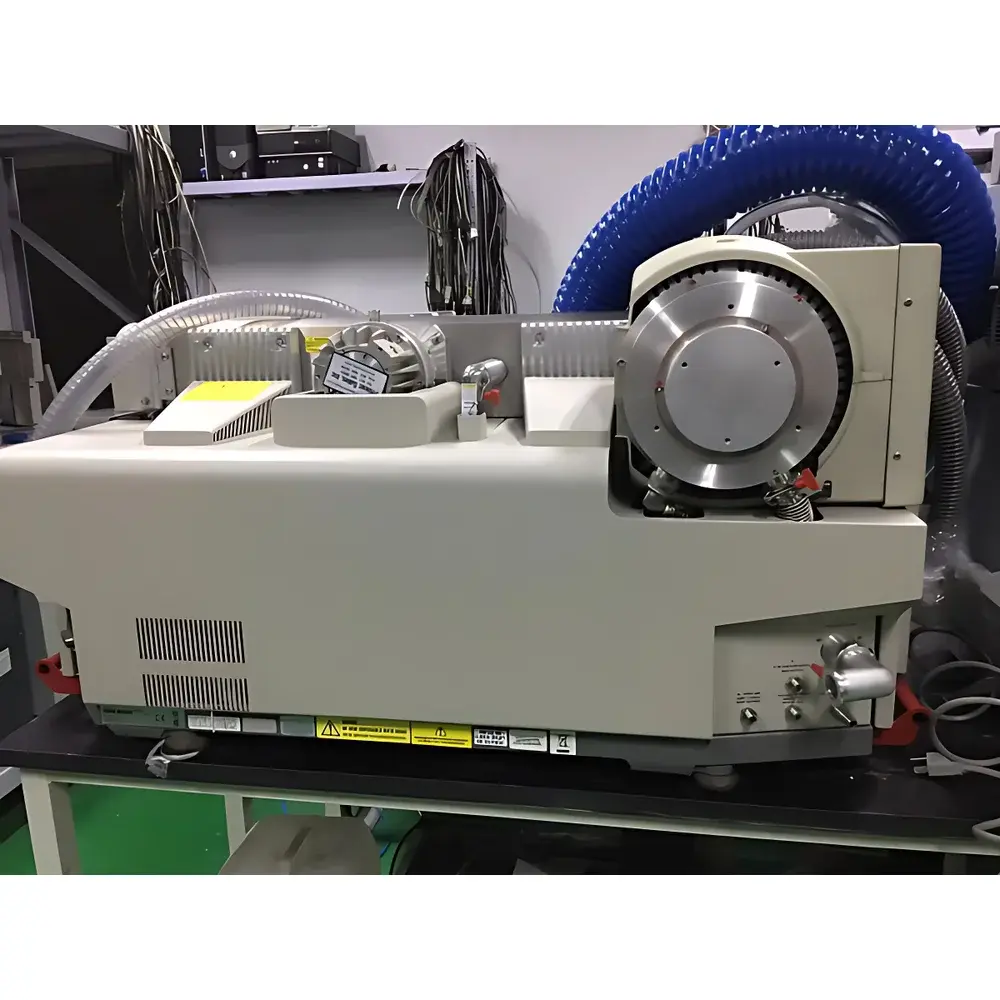
SCIEX AB-4000 Triple Quadrupole Liquid Chromatography Tandem Mass Spectrometer (LC-MS/MS)
| Brand | SCIEX |
|---|---|
| Origin | USA |
| Model | AB-4000 |
| Instrument Type | Triple Quadrupole (QqQ) |
| Mass Range | 5–2,000 m/z |
| Sensitivity | <10 fg on-column for reserpine (ESI+, 400 µL/min) |
| Resolution | Unit mass resolution (±0.13 u at full width at half maximum) |
| Accurate Mass Capability | ±0.13 u (calibrated, external standard) |
| Ionization Sources | Turbo V™ ESI/APCI dual-mode source with rapid switchable probe |
| Collision Cell | Linear Accelerator (LINAC™) collision cell |
| Detector | Digital Pulse Detection System with >5-decade dynamic range |
| Software | Analyst® 1.7.2 or later (21 CFR Part 11 compliant) |
Overview
The SCIEX AB-4000 Triple Quadrupole LC-MS/MS system is a purpose-built, high-performance tandem mass spectrometer engineered for quantitative and qualitative analysis in regulated and research-intensive laboratories. Operating on the principle of electrospray ionization (ESI) and atmospheric pressure chemical ionization (APCI), coupled with triple quadrupole mass filtering and fragmentation, the AB-4000 delivers robust, reproducible detection and quantification of small molecules across complex biological, environmental, and pharmaceutical matrices. Its architecture integrates a Turbo V™ ion source, LINAC™ collision cell, and digital pulse detection technology—each contributing to superior signal-to-noise ratios, minimized matrix effects, and sustained operational uptime. Designed for compliance-critical environments, the system meets foundational performance requirements for GLP, GMP, and clinical laboratory workflows—including method validation, bioanalysis, impurity profiling, and residue monitoring per ISO/IEC 17025, USP , and FDA Bioanalytical Method Validation Guidance.
Key Features
- Turbo V™ ion source with dual ESI/APCI capability and automated probe switching—enabling seamless transition between ionization modes without hardware reconfiguration
- Ceramic-based, self-cleaning interface with curtain gas technology—reducing ion source contamination and extending maintenance intervals
- LINAC™ linear accelerator collision cell—ensuring high ion transmission efficiency during MRM, precursor ion, neutral loss, and product ion scans, even at sub-50 ms dwell times
- Digital pulse detection system—providing stable response over five orders of magnitude with low drift and high day-to-day reproducibility (RSD <8% for intra-day, <12% for inter-day precision)
- Optimized gas dynamics and dual auxiliary heating—supporting LC flow rates from 50 µL/min to 3 mL/min without sensitivity loss
- Modular vacuum system with turbomolecular pumps—ensuring rapid pump-down and stable high-vacuum operation under continuous high-throughput conditions
Sample Compatibility & Compliance
The AB-4000 accommodates a broad spectrum of sample types, including plasma, serum, urine, tissue homogenates, plant extracts, water, soil digests, and food matrices. It supports both reversed-phase and HILIC chromatographic separations and interfaces natively with UHPLC systems (e.g., Shimadzu Nexera, Waters ACQUITY, Thermo Vanquish). Regulatory alignment includes full support for 21 CFR Part 11 requirements via Analyst® software—featuring role-based access control, electronic signatures, immutable audit trails, and secure data archiving. The system satisfies analytical validation criteria outlined in ICH M10, FDA BMV Guidance, and EMA Guideline on Bioanalytical Method Validation. Routine operation adheres to ISO/IEC 17025:2017 clause 7.2.2 (method validation) and clause 7.7 (uncertainty estimation), particularly for low-level quantitation (LOQ ≤ 1 pg/mL in biological fluids).
Software & Data Management
Analyst® software serves as the unified platform for instrument control, data acquisition, processing, and reporting. Its architecture supports centralized deployment across networked lab environments, enabling remote method deployment, batch queue management, and LIMS integration via ODBC and XML-based APIs. Key modules include AutoQuant™ for automated MRM optimization, Intelligent Peak Integration™ (parameter-free peak detection), and Audit Trail Manager™—which logs all user actions, parameter changes, and data modifications with timestamps and operator IDs. All raw data files (.wiff) are stored with embedded metadata (instrument configuration, calibration history, sequence logs), ensuring full traceability from acquisition to final report generation. Backups comply with NIST SP 800-88 Rev. 1 sanitization standards; archived datasets retain integrity for ≥15 years under controlled storage conditions.
Applications
The AB-4000 is extensively deployed in pharmaceutical development (PK/PD studies, metabolite identification, stability-indicating assays), clinical toxicology (therapeutic drug monitoring, overdose screening), food safety (pesticide multi-residue analysis, veterinary drug confirmation), and environmental testing (PFAS, endocrine disruptors, pharmaceutical pollutants in wastewater). Its high specificity in MRM mode enables reliable quantitation of analytes at sub-pg/mL levels in 96-well plate formats—supporting throughput of >200 samples/day with <2-min run times. For discovery workflows, its fast polarity-switching capability and scheduled MRM allow simultaneous quantitation and structural characterization within a single injection. Method transfer from legacy SCIEX platforms (e.g., API 3000, API 4000) is fully supported via backward-compatible .qdb and .mrm file import.
FAQ
Is the AB-4000 compatible with modern UHPLC systems?
Yes—the system features low-dead-volume interfaces and real-time pressure compensation algorithms, supporting gradients up to 1,500 bar and flow rates from 10 µL/min to 3 mL/min.
What calibration standards are required for routine operation?
A two-point external calibration using polypropylene glycol (PPG) or reserpine solution is recommended daily; mass axis calibration is verified weekly using tuning compound mixtures (e.g., APCI Tune Mix).
Does the system support retrospective data reprocessing?
Yes—Analyst® retains all raw spectral data and acquisition parameters, allowing full reintegration, recalibration, and re-quantitation without re-injection.
Can the AB-4000 be upgraded to support higher-resolution detection?
No—the AB-4000 is a fixed-resolution triple quadrupole platform; enhanced mass accuracy requires migration to QTOF or Orbitrap-based systems (e.g., SCIEX X500B or ZenoTOF 7600).
What documentation is provided with refurbished units?
Each unit ships with full service history, post-refurbishment IQ/OQ reports, instrument qualification summary, and updated firmware/software installation media compliant with current SCIEX release policies.
Related Products





