
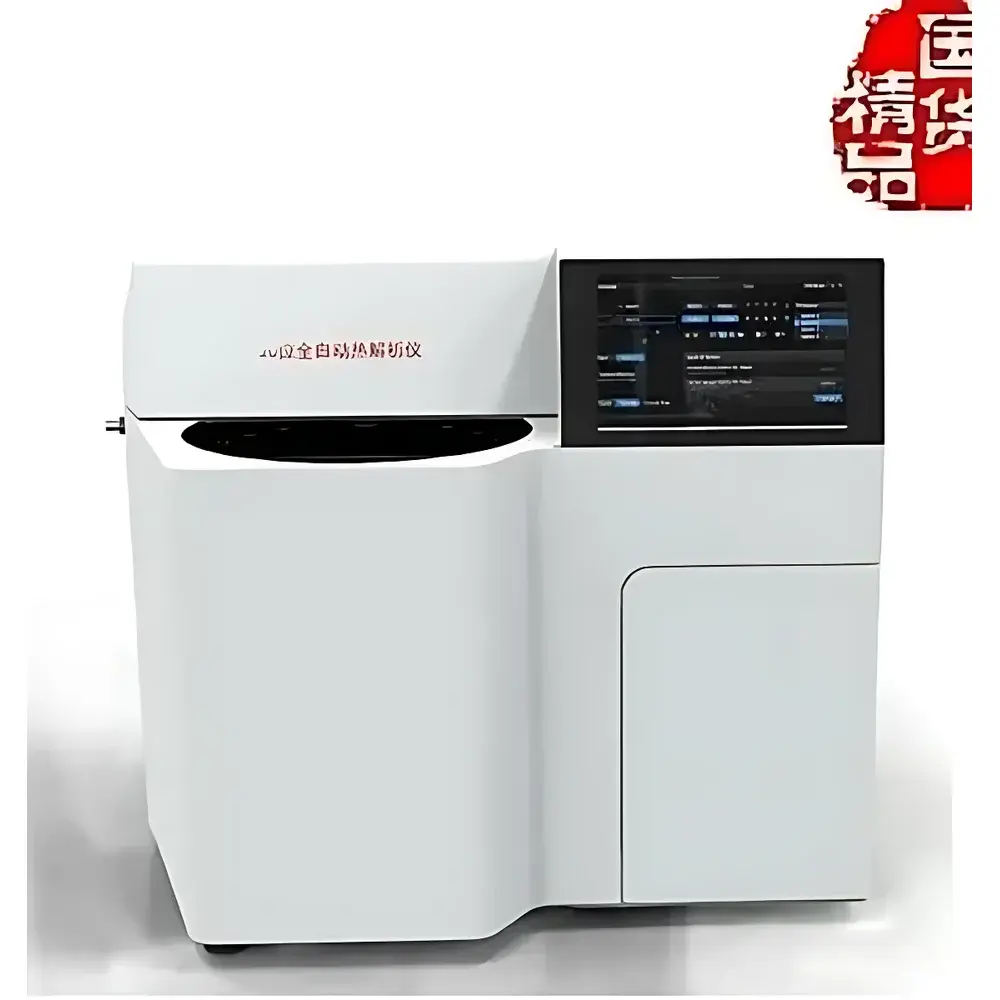
Kyocera ATD-01/20 Automated Thermal Desorber
| Brand | Kyocera |
|---|---|
| Origin | Beijing, China |
| Model | ATD-01/20 |
| Instrument Type | Dual-Stage Thermal Desorber |
| Desorption Temperature Range | Ambient to 400 °C |
| Cryo-Focusing Trap Temperature Range | –35 °C to 400 °C |
| Desorption Recovery Rate | >98% (compound-dependent) |
| Sample Capacity | 1–20 adsorption tubes |
| Valve System | Motorized 6-port switching valve + solenoid valves |
| Transfer Line Temp. Control | Ambient to 260 °C (±1 °C) |
| Focusing Trap Flash Heating Rate | >3000 °C/min |
| Purge Flow Rate | 0–600 mL/min (adjustable) |
| Simulated Sampling Flow | 100 mL/min |
Overview
The Kyocera ATD-01/20 Automated Thermal Desorber is a dual-stage thermal desorption system engineered for high-fidelity volatile organic compound (VOC) and semi-volatile organic compound (SVOC) analysis in environmental, occupational health, and indoor air quality laboratories. It operates on the principle of thermally driven analyte release from sorbent-packed sampling tubes, followed by cryogenic focusing in a low-temperature trap and rapid flash desorption into a gas chromatograph (GC) or GC–MS system. This two-step process—primary thermal desorption and secondary cryo-focused injection—minimizes band broadening, enhances sensitivity (detection limits typically sub-ppt), and ensures quantitative reproducibility across complex matrices. The system is fully integrated with standard GC inlets via synchronized TTL signaling, enabling precise timing control of desorption, transfer, and injection events without manual intervention.
Key Features
- Fully automated batch processing of 1–20 sorbent tubes per run, supporting unattended overnight operation and high-throughput laboratory workflows.
- Independent, PID-controlled temperature zones for sample tube oven (ambient to 400 °C), 6-port valve manifold (ambient to 220 °C), transfer line (ambient to 260 °C), and cryofocusing trap (–35 °C to 400 °C), each with ±1 °C accuracy and stability.
- Motorized 6-port valve combined with precision solenoid valves enables robust, leak-tight sequencing of desorption, carrier gas purge, backflush cleaning, and analytical injection—eliminating manual gas routing and reducing carryover risk.
- Integrated touchscreen interface (7-inch capacitive display) supports intuitive method creation, storage, and recall; real-time status visualization of all pneumatic and thermal events during sequence execution.
- Built-in simulated sampling function delivers calibrated 100 mL/min flow for direct preparation of calibration standards on-tube—streamlining method validation and linear range verification per ISO 16000-6 and ASTM D6196.
- Flash-heating capability (>3000 °C/min ramp rate from cryo-trap) ensures narrow analyte bands and optimal chromatographic resolution, particularly critical for early-eluting VOCs such as formaldehyde, acetaldehyde, and benzene.
Sample Compatibility & Compliance
The ATD-01/20 accommodates industry-standard 1/4″ OD stainless steel or quartz sorbent tubes packed with multi-bed media (e.g., Tenax TA, Carbopack B/C, Carboxen 1000), including diffusion-capillary and multi-sorbent configurations. It meets essential regulatory and methodological requirements for environmental monitoring, including but not limited to: HJ 644–2013 (ambient air VOCs, TD–GC–MS), HJ 583–2010 (benzene series, TD–GC), HJ 734–2014 (stationary source emissions), HJ/T 400–2007 (in-vehicle air), GB/T 18883–2002 (indoor air quality), and GB 50325–2010 (civil construction IAQ control). All thermal and pneumatic parameters are logged with timestamped audit trails, supporting GLP-compliant data integrity frameworks and alignment with FDA 21 CFR Part 11 principles when paired with validated chromatography data systems (CDS).
Software & Data Management
Control firmware supports time-based method programming for full sequence automation—including tube pre-desorption conditioning, primary desorption, cold trap focusing, secondary flash desorption, GC trigger output, and post-run tube bake-out (reconditioning). Method files store complete thermal profiles, valve timing maps, flow settings, and user annotations. Exportable log files include temperature setpoints, actual readings, valve actuation timestamps, and error codes—facilitating root-cause analysis and instrument qualification (IQ/OQ/PQ). No proprietary software license is required; integration with third-party CDS platforms (e.g., Thermo Chromeleon, Agilent OpenLab, Shimadzu GC Solutions) is achieved via hardware-triggered start signals and standardized ASCII log outputs.
Applications
- Regulatory compliance testing for ambient, indoor, and workplace air per national and international VOC monitoring protocols.
- Method development and validation for trace-level aldehydes, aromatics, halogenated hydrocarbons, and oxygenated VOCs in complex sorbent matrices.
- Quality control of building materials, automotive interiors, and consumer products under emission testing standards (e.g., VDA 278, ISO 12219-3).
- Forensic air analysis and odor investigation requiring high sensitivity and retention time stability.
- Research applications involving dynamic headspace sampling, polymer off-gassing studies, and catalyst emission profiling.
FAQ
Does the ATD-01/20 support both single-stage and dual-stage desorption modes?
Yes—the system is configurable for either primary-only desorption (direct transfer) or full dual-stage operation with cryofocusing and flash injection, depending on analytical requirements and target compound volatility.
Can the instrument be used with GC–MS systems from different manufacturers?
Yes—hardware synchronization uses standard TTL-level trigger pulses compatible with all major GC and GC–MS vendors; no custom drivers or OEM-specific interfaces are required.
Is the cryofocusing trap capable of sub-ambient operation during trapping?
Yes—the trap achieves stable temperatures down to –35 °C using Peltier-based cooling, enabling efficient condensation of highly volatile compounds such as C2–C4 hydrocarbons and chloromethanes.
What maintenance routines are recommended for long-term reliability?
Routine procedures include quarterly valve seal inspection, annual calibration of temperature sensors against NIST-traceable references, and periodic replacement of O-rings in high-temperature zones per manufacturer’s service schedule.
How is data integrity ensured during unattended operation?
All thermal and pneumatic events are timestamped and recorded in non-volatile memory; method files and logs are write-protected during acquisition and exportable in CSV or plain-text formats for independent review and archival.






