
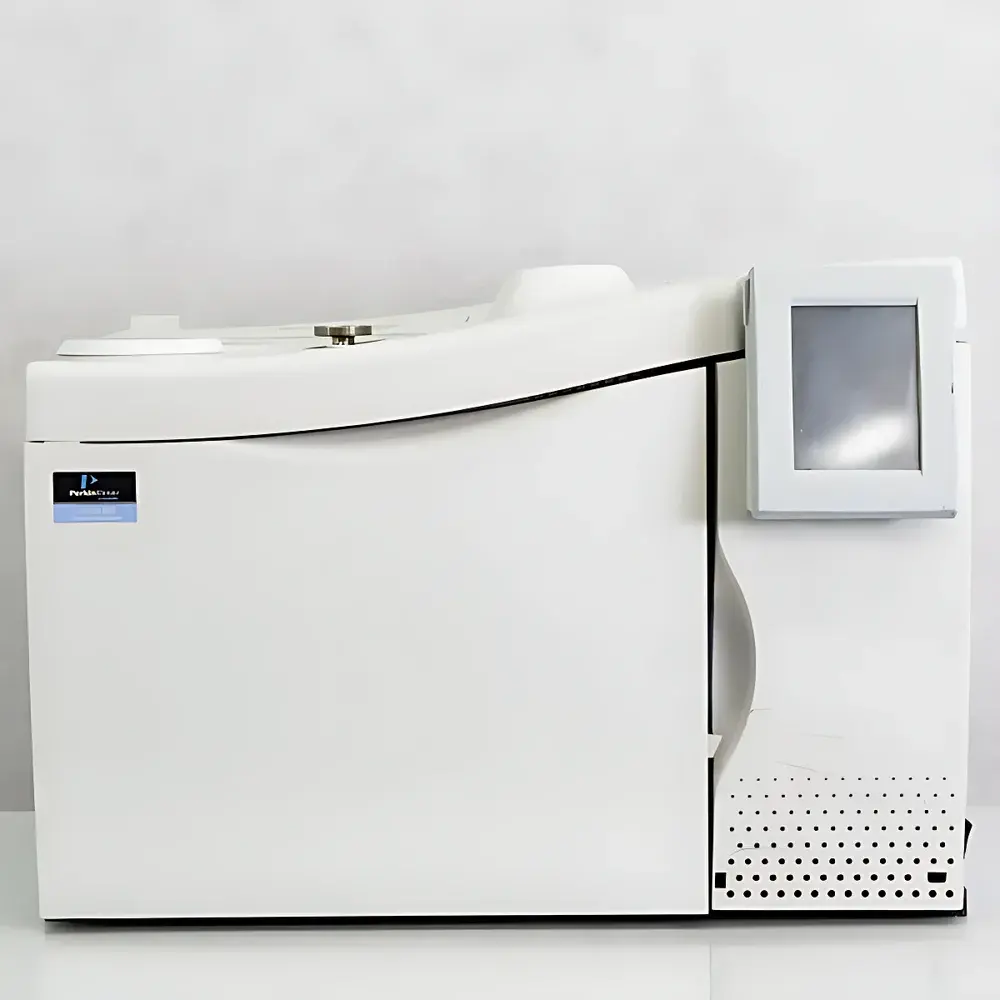
PerkinElmer Clarus 500 Used Gas Chromatograph
| Brand | PerkinElmer |
|---|---|
| Origin | USA |
| Model | Clarus 500 |
| Instrument Type | Laboratory Gas Chromatograph |
| Application Scope | General-Purpose |
| Oven Temperature Range | Ambient + 4 °C to 450 °C |
| Oven Ramp Rate | 0.1–40 °C/min |
| Oven Cool-Down Time | ~6 min (450 °C → 50 °C) |
| Carrier Gas Flow Range & Control | 0–1200 mL/min |
| Carrier Gas Pressure Range & Control | 0–970 kPa |
| Injector Maximum Operating Temperature | 450 °C |
| Injector Pressure Setting Range | 0–970 kPa |
| Injector Total Flow Setting Range | 0–1200 mL/min |
Overview
The PerkinElmer Clarus 500 is a high-performance, laboratory-grade gas chromatograph engineered for precision, reproducibility, and operational flexibility in routine and method-development environments. Based on robust capillary and packed column separation principles, the Clarus 500 employs temperature-programmed oven control, digitally regulated electronic pneumatic control (EPC), and modular detector architecture to deliver consistent retention time stability and quantitative accuracy across diverse sample matrices. Its design adheres to fundamental GC operating requirements defined in ASTM D3699, ISO 17025-compliant validation frameworks, and USP chromatographic system suitability criteria. As a pre-owned instrument, each Clarus 500 undergoes full functional verification—including leak testing, temperature calibration traceability, and detector response linearity assessment—prior to deployment, ensuring compliance with GLP and internal QC documentation standards.
Key Features
- Intuitive graphical user interface with color touchscreen display for real-time method editing, status monitoring, and diagnostic feedback
- Modular detector compatibility supporting FID, ECD, TCD, NPD, and FPD configurations—each with dedicated thermal management and gas flow optimization
- PSS (Programmable Sample Splitter) injector enabling split, splitless, on-column, and cool-on-column injection modes with precise pressure/flow decoupling
- PreVent™ and Protect™ technologies minimizing column contamination and extending consumable lifetime through active inlet liner conditioning and backflush-enabled guard column management
- Integrated TurboMatrix™ headspace compatibility for automated volatile organic compound (VOC) analysis in environmental, pharmaceutical, and food safety applications
- Electronic Pneumatic Control (EPC) system providing ±0.01 psi pressure resolution and <0.1% RSD flow repeatability across all carrier and auxiliary gas lines
Sample Compatibility & Compliance
The Clarus 500 accommodates a broad range of sample types—including residual solvents, hydrocarbon fractions, pesticide residues, fatty acid methyl esters (FAMEs), and volatile metabolites—when paired with appropriate stationary phases (e.g., DB-5ms, HP-INNOWAX, or RTX-1). All detector modules meet applicable sensitivity thresholds outlined in EPA Method 8260C (FID/ECD), USP (residual solvents), and ISO 11843-2 (limit of detection estimation). The system supports 21 CFR Part 11–compliant audit trails when operated with PerkinElmer’s TotalChrom™ software under validated networked configurations. Mechanical and electrical safety conforms to IEC 61010-1:2010; oven insulation and gas handling components comply with UL 61010B-1 certification requirements.
Software & Data Management
TotalChrom™ Navigator serves as the native acquisition and reporting platform, offering method development wizards, automated system suitability testing (SST), peak integration with customizable baselines, and multi-level user access control. Raw data files (.ch) are stored in vendor-neutral formats compatible with third-party review tools. Audit trail functionality records all parameter changes, sequence modifications, and report generation events with timestamped operator IDs. Data integrity safeguards include write-protected archive folders, digital signature support, and optional integration with LIMS via ASTM E1384-compliant interfaces. For laboratories requiring long-term archival, raw data export to CSV or CDF (Common Data Format) is supported without loss of metadata fidelity.
Applications
The Clarus 500 is routinely deployed in quality control laboratories for pharmacopeial testing (e.g., residual solvent analysis per ICH Q3C), environmental monitoring (e.g., BTEX and PAH quantification in soil extracts), petrochemical profiling (e.g., simulated distillation per ASTM D2887), and forensic toxicology (e.g., ethanol and volatiles screening in blood). Its dual-channel TCD configuration enables simultaneous reference-standard tracking in gas purity assays, while the NPD’s selective response to nitrogen- and phosphorus-containing compounds supports pesticide residue screening in agricultural commodities. When coupled with cryogenic trapping or large-volume injection accessories, the platform extends into ultra-trace analysis domains such as ambient air VOC monitoring at sub-ppt levels.
FAQ
What detector configurations are verified during pre-delivery qualification?
All installed detectors undergo baseline noise assessment, linear dynamic range verification (minimum 10⁴ for FID/ECD), and retention time reproducibility testing (<0.02% RSD over 10 injections) using certified reference standards.
Is the Clarus 500 compatible with modern LIMS environments?
Yes—via TotalChrom’s ODBC-compliant database schema and ASTM E1384-compliant data exchange protocols, enabling bidirectional sample queueing and result ingestion.
Does the system support method transfer from other GC platforms?
Method translation tools within TotalChrom facilitate migration from Agilent 6890/7890 or Thermo ISQ systems, including retention index alignment and gradient scaling algorithms.
What maintenance documentation accompanies the instrument?
Each unit ships with a full service history log, calibration certificates traceable to NIST standards, and a completed IQ/OQ checklist aligned with GAMP5 guidance.
Can the Clarus 500 operate under 21 CFR Part 11 compliance?
Yes—when configured with TotalChrom v6.4.1 or later, enabled electronic signatures, and deployed on a domain-controlled Windows Server environment with encrypted audit trail storage.





