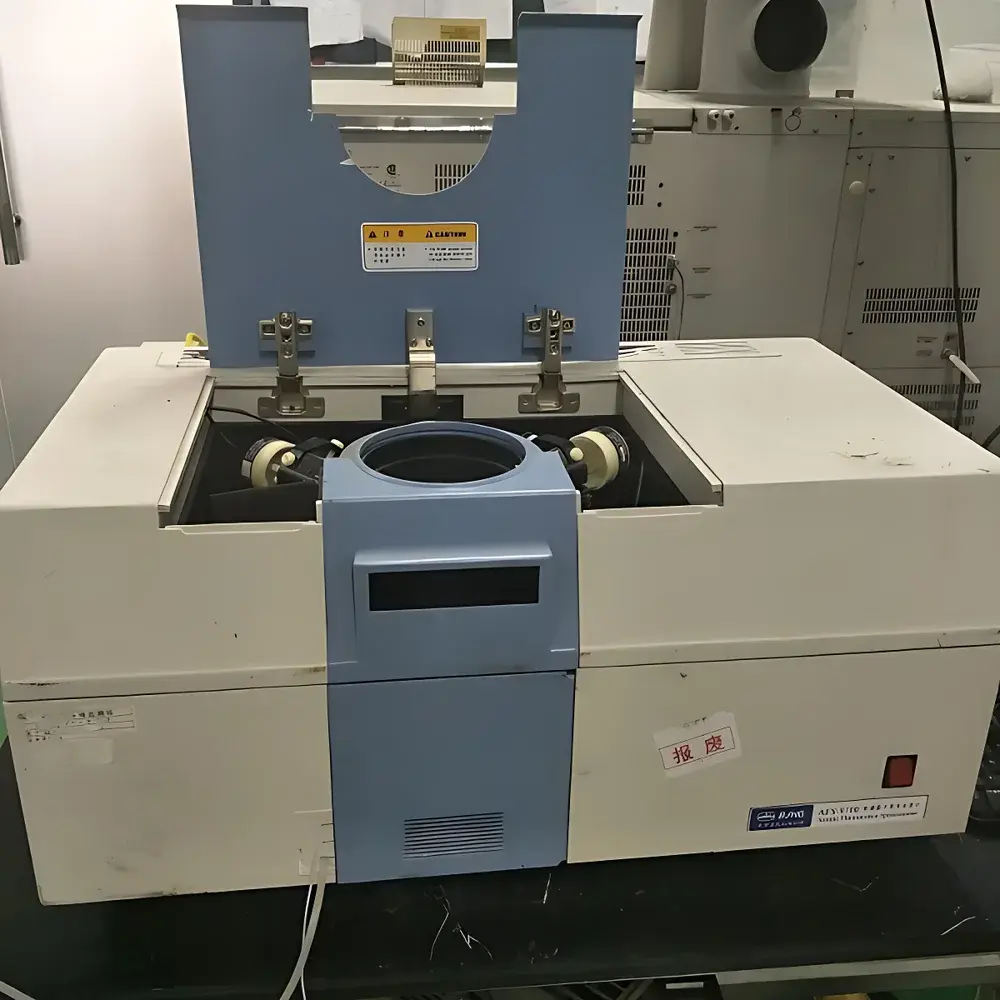
Kyocera WX-AFS-9700 Atomic Fluorescence Spectrometer Maintenance and Repair Service
| Brand | Kyocera |
|---|---|
| Origin | Beijing, China |
| Manufacturer Type | Authorized Distributor |
| Product Category | Domestic Instrument |
| Model | WX-AFS-9700 |
| Service Fee | USD 700–1,400 (excl. parts) |
| Field Experience | 10 years |
| Instrument Type | Analytical Instrument |
| Response Time | ≤12 hours |
| Service Scope | Preventive Maintenance, Fault Diagnosis, Component Replacement, System Calibration, Performance Validation |
| Location | Beijing, China |
Overview
The Kyocera WX-AFS-9700 Atomic Fluorescence Spectrometer Maintenance and Repair Service is a specialized technical support offering designed exclusively for laboratories operating hydride-generation atomic fluorescence spectrometry (HG-AFS) systems. AFS is a highly sensitive elemental analysis technique widely applied in environmental monitoring (e.g., As, Hg, Se, Bi, Sb quantification in water and soil), food safety testing (e.g., arsenic speciation in rice), and pharmaceutical impurity profiling. Unlike optical emission or absorption methods, AFS relies on the measurement of characteristic fluorescent radiation emitted by ground-state atoms after photoexcitation—requiring precise control of hydride generation efficiency, quartz tube atomizer temperature, and optical alignment. Given the instrument’s sensitivity to gas flow stability, reagent purity, and detector dark-current drift, routine maintenance and expert intervention are critical to sustaining method accuracy, detection limit reproducibility (<0.01 µg/L for As), and long-term calibration stability per ISO/IEC 17025 requirements.
Key Features
- On-site or benchtop repair conducted by ASE-certified AFS service engineers with ≥10 years’ hands-on experience on Kyocera and legacy Haiguang platforms
- Comprehensive diagnostic protocol covering HG system integrity (NaBH4 delivery, acid mixing, gas–liquid separator function), atomization chamber thermal uniformity, and PMT voltage optimization
- Preventive maintenance kits including quartz atomizers, hollow cathode lamps (HCLs), gas regulators, and high-purity carrier gas filters compliant with ASTM D5673 for trace metal analysis
- Post-repair performance validation using NIST-traceable standard solutions (e.g., SRM 1640a, 1643e) across defined linear ranges (0.1–100 µg/L)
- Documentation aligned with GLP/GMP expectations: service report includes fault root cause, replaced components (with serial numbers), pre/post-calibration data, and operator sign-off
Sample Compatibility & Compliance
This service supports all WX-AFS-9700 configurations used in regulated environments—including those deployed under China’s GB 5749–2022 (drinking water), US EPA Method 1631E (mercury in water), and EU Directive 2009/54/EC (natural mineral waters). All calibration verifications follow ISO 11885 (water quality—determination of elements by AAS/AFS) and include uncertainty budgeting per GUM (JCGM 100:2008). No hardware modification or firmware upgrade is performed without prior written client consent and documented impact assessment per ICH Q5A(R2) for analytical instrument qualification.
Software & Data Management
Service includes verification of native Kyocera AFS software (v3.2.x or later) functionality: spectral baseline correction algorithms, peak integration parameters, and multi-point calibration curve fitting (linear/quadratic). Data files (.afp, .txt) are validated for integrity and export compatibility with LIMS platforms (e.g., LabWare, Thermo SampleManager) via ODBC drivers. Audit trails—including method edits, calibration events, and user logins—are preserved in accordance with FDA 21 CFR Part 11 requirements when enabled; electronic signatures and role-based access controls are verified during system restart.
Applications
This maintenance program directly supports compliance-critical workflows: regulatory testing labs performing CNAS-accredited mercury analysis in seafood; QC departments validating arsenic content in generic APIs per USP ; municipal water authorities verifying selenium levels against WHO guidelines; and academic research groups conducting speciation studies using hydride separation coupled to HPLC-AFS. The service ensures uninterrupted operation during seasonal peak demand (e.g., post-harvest grain testing cycles) and minimizes downtime-induced nonconformance risks in ISO 9001-certified facilities.
FAQ
What is the typical turnaround time for on-site AFS repair?
Standard response is within 12 business hours from confirmed service request; full diagnosis and resolution typically completed within 1–3 working days depending on component availability.
Do you replace consumables during preventive maintenance?
Yes—quartz atomizers, HCLs, gas filters, and peristaltic pump tubing are inspected and replaced if wear exceeds manufacturer-specified thresholds (e.g., >500 h lamp usage, visible quartz clouding).
Is remote diagnostics available before dispatching an engineer?
Yes—clients may share raw data files, error logs, and system screenshots via secure SFTP; preliminary assessment is provided within 4 business hours.
Can calibration certificates be issued post-service?
Yes—certificates conforming to ISO/IEC 17025 Annex A.2 are issued upon request, listing measurement uncertainty, reference standards used, and environmental conditions during validation.
Are software updates included in the service fee?
No—firmware or application software upgrades require separate authorization and are billed separately per Kyocera’s official licensing terms.
Related Products