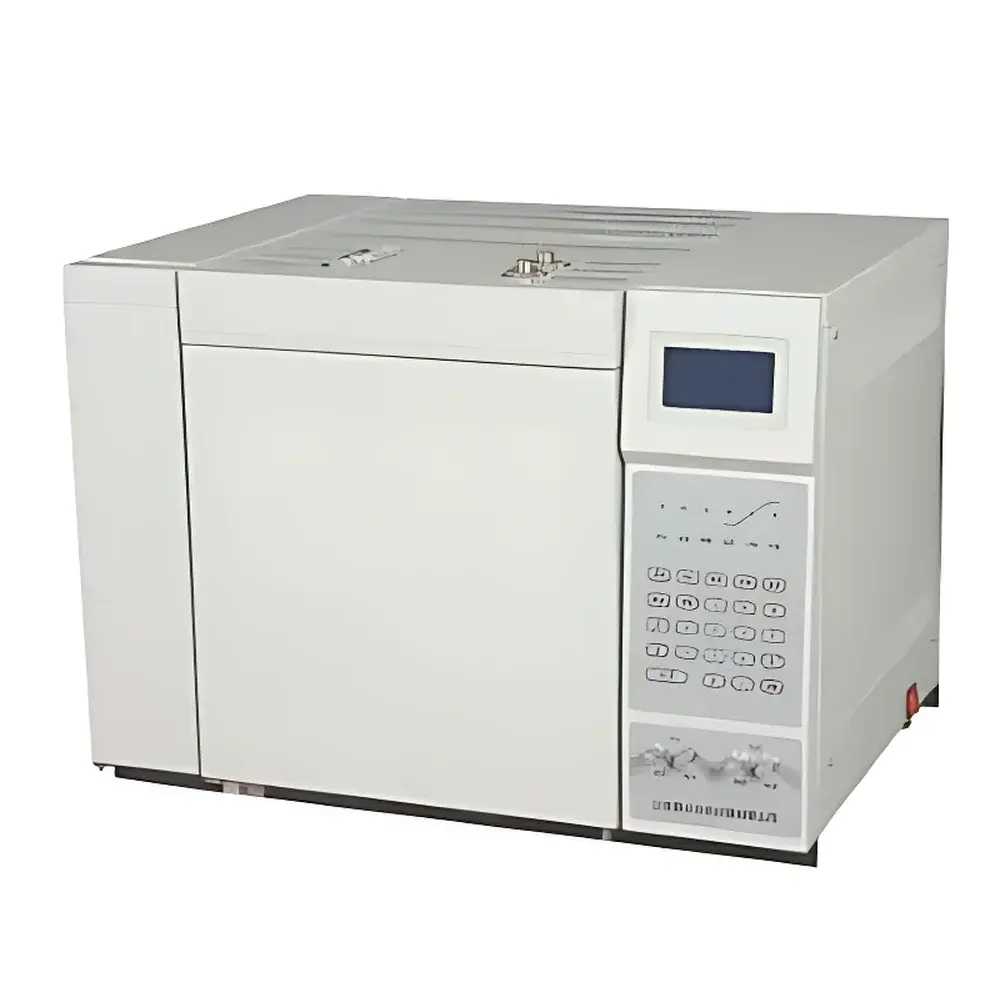
Kyocera SP7800II Online Gas Chromatograph for Industrial Process Gas Analysis
| Brand | Kyocera |
|---|---|
| Origin | Beijing, China |
| Manufacturer Type | Authorized Distributor |
| Product Category | Domestic Industrial GC System |
| Model | SP7800II |
| Pricing | Available Upon Request |
| Detection Principle | Capillary/Packed Column Gas Chromatography with TCD/FID/PID Detector Options |
| Sample Introduction | Automated Valve-Actuated Loop Injection or Manual Gas Bag Sampling |
| Column Configuration | Triple-Column Parallel Setup with Programmable Multi-Position Valves |
| Temperature Control | Dual-Zone Oven with ±0.1 °C Stability |
| Detection Limits | CO, C₂H₂, C₂H₄ ≤ 1 ppm (v/v) |
| TCD Sensitivity | ≥ 5000 mV·mL/mg |
| System Accuracy | ≤ 1% RSD (Relative Standard Deviation) |
| Compliance Standards | GB/T 13610–2003, GB/T 11062–1998, SH/T 0230–92, GB/T 12206–2006, GB 10410.1–89, GB 10410.2–89, GB 10410.3–89 |
| Data Output | Real-Time Reporting via Embedded PC, USB/RS-232/Ethernet Connectivity, Optional 21 CFR Part 11-Compliant Software Module |
Overview
The Kyocera SP7800II Online Gas Chromatograph is an industrial-grade, continuously operating analytical system engineered for real-time compositional monitoring of process gases in demanding production and safety-critical environments. Based on robust gas chromatographic separation principles—employing temperature-programmed capillary or packed columns coupled with selective detection technologies—the SP7800II delivers quantitative analysis of permanent gases (H₂, O₂, N₂, CO, CO₂), light hydrocarbons (C₁–C₅ alkanes/alkenes), sulfur compounds, and volatile organic compounds (VOCs) in complex multi-component streams. Its architecture integrates a microprocessor-controlled oven, high-reproducibility six-port valve switching, and thermally stable detector modules to ensure consistent retention time alignment and peak resolution across extended unattended operation cycles. Designed specifically for integration into distributed control systems (DCS) or supervisory control and data acquisition (SCADA) networks, the instrument supports deterministic sampling intervals (e.g., every 5–30 minutes), automated calibration verification, and fail-safe gas flow management—including integrated power-loss and carrier-gas-interruption protection protocols.
Key Features
- Triple-column parallel configuration with programmable multi-position rotary valves enabling single-injection quantification of up to 18 components without re-injection or column re-equilibration
- Dual-zone temperature-controlled oven (ambient to 250 °C) with ramp rate precision of ±0.1 °C and thermal uniformity < 0.3 °C across column bed
- Modular detector compatibility: configurable selection of Thermal Conductivity Detector (TCD), Flame Ionization Detector (FID), or Photoionization Detector (PID) based on target analyte classes and regulatory requirements
- Automated sample introduction via stainless-steel loop injection (0.25–2.0 mL volume options) with optional manual sampling interface for offline validation using Tedlar® bags or gas-tight syringes
- Embedded industrial PC running real-time acquisition firmware; supports scheduled auto-calibration using certified standard gas mixtures and drift correction algorithms
- Fail-safe hardware interlocks including carrier gas pressure monitoring, detector flame-out detection (for FID), and automatic venting upon abnormal temperature excursions
Sample Compatibility & Compliance
The SP7800II is validated for direct analysis of non-corrosive, low-particulate gas matrices including natural gas, refinery off-gas, synthesis gas (syngas), coal mine ventilation air, landfill biogas, and industrial purge streams. It complies with multiple national standards governing gas composition measurement, including GB/T 13610–2003 (natural gas analysis), SH/T 0230–92 (LPG composition), and GB 10410 series (artificial and liquefied petroleum gases). For regulated pharmaceutical or environmental applications, optional software modules provide audit trails, electronic signatures, and data integrity features aligned with FDA 21 CFR Part 11 and ISO/IEC 17025 laboratory accreditation requirements. Pre-cut column protection ensures long-term column life (>2 years typical under continuous operation), minimizing downtime and consumables cost.
Software & Data Management
Acquisition and reporting are managed through Kyocera ChromaView™ v4.x—a Windows-based chromatography data system (CDS) supporting method development, sequence scheduling, peak integration using tangent skim or valley-to-valley algorithms, and customizable report templates compliant with GLP/GMP documentation workflows. Raw data files (.chd) are stored in vendor-neutral formats compatible with third-party LIMS integration. Remote access is enabled via secure HTTPS or OPC UA protocol, allowing centralized fleet monitoring across geographically dispersed facilities. All chromatograms, calibration logs, maintenance records, and system event timestamps are archived with SHA-256 hash verification to meet traceability mandates.
Applications
- Natural gas quality assurance: quantification of calorific value contributors (CH₄, C₂H₆, C₃H₈), inert diluents (N₂, CO₂), and contaminants (H₂S, mercaptans)
- Petrochemical process optimization: real-time tracking of ethylene/propylene purity, butadiene recovery efficiency, and catalyst deactivation indicators (e.g., acetylene buildup)
- Environmental emissions monitoring: continuous measurement of benzene, toluene, ethylbenzene, xylenes (BTEX), chlorinated solvents (CHCl₃, C₂Cl₄), and odorants (tert-butylthiol) per local EPA or EU IED directives
- Occupational health & safety: detection of phosphine (PH₃), arsine (AsH₃), and epoxyethane (EtO) residuals in sterilization chambers or grain fumigation systems
- Waste-to-energy operations: monitoring of landfill gas composition (CH₄/CO₂ ratio), trace VOCs, and siloxanes that threaten turbine integrity
FAQ
What carrier gases are supported?
Helium, hydrogen, and nitrogen are fully supported; hydrogen offers fastest analysis times and highest TCD sensitivity, while helium provides optimal FID stability.
Can the system operate unattended for extended periods?
Yes—designed for 30-day continuous operation with scheduled self-diagnostics, automatic baseline correction, and alarm-triggered remote notification via email/SMS.
Is method transfer possible from lab-based GC systems?
Retention time alignment and peak identification are maintained through column geometry matching and standardized temperature ramp profiles; Kyocera provides migration support packages including method conversion worksheets and retention index validation kits.
How is calibration traceability ensured?
Certified reference materials (CRMs) from NIST-traceable suppliers are used; calibration certificates include uncertainty budgets, stability data, and matrix-matched validation against field samples.
What maintenance intervals are recommended?
Detector cleaning every 6 months; column bake-out monthly; valve seal replacement annually; full system performance verification semiannually per ISO 17025 Annex A.3 guidelines.
Related Products