
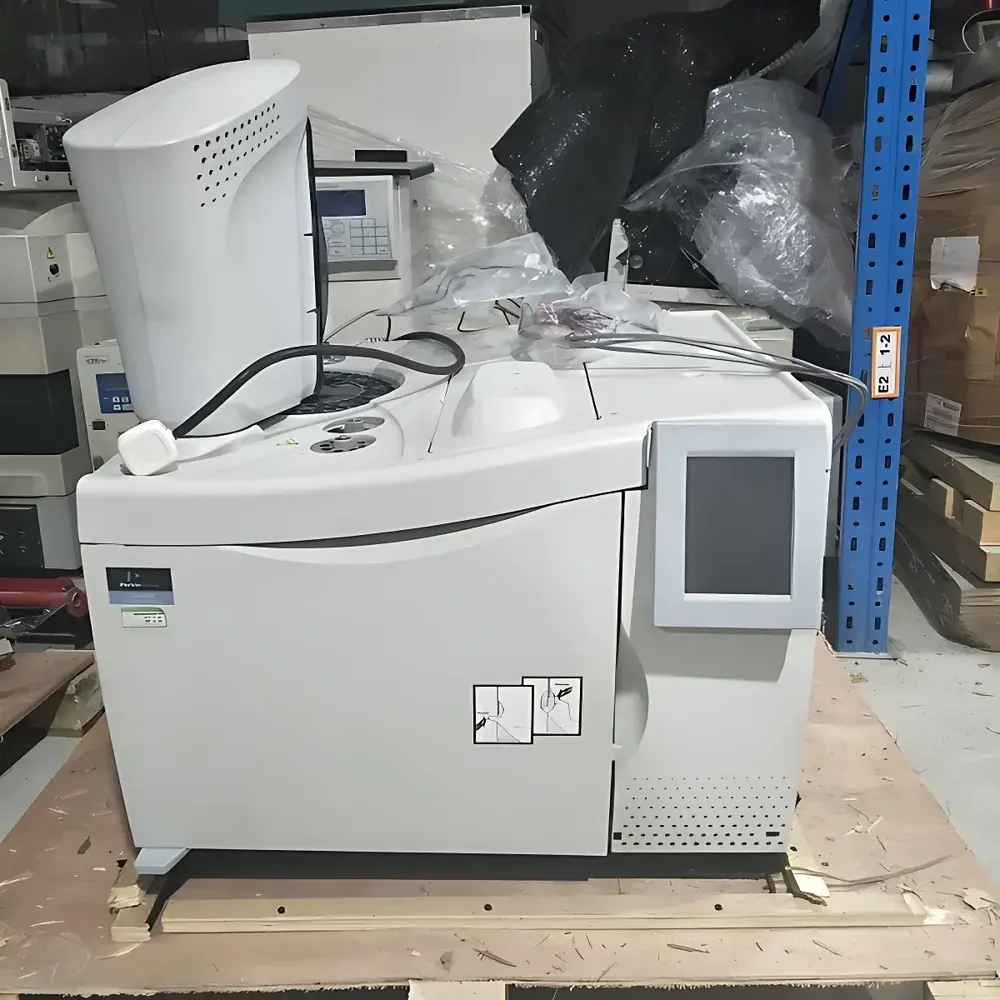
PerkinElmer Clarus 680 Used Gas Chromatograph
| Brand | PerkinElmer |
|---|---|
| Origin | USA |
| Model | Clarus 680 |
| Instrument Type | Laboratory Gas Chromatograph |
| Application Scope | General-Purpose |
| Oven Temperature Range | Ambient + 4 °C to 450 °C |
| Oven Ramp Rate | 0.1–40 °C/min |
| Oven Cool-Down | 450 °C to 50 °C in ~6 min |
| Carrier Gas Flow Range & Control | 0–1200 mL/min |
| Carrier Gas Pressure Range & Control | 0–970 kPa |
| Injector Maximum Operating Temperature | 450 °C |
| Injector Pressure Setting Range | 0–970 kPa |
| Injector Total Flow Setting Range | 0–1200 mL/min |
Overview
The PerkinElmer Clarus 680 is a high-performance, laboratory-grade gas chromatograph engineered for precision, reproducibility, and operational efficiency in routine and method-developed analyses. Based on robust capillary GC architecture, it employs temperature-programmed separation with precise carrier gas flow and pressure regulation to resolve volatile and semi-volatile organic compounds across diverse matrices. Its core design centers on rapid thermal cycling—enabled by an aerodynamically optimized, dual-layer oven—and integrated hardware automation, making it particularly suitable for high-throughput environments where cycle time, method transferability, and instrument uptime are critical performance indicators.
Key Features
- Rapid oven cooling: Achieves 450 °C → 50 °C in ≤6 minutes via patented dual-zone airflow management and thermally decoupled heating elements—reducing turnaround time between runs without compromising column stability or retention time reproducibility.
- Integrated 108-position autosampler: Fully embedded within the main chassis; eliminates external footprint, reduces inert surface area, and supports sequential injection to dual inlets without mechanical repositioning—enabling true parallel inlet operation and manual override during standby.
- Programmable Pressure Control (PPC): Digital pressure regulation at both inlet and detector ends ensures consistent linear velocity across temperature ramps, improving peak shape, resolution, and quantitative accuracy—especially for complex gradients and multi-analyte methods.
- Tailless detector configuration: Flame Ionization (FID), Flame Photometric (FPD), and Nitrogen-Phosphorus (NPD) detectors operate without supplemental makeup gas, reducing total carrier gas consumption by up to 35% compared to conventional configurations requiring ~28 mL/min tail-blanket flow.
- Intuitive touchscreen interface: 7-inch capacitive display with context-sensitive soft keys and real-time parameter visualization—designed for minimal training overhead while maintaining full access to method parameters, diagnostics, and system status.
- SwafER microchannel technology compatibility: Supports optional microfluidic sample introduction modules for enhanced sensitivity in trace-level environmental or forensic applications, including cryo-trapping and cold-on-column injection variants.
Sample Compatibility & Compliance
The Clarus 680 accommodates standard 0.1–0.53 mm ID fused-silica capillary columns (up to 60 m length) and is validated for use with common stationary phases including polydimethylsiloxane (e.g., DB-1, HP-1), polar cyanopropylphenyl (e.g., DB-1301, HP-50+), and wax-based phases. It meets essential regulatory expectations for GLP/GMP-aligned laboratories through hardware-level audit trail logging (via TotalChrom CDS), electronic signature support compliant with FDA 21 CFR Part 11, and method validation traceability per ISO/IEC 17025 and ASTM D3699 (hydrocarbon analysis), D5504 (sulfur speciation), and EPA Method 8260/8270.
Software & Data Management
TotalChrom Chromatography Data System (CDS) serves as the native platform—offering fully integrated instrument control, sequence management, peak integration, calibration curve generation, and customizable reporting templates. The system supports LIMS connectivity via ASTM E1384-compliant export formats and provides secure user role management (admin, analyst, reviewer). Third-party interoperability includes native drivers for Waters Empower 2 and Agilent EZChrom Elite, enabling centralized fleet management in multi-vendor lab environments. All raw data files (.ch, .seq) are stored in vendor-neutral, timestamped directories with SHA-256 checksum integrity verification.
Applications
The Clarus 680 delivers reliable performance in regulated and research-driven workflows including: residual solvent analysis in pharmaceuticals (ICH Q3C); pesticide screening in food and agricultural commodities (AOAC 2007.01); hydrocarbon fingerprinting in petroleum products (ASTM D5292); volatile organic compound (VOC) profiling in ambient air and water (EPA TO-17); flavor/aroma compound quantification in beverages and dairy; and toxicant identification in forensic toxicology (SWGDAM guidelines). Its flexible inlet options—including split/splitless, PTV, and cool-on-column—support both volatile and thermally labile analytes without derivatization.
FAQ
Is the Clarus 680 compatible with mass spectrometric detection?
Yes—when coupled with PerkinElmer’s Torion T-9 or AxION iQT mass spectrometers, or third-party GC-MS systems via standard transfer line interfaces and synchronization protocols.
What maintenance intervals are recommended for routine operation?
Carrier gas filters require replacement every 6 months; inlet liners and septa every 100–200 injections; and column trimming every 2–3 months depending on sample cleanliness. Full system performance verification (SPV) is advised quarterly using certified test mixtures.
Can legacy methods developed on older Clarus models be migrated directly?
Yes—method parameters (ramp rates, hold times, pressure setpoints) retain full backward compatibility; only minor adjustments to dwell times or detector gain settings may be needed due to improved signal-to-noise ratio.
Does the instrument support unattended overnight operation?
Yes—equipped with automated shutdown sequences, leak detection routines, and power-failure recovery logic that preserves method state and resumes acquisition upon restoration.
Related Products




