
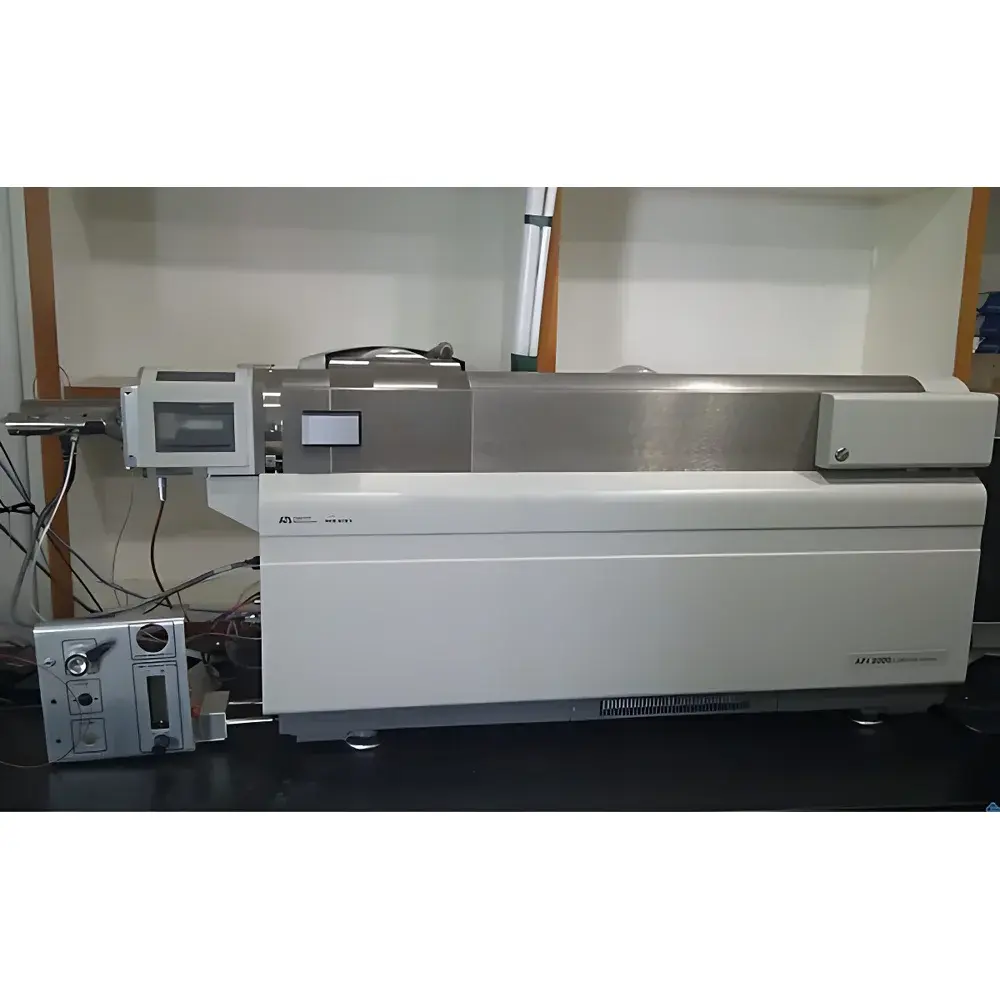
SCIEX API 3000 Triple Quadrupole Liquid Chromatography Mass Spectrometer (Refurbished)
| Brand | SCIEX |
|---|---|
| Origin | USA |
| Model | API 3000 |
| Instrument Type | Triple Quadrupole LC-MS/MS |
| Mass Range | 10–3000 Da |
| Sensitivity | S/N ≥ 100:1 for 1 pg on-column reserpine (ESI+) |
| Resolution | 0.5–0.7 Da (FWHM) |
| Mass Accuracy | ±0.1 Da |
| Ion Sources | Electrospray Ionization (ESI) and Atmospheric Pressure Chemical Ionization (APCI) |
| Operating Temperature | 15–30 °C |
| Power Supply | 208–240 V AC, 50/60 Hz |
| Required Gases | High-purity nitrogen (≥99.999%), zero-air (oil-free, particle-filtered compressed air) |
| Vacuum System | Varian DS602 dual-stage rotary vane pump with oil mist filter |
Overview
The SCIEX API 3000 is a high-performance, refurbished triple quadrupole liquid chromatography–mass spectrometry (LC-MS/MS) system engineered for quantitative bioanalysis and targeted compound identification in complex matrices. Based on collision-induced dissociation (CID) within a pressurized linear accelerator (LINAC) collision cell, the API 3000 delivers robust, reproducible multiple reaction monitoring (MRM) performance across diverse sample types—including plasma, serum, tissue homogenates, urine, environmental extracts, and food digests. Its core architecture integrates electrospray ionization (ESI) and atmospheric pressure chemical ionization (APCI) sources, enabling broad analyte coverage across polarities and volatilities. Designed for regulatory-compliant workflows, the system supports method validation per ICH M10, FDA Bioanalytical Method Validation Guidance, and EMA guidelines—making it suitable for GLP- and GCP-aligned preclinical pharmacokinetic (DMPK), clinical trial bioanalysis, newborn screening, forensic toxicology, and environmental residue analysis.
Key Features
- Patented curtain gas interface: Minimizes source contamination while maintaining high ion transmission efficiency and signal stability over extended run times.
- Gold-coated ceramic quadrupole rods: Exhibit ultra-low thermal expansion coefficients (<0.5 ppm/°C), ensuring long-term mass calibration stability and inter-day reproducibility.
- Linear Accelerator (LINAC) collision cell: Provides uniform collision energy distribution and near-100% duty cycle for all MRM transitions, eliminating dwell-time sensitivity loss during multi-analyte quantitation.
- High-throughput MRM capability: Supports concurrent monitoring of up to 40 precursor→product ion transitions without compromising cycle time or detection limits.
- Hybrid scan functionality: Enables seamless integration of scanning modes—including full-scan MS, product ion scan, precursor ion scan, and neutral loss scan—in a single acquisition, facilitating structural confirmation and retrospective data mining.
- Dual-source compatibility: Integrated ESI and APCI probes allow rapid switching between ionization mechanisms without hardware reconfiguration or venting.
Sample Compatibility & Compliance
The API 3000 demonstrates exceptional compatibility with biological fluids (e.g., whole blood, CSF, saliva), tissue lysates, plant extracts, wastewater, pesticide residues, and petroleum fractions. It meets essential operational requirements for ISO/IEC 17025-accredited laboratories and supports audit-ready documentation when paired with validated software configurations. While the original Analyst™ 1.4.x software does not natively support 21 CFR Part 11 electronic signatures, instrument control logs, acquisition metadata, and raw data files are fully traceable and exportable for integration into compliant LIMS or ELN environments. Routine maintenance records, calibration reports, and system suitability test (SST) results align with GLP Annex 11 and USP analytical instrument qualification (AIQ) frameworks.
Software & Data Management
The system operates with SCIEX Analyst™ software (v1.4.2 or compatible), providing comprehensive method development tools, real-time peak integration, spectral deconvolution, and automated report generation. Raw data (.wiff files) are stored in vendor-neutral formats compatible with third-party processing platforms (e.g., Skyline, MultiQuant™ legacy import, OpenMS). All acquisition parameters—including dwell times, declustering potentials, collision energies, and source temperatures—are fully parameterized and version-controlled. Audit trails capture user logins, method modifications, sequence changes, and data exports—enabling full reconstruction of analytical history per ALCOA+ principles.
Applications
- Clinical pharmacokinetics: Quantification of small-molecule drugs and metabolites in human plasma at sub-ng/mL levels using stable isotope-labeled internal standards.
- Newborn screening: Simultaneous measurement of acylcarnitines, amino acids, and succinylacetone from dried blood spots.
- Toxicology screening: Targeted detection of opioids, benzodiazepines, stimulants, and novel psychoactive substances (NPS) in forensic urine specimens.
- Environmental monitoring: Trace-level analysis of pharmaceuticals, perfluoroalkyl substances (PFAS), and endocrine disruptors in surface water and sludge.
- Food safety: Residue testing for veterinary drugs (e.g., sulfonamides, tetracyclines) and mycotoxins (e.g., aflatoxin B1) in milk, meat, and cereals.
- Petroleum characterization: Identification and semi-quantitation of sulfur- and nitrogen-containing heterocycles in crude oil fractions.
FAQ
Is the API 3000 compliant with current regulatory data integrity standards?
The refurbished system meets functional requirements for data traceability and instrument control logging; however, full 21 CFR Part 11 compliance requires supplementary procedural controls and IT infrastructure validation.
What is the typical mass calibration frequency for routine operation?
Mass calibration is recommended before each analytical batch using polypropylene glycol (PPG) or tuning mix, with verification via lock-mass infusion if available.
Can the API 3000 be interfaced with modern UHPLC systems?
Yes—its analog signal input and TTL trigger compatibility enable seamless integration with Agilent 1290, Waters Acquity UPLC, and Thermo Vanquish platforms using standard LC-MS interfaces.
Does the system include vacuum pump maintenance history?
All refurbished units undergo full pump inspection; service records for the Varian DS602—including oil change logs and ultimate vacuum verification—are provided upon request.
What level of technical support is available post-installation?
Comprehensive installation qualification (IQ), operational qualification (OQ), and preventive maintenance plans are offered through authorized SCIEX service partners under annual support contracts.
Related Products





