
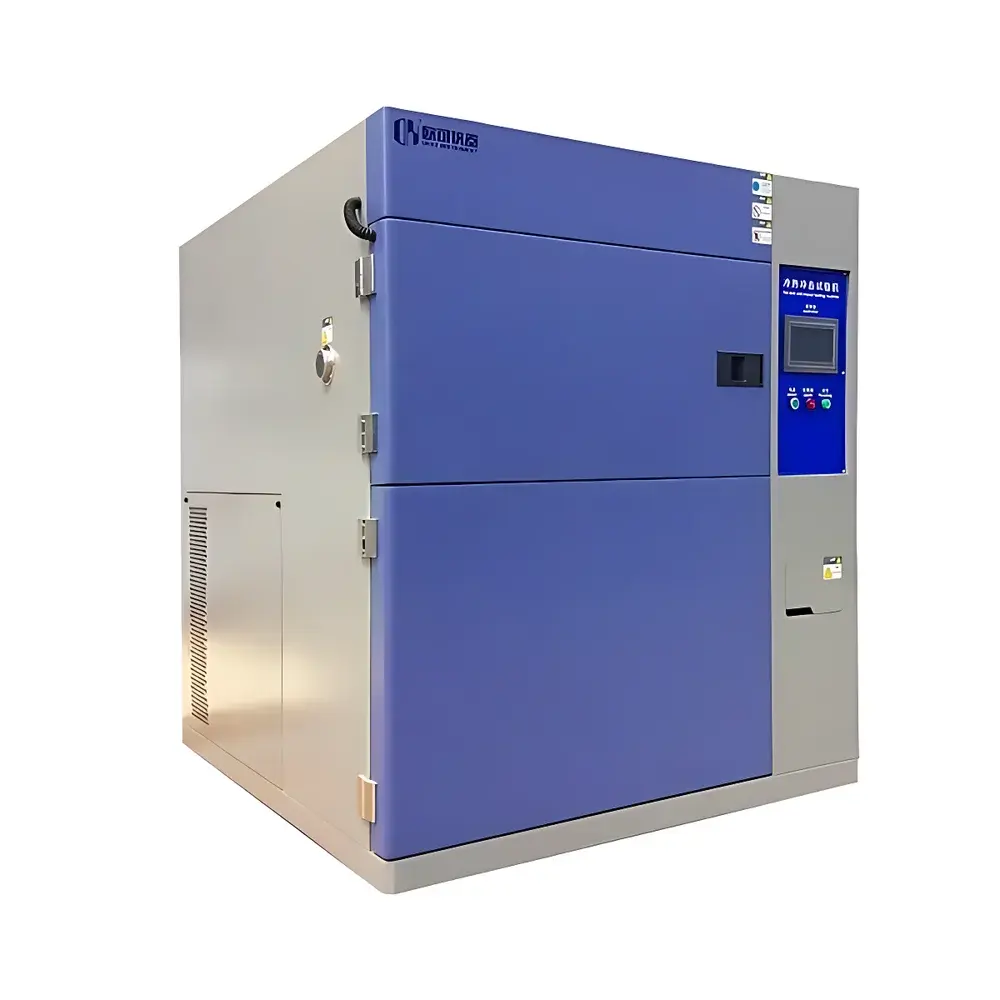
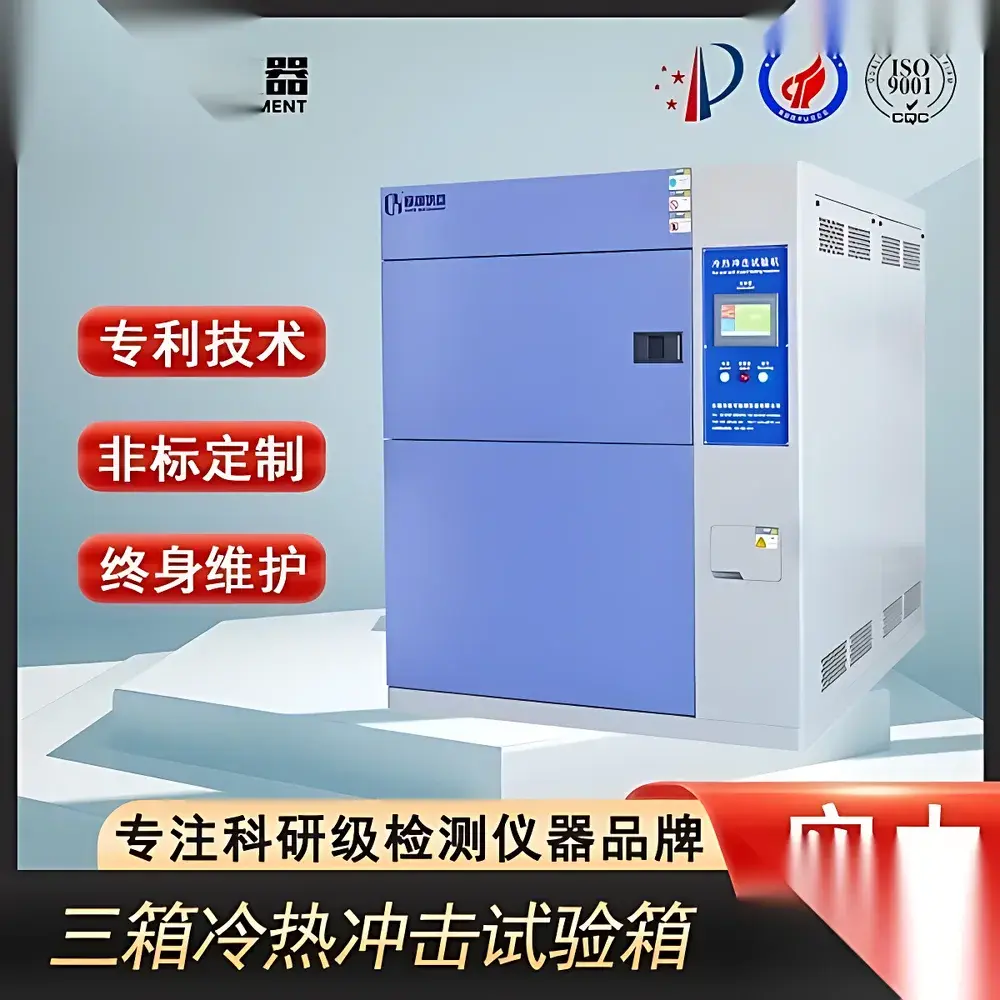
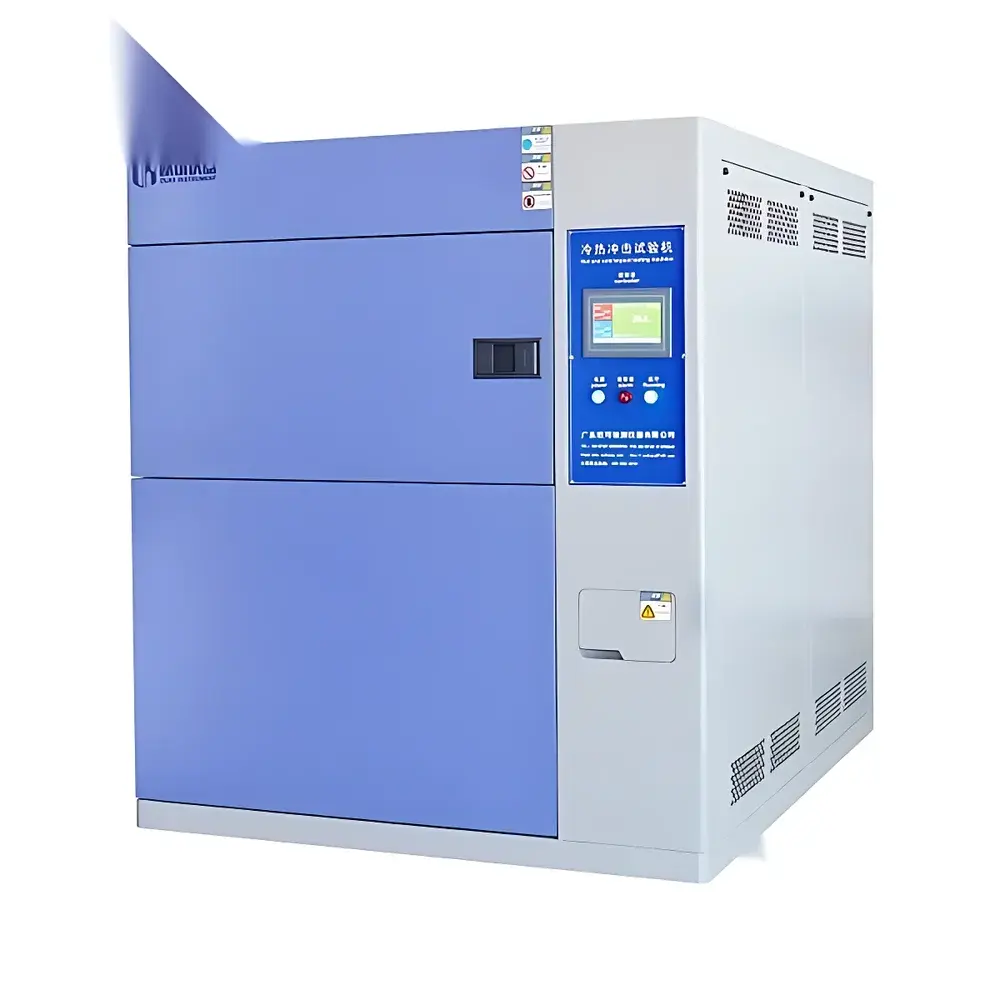
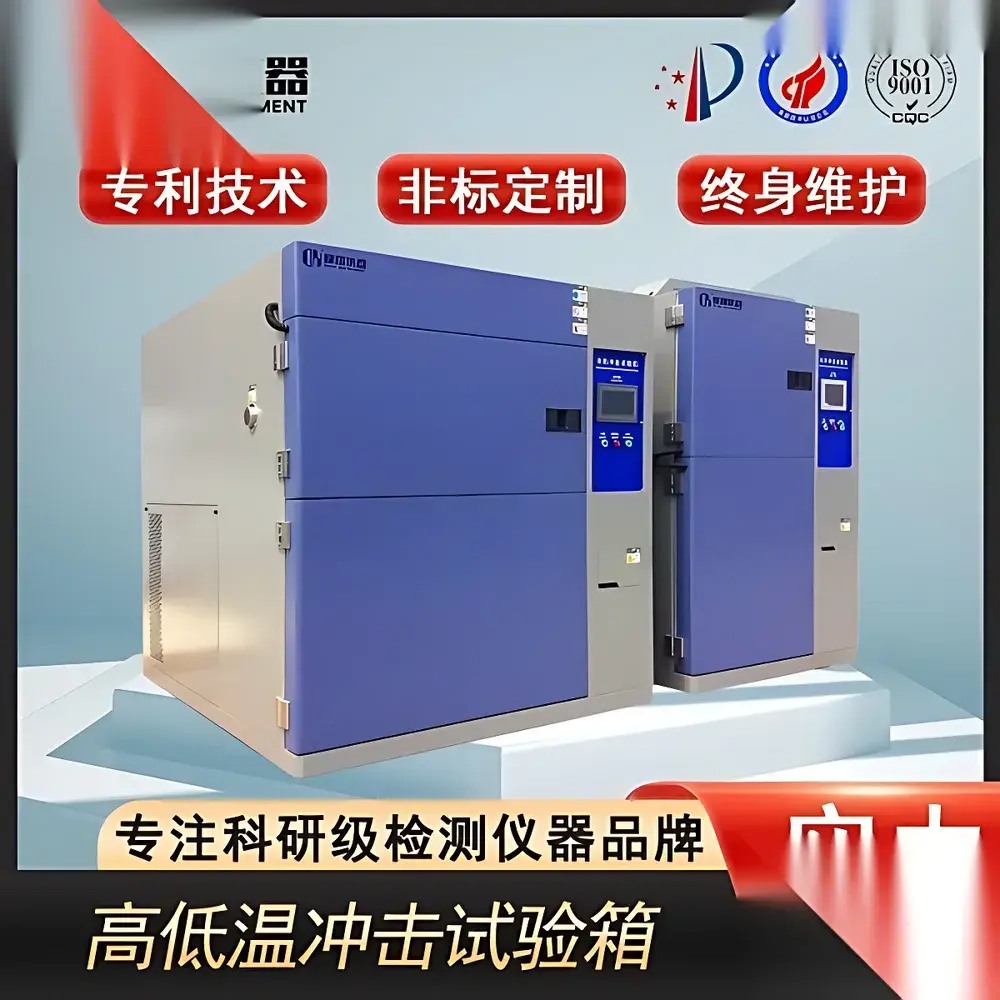
OK-TS Series Thermal Shock Test Chamber (Two-Zone or Three-Zone Configuration)
| Brand | OK Instruments |
|---|---|
| Origin | Imported |
| Manufacturer Type | Authorized Distributor |
| Price | USD 12,500–18,900 (FOB) |
| Internal Dimensions (W×H×D) | 40×35×30 cm to 70×60×60 cm |
| External Dimensions (W×H×D) | 145×180×140 cm to 190×170×270 cm |
| High-Temperature Reservoir Range | RT to +200 °C |
| Low-Temperature Reservoir Range | RT to –70 °C |
| Test Zone Temperature Range | +60 to +150 °C (hot shock) |
| Temperature Uniformity | ±2.0 °C |
| Temperature Control Accuracy | ±0.5 °C |
| Transition Time (Hot ↔ Cold) | < 5 min |
| Preheating Time (RT → 150 °C) | ~30 min |
| Precooling Time (RT → –70 °C) | ~85 min |
| Refrigeration System | Dual-stage cascade refrigeration with semi-hermetic compressors (Germany-sourced), R404A/R23 eco-friendly refrigerants |
| Cooling Water Requirement | 10 m³/h cooling tower (external, user-supplied) |
| Construction | Interior—SUS#304 mirror-finish stainless steel |
| Insulation | High-density fire-retardant PU foam |
| Power Supply | AC 380 V ±5%, 50 Hz ±0.5 Hz, 3-phase 5-wire |
Overview
The OK-TS Series Thermal Shock Test Chamber is an engineered environmental stress screening system designed for accelerated reliability assessment of materials and components under rapid, extreme temperature transitions. It operates on the principle of thermal shock—subjecting test specimens to repeated, abrupt shifts between high- and low-temperature reservoirs—to quantify resistance to thermo-mechanical fatigue, interfacial delamination, solder joint fracture, seal integrity loss, and dimensional instability. Unlike standard temperature cycling chambers, this system implements either a two-zone (hot/cold chamber with specimen-mounted basket transfer) or three-zone (separate hot reservoir, cold reservoir, and static test chamber) architecture, enabling precise control over dwell time, transition rate, and thermal gradient exposure per IEC 60068-2-14 (Test N), MIL-STD-810H Method 503.7, and GJB 150.5A–2009. Its dual-stage cascade refrigeration architecture—comprising independent high- and low-temperature circuits linked via an evaporative condenser—ensures stable operation down to –70 °C while maintaining reproducible ramp rates and minimal overshoot.
Key Features
- Dual configuration flexibility: Selectable two-zone (basket-transfer) or three-zone (static test chamber) layout to match application-specific throughput, specimen size, and thermal inertia requirements.
- High-fidelity temperature control: PID-based digital controllers with real-time feedback from multiple PT100 sensors ensure ±0.5 °C setpoint accuracy and ±2.0 °C uniformity across the test volume.
- Energy-regulated cascade refrigeration: Semi-hermetic compressors (Germany-sourced) paired with R404A (high-stage) and R23 (low-stage) refrigerants deliver rapid thermal recovery (<5 minutes between extremes) without compressor cycling-induced instability.
- Robust mechanical construction: Interior chamber fabricated from electropolished SUS#304 stainless steel; exterior housing in corrosion-resistant stainless steel or industrial-grade powder-coated steel; insulation using high-density, halogen-free, fire-rated polyurethane foam (UL94 V-0 compliant).
- Standardized interface provisions: One 50 mm diameter cable port (stainless steel grommet), two adjustable SUS#304 shelf levels, and rear-mounted 3-phase 5-wire power inlet (2.5 m cable length).
- Compliance-ready design: Pre-configured for audit traceability—including event logging, setpoint history, alarm records, and user-access controls—supporting GLP/GMP documentation workflows per FDA 21 CFR Part 11 when integrated with validated software.
Sample Compatibility & Compliance
The OK-TS chamber accommodates rigid and semi-rigid specimens up to 70 × 60 × 60 cm (internal volume: 225 L), including printed circuit boards (PCBs), automotive ECUs, aerospace composites, medical device housings, and polymer encapsulants. It supports standardized thermal shock profiles defined in GB/T 2423.22–2002 (Temperature Change), IEC 60068-2-14, MIL-STD-810H Method 503.7, GJB 150.5A–2009, and EIA-364-32 (for connector thermal cycling). All models are CE-marked and comply with EN 61000-6-2 (immunity) and EN 61000-6-4 (emission) standards. Optional calibration certificates (NIST-traceable) and IQ/OQ documentation packages are available for regulated industries requiring validation under ISO/IEC 17025 or ASTM E2297.
Software & Data Management
The embedded controller features a 7-inch TFT-LCD touchscreen interface with multilingual support (English, Chinese, Spanish), real-time graphing of chamber and specimen temperatures, and USB export of CSV-formatted test logs (timestamp, setpoints, actual values, alarms, door status). For enterprise integration, optional PC-based software enables remote monitoring via Ethernet, automated report generation (PDF/Excel), trend analysis, and secure user role management (admin/operator/viewer). Audit trail functionality—including operator ID, parameter changes, and calibration events—is configurable to meet FDA 21 CFR Part 11 electronic record requirements when deployed with digital signature and electronic audit log modules.
Applications
This thermal shock system is routinely deployed in quality assurance laboratories for qualification testing of electronic assemblies prior to field deployment; in R&D settings for failure mode identification in new material systems (e.g., thermally conductive adhesives, MEMS packaging); and in supplier certification programs for automotive Tier-1 vendors complying with AEC-Q200 stress testing protocols. Typical use cases include evaluating solder joint reliability in lead-free assemblies, assessing glass-to-metal seal integrity in hermetic sensors, validating thermal expansion coefficient (CTE) mismatch tolerance in multi-layer ceramic capacitors (MLCCs), and screening out latent defects in molded plastic connectors exposed to seasonal ambient extremes.
FAQ
What is the difference between two-zone and three-zone thermal shock configurations?
In a two-zone system, the test specimen moves between hot and cold chambers via a motorized basket; in a three-zone system, the specimen remains stationary in a central test chamber while air or gas is rapidly transferred between isolated hot and cold reservoirs—reducing mechanical stress on delicate samples and improving repeatability.
Is external cooling water mandatory?
Yes. The dual-stage cascade refrigeration system requires a continuous 10 m³/h flow of chilled water (15–25 °C inlet) supplied by an external cooling tower. This is specified in the installation manual and must be commissioned prior to operational qualification.
Can the chamber be calibrated to NIST-traceable standards?
Yes. Optional factory calibration includes as-found/as-left reports with uncertainty budgets, traceable to national metrology institutes. On-site recalibration services are available globally through authorized service partners.
Does the system support programmable multi-step thermal shock profiles?
Yes. Up to 99 segments per profile, each with independent dwell time, ramp rate, temperature setpoint, and chamber selection (hot/cold/test), stored in non-volatile memory with password-protected editing.
What safety protections are built into the refrigeration system?
Comprehensive safeguards include high/low pressure cutouts, compressor discharge temperature limiters, phase failure detection, refrigerant leak sensors, and emergency thermal shutdown triggered by sustained deviation >±3 °C from setpoint for >60 seconds.



