
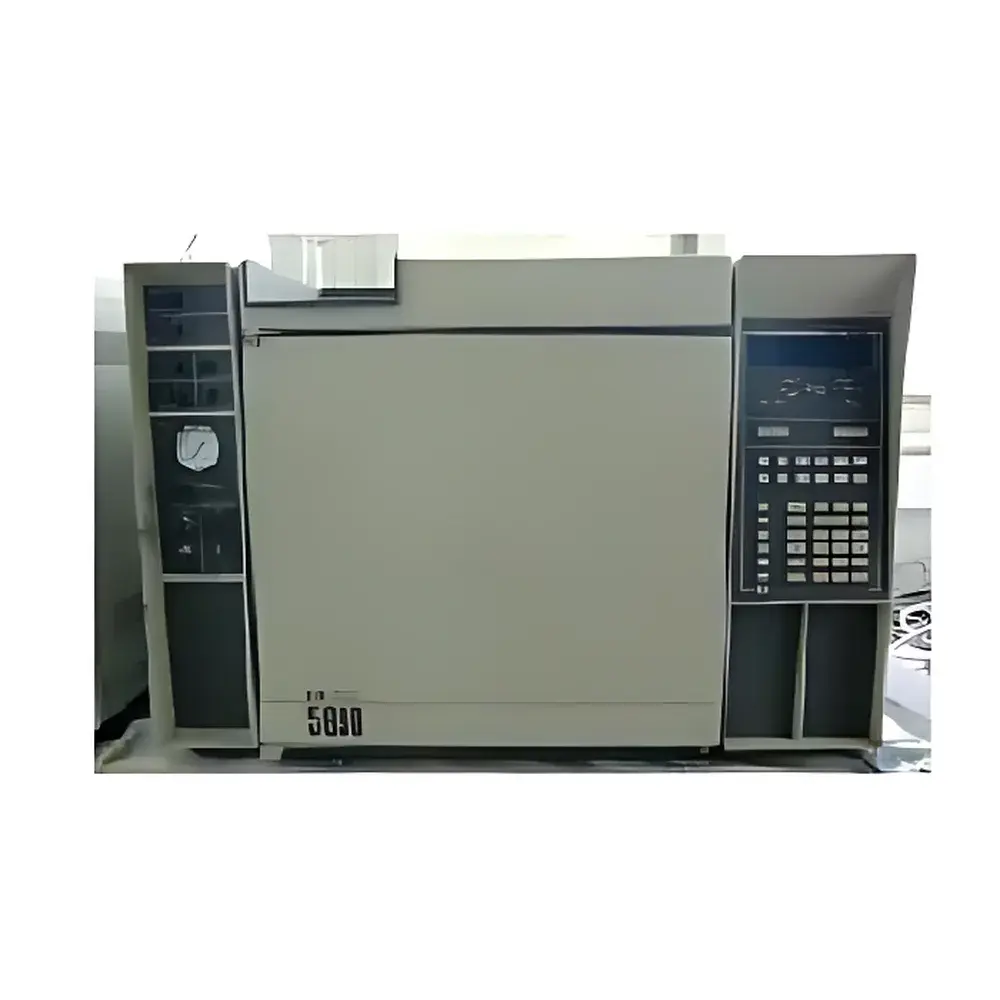
Agilent HP-5890 Gas Chromatograph (Refurbished)
| Brand | Agilent Technologies |
|---|---|
| Origin | USA |
| Manufacturer Type | Authorized Distributor |
| Origin Category | Imported Instrument |
| Model | HP-5890 |
| Instrument Type | Laboratory Gas Chromatograph |
| Application Scope | General-Purpose |
| Temperature Control Range | Ambient to 400 °C (oven), up to 400 °C (inlet) |
| Ramp Rate | 0.1–40 °C/min |
| Cool-Down Rate | 50 °C/min |
| Carrier Gas Flow Range & Control | 0–650 mL/min |
| Carrier Gas Pressure Range & Control | 0–8000 kPa |
| Injector Maximum Operating Temperature | 400 °C |
| Injector Pressure Setting Range | 0–700 kPa |
| Injector Total Flow Setting Range | 0–100 mL/min |
Overview
The Agilent HP-5890 Gas Chromatograph is a robust, benchtop laboratory gas chromatograph originally introduced in the late 1980s and widely deployed across academic, industrial, and regulatory laboratories for routine qualitative and quantitative analysis of volatile and semi-volatile organic compounds. This refurbished unit operates on the principle of partition chromatography, where analytes are separated based on differential distribution between a mobile phase (inert carrier gas—typically helium, hydrogen, or nitrogen) and a stationary phase coated on the inner wall of a fused-silica capillary column. Its dual-detector configuration (FID and FPD), combined with precise temperature-programmed oven control and flexible inlet operation, supports method development and compliance-driven workflows in environmental testing, petrochemical analysis, food safety screening, and forensic toxicology.
Key Features
- Thermally stable, microprocessor-controlled oven with programmable ramp rates from 0.1 to 40 °C/min and rapid cool-down capability (50 °C/min), enabling high-throughput method execution and reproducible retention time alignment.
- Split/splitless capillary inlet system with pressure and flow programming support, capable of operating at up to 400 °C and accommodating a wide range of sample matrices—including aqueous extracts, solvent dilutions, and headspace vapors.
- Flame Ionization Detector (FID) delivering linear dynamic range >10⁷ and picogram-level sensitivity for hydrocarbons and most organic compounds.
- Flame Photometric Detector (FPD) optimized for selective detection of sulfur- and phosphorus-containing compounds with wavelength-specific optical filtering and low-background flame stabilization.
- Integrated electronic pneumatic control (EPC) for carrier gas, makeup gas, and detector gases—ensuring consistent flow and pressure profiles across repeated injections and multi-day sequences.
- Refurbishment includes full mechanical inspection, leak-tested gas pathways, calibrated temperature sensors, verified detector response linearity, and firmware verification against original HP specifications.
Sample Compatibility & Compliance
The HP-5890 accommodates liquid, gaseous, and solid-phase microextraction (SPME) samples via standard 10–100 µL syringe injection or automated liquid sampler integration. It supports ASTM D3606 (benzene/toluene in gasoline), EPA Method 8021B (organophosphorus pesticides), and USP chromatographic system suitability requirements when operated with validated methods and documented calibration records. While not natively compliant with 21 CFR Part 11 out-of-the-box, its analog signal outputs and deterministic timing architecture allow integration into LIMS or validated data acquisition environments meeting GLP/GMP audit requirements—provided appropriate procedural controls, audit trails, and electronic signature protocols are implemented externally.
Software & Data Management
This unit ships with a localized Chinese-language chromatography data system (CDS) compatible with Windows-based workstations. The software provides real-time signal monitoring, peak integration using tangent skim and valley-to-valley algorithms, retention time locking (RTL) support for method transfer, and customizable report templates aligned with ISO/IEC 17025 documentation expectations. Raw data files are stored in proprietary binary format but exportable to ASCII (.csv) and AIA (.cdf) standards for third-party processing or long-term archival. All calibration curves, sequence logs, and instrument status reports are timestamped and user-annotatable to support traceability during internal QA reviews or external accreditation audits.
Applications
- Environmental: Quantification of BTEX (benzene, toluene, ethylbenzene, xylenes), chlorinated solvents (e.g., TCE, PCE), and PAHs in soil/water extracts per EPA SW-846 methods.
- Petrochemical: Hydrocarbon group-type analysis (PIONA), octane number estimation, and refinery stream profiling using simulated distillation (SimDis) protocols.
- Food & Flavor: Residual solvent testing in packaging materials, pesticide residue screening in fruits/vegetables, and essential oil composition profiling.
- Pharmaceutical: Assay of residual solvents in APIs per ICH Q3C guidelines; stability-indicating assays for oxidation-prone small molecules.
- Forensic: Detection and quantification of accelerants in arson debris, toxicological screening for volatiles (e.g., ethanol, methanol, isopropanol).
FAQ
Is this unit eligible for extended warranty or service contract support?
Yes—qualified refurbished HP-5890 systems are eligible for optional Agilent-certified service plans through authorized third-party providers, covering preventive maintenance, detector refurbishment, and on-site technical escalation.
Can modern autosamplers be interfaced with this model?
The HP-5890 features standard TTL and RS-232 interfaces compatible with legacy HP G1888 or G1889 autosamplers, as well as select third-party models supporting GC trigger synchronization and status polling.
What documentation accompanies the instrument?
Each unit includes a refurbishment certificate, post-calibration verification report (oven temp accuracy ±0.5 °C, inlet pressure repeatability ±0.5% FS), detector sensitivity test data, and full electrical safety certification per UL 61010-1.
Is method transfer from newer Agilent GCs feasible?
Yes—retention time locking (RTL) and retention index normalization enable cross-platform method portability when using identical column chemistry and comparable thermal gradients.
Does the system meet current ISO/IEC 17025 traceability requirements?
When operated under documented SOPs—including daily system suitability tests, certified reference standards, and technician training records—the HP-5890 satisfies the technical competence criteria outlined in ISO/IEC 17025:2017 Clause 6.4 and 6.5.
Related Products






