
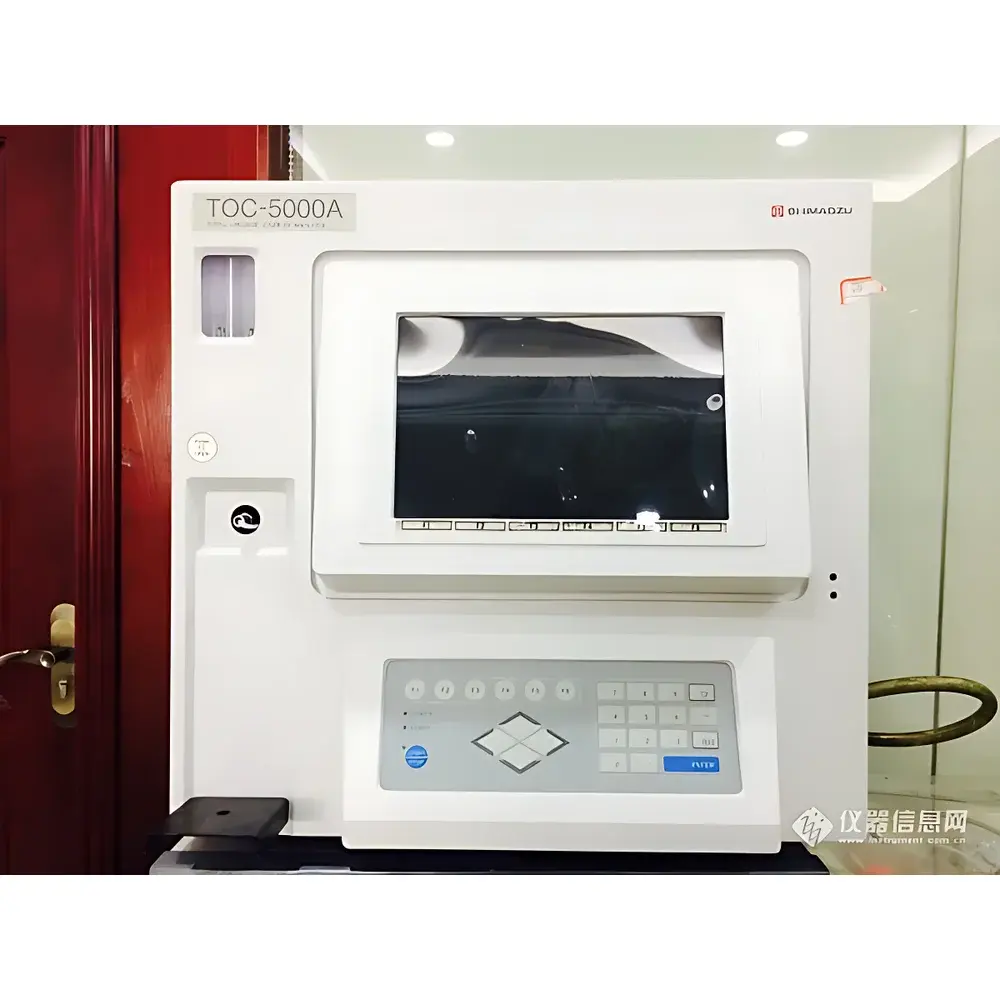
Shimadzu TOC-5000A Total Organic Carbon Analyzer (Refurbished)
| Brand | Shimadzu |
|---|---|
| Origin | Japan |
| Model | TOC-5000A |
| Instrument Type | Laboratory TOC Analyzer |
| Oxidation Method | UV/Persulfate Oxidation |
| Measurement Range | 0–50,000 ppm C |
| Accuracy | ±4% |
| Detection Limit | 0.005 ppm C |
| Resolution | 0.001 ppb C |
| Repeatability | ≤3% RSD |
| Sample Types | Liquid (aqueous), Solid (soil, sludge, sediment, wipe samples), Suspended Solids-Rich Water |
| Compliance | Designed for GLP/GMP environments with audit-ready operation |
Overview
The Shimadzu TOC-5000A is a high-performance, dual-mode total organic carbon analyzer engineered for precise quantification of organic carbon content across diverse sample matrices—including aqueous solutions, suspended solids-laden waters, soils, sludges, sediments, and surface wipe extracts. Its core measurement principle relies on catalytic UV/persulfate oxidation, followed by non-dispersive infrared (NDIR) detection of evolved CO₂. This oxidation pathway ensures complete mineralization of refractory and non-volatile organic compounds under controlled acidic and oxidative conditions—critical for regulatory compliance in pharmaceutical cleaning validation, environmental monitoring, and wastewater treatment process control. Unlike single-mode TOC analyzers, the TOC-5000A integrates hardware and firmware architecture compatible with both liquid-phase (TOC-L) and solid-phase (SSM-5000A) measurement protocols, enabling seamless mode switching via front-panel configuration without hardware modification or recalibration.
Key Features
- Dual operational mode: Supports both TOC-L (liquid samples) and SSM-5000A (solid samples) methodologies within a single instrument platform.
- UV/persulfate oxidation system: Delivers robust and reproducible oxidation efficiency for complex organic matrices, including humic substances, polymers, and particulate-bound organics.
- NDIR CO₂ detection: Provides high selectivity, low drift, and long-term stability with minimal interference from inorganic anions or volatile acids.
- Solid sample capability: Accepts up to 1.0 g of solid material with maximum carbon loading of 30 mg C—optimized for heterogeneous environmental solids where homogenization and subsampling errors are minimized.
- High sensitivity and dynamic range: Detection limit of 0.005 ppm C and linear response over 0–50,000 ppm C supports trace-level clean verification and high-concentration industrial effluent analysis.
- Integrated acidification and sparging: Removes inorganic carbon (IC) prior to TOC determination using programmable acid addition and inert gas purging—ensuring accurate TOC = TC – IC calculation.
- Front-panel mode selection: Enables rapid transition between aqueous and solid sample workflows without software reconfiguration or external accessories.
Sample Compatibility & Compliance
The TOC-5000A accommodates a broad spectrum of regulated and research-grade samples: clarified and turbid waters (including seawater and wastewater with >100 mg/L suspended solids), freeze-dried or air-dried soils, digested sludges, sediment cores, and pharmaceutical surface wipes extracted in ultrapure water or dilute alkali. It is routinely deployed in facilities operating under cGMP, ISO 17025, and USP guidelines for TOC testing. While the instrument itself does not include built-in 21 CFR Part 11-compliant electronic signatures, its data output structure (ASCII text, time-stamped raw signals, and method metadata) supports integration into validated LIMS or ELN systems with full audit trail capabilities. The system meets ASTM D7573-22 requirements for solid-phase TOC determination and aligns with EPA Method 415.3 for aqueous TOC analysis when operated per manufacturer-specified calibration and QC protocols.
Software & Data Management
Data acquisition and reporting are managed via Shimadzu’s proprietary TOC Control software (v3.x or later), which runs on Windows-based host PCs connected via RS-232 or USB. The software enables method storage, calibration curve management (linear, quadratic, or multi-point), QC flagging (e.g., blank drift >0.5 ppb, recovery outside 85–115%), and automated report generation compliant with laboratory quality standards. All analytical sequences—including acid addition timing, oxidation duration, purge cycles, and detector stabilization periods—are fully programmable and logged with timestamps. Raw chromatograms (CO₂ peak area vs. time) and integrated results are exportable in CSV and PDF formats. For GxP environments, instrument qualification documentation (IQ/OQ templates) and calibration log templates are available upon request from authorized Shimadzu service partners.
Applications
- Pharmaceutical cleaning validation: Quantifying residual organic contaminants on equipment surfaces via swab/wipe extraction.
- Environmental site assessment: Measuring TOC in soil cores and groundwater to assess hydrocarbon contamination or natural organic matter distribution.
- Wastewater treatment optimization: Monitoring influent/effluent TOC to evaluate biological degradation efficiency and membrane fouling potential.
- Drinking water safety: Verifying disinfection by-product precursor removal in advanced oxidation and activated carbon processes.
- Academic and regulatory research: Supporting method development for emerging contaminants (e.g., PFAS co-oxidation behavior, microplastic-associated carbon).
- Power plant chemistry: Assessing organic ingress in boiler feedwater and condensate systems where low-ppb TOC impacts corrosion and deposition rates.
FAQ
Does the TOC-5000A support total nitrogen (TN) analysis?
No. The TOC-5000A is dedicated exclusively to carbon quantification. It does not incorporate chemiluminescent or thermal conductivity detection for nitrogen species.
Can it analyze samples with high chloride concentrations?
Yes—when operated with appropriate acid concentration and persulfate dosage, the system tolerates chloride levels up to 10,000 mg/L without significant interference, though method validation is recommended for each matrix.
What maintenance is required for long-term reliability?
Routine maintenance includes quarterly NDIR cell cleaning, annual UV lamp replacement, biannual pump tubing inspection, and daily system blanks to verify baseline stability.
Is factory refurbishment documentation available?
Yes—each refurbished unit includes a full functional test report, calibration certificate traceable to NIST SRMs, and six-month limited hardware warranty covering detector, furnace, and fluidic assemblies.
How is solid sample homogeneity addressed during analysis?
The instrument accepts up to 1.0 g of sample mass, reducing subsampling error; users are advised to perform replicate analyses (n ≥ 3) and apply certified reference materials (e.g., NIST SRM 2710a) for method-specific precision assessment.
Related Products







