
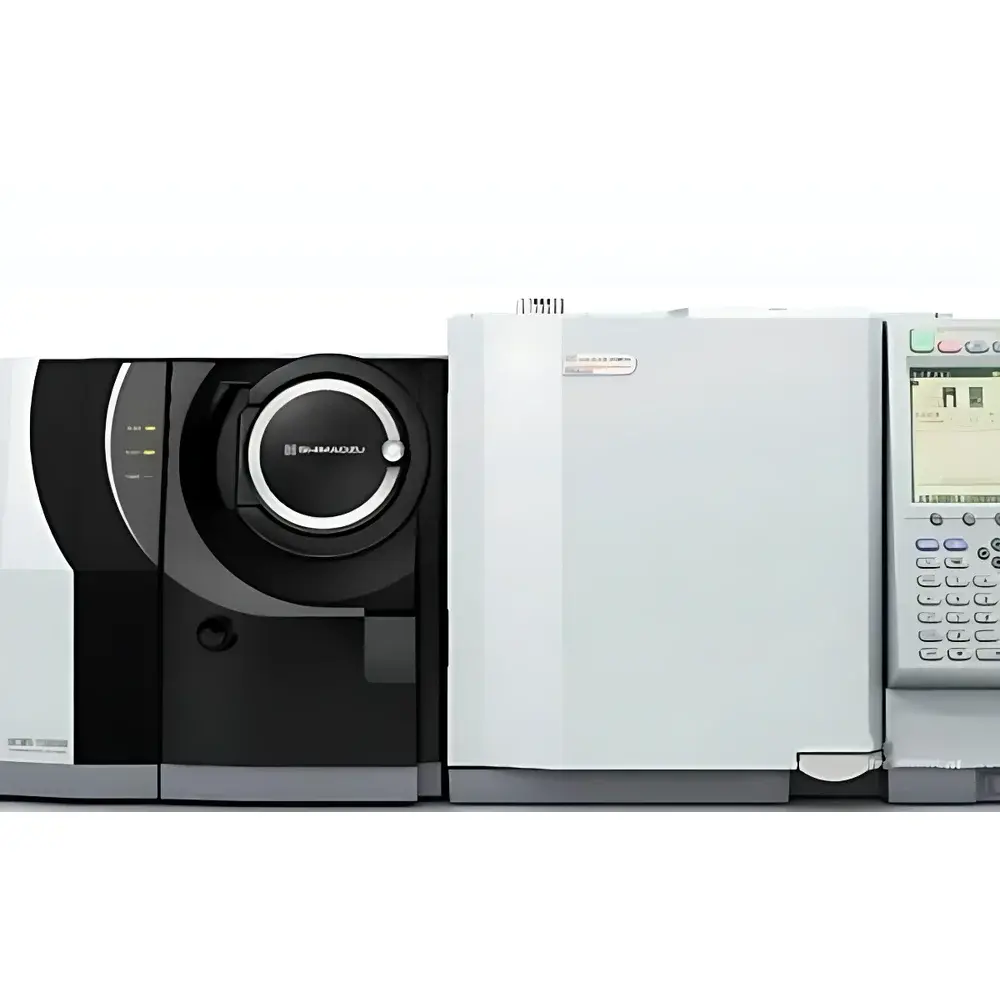
Shimadzu Used GC-MS/MS System GCMS-TQ8050 Triple Quadrupole Gas Chromatograph Mass Spectrometer
| Brand | Shimadzu |
|---|---|
| Origin | Japan |
| Model | GCMS-TQ8050 |
| Mass Range | 1–1000 m/z |
| Resolution | 1000–2000 (unit mass) |
| Sensitivity | >300:1 (S/N, at 1 pg OFN, MRM mode) |
| Scan Speed | 15,000 u/s |
| Ion Source | High-brightness, low-contamination EI source |
| Detector | Ultra-high-gain electron multiplier with triple-noise-reduction architecture |
| Vacuum System | Dual-inlet, high-capacity turbomolecular pump (oil-free forepump, 3-year maintenance interval) |
| Software | LabSolutions Insight with Smart MRM and audit-trail-enabled precision management |
Overview
The Shimadzu GCMS-TQ8050 is a high-performance triple quadrupole gas chromatography–tandem mass spectrometry (GC-MS/MS) system engineered for ultra-trace quantitative analysis in regulated and research environments. Unlike single-quadrupole or Orbitrap-based platforms — which are misclassified in the source data — the GCMS-TQ8050 employs a true three-stage quadrupole architecture: Q1 (mass selection), q2 (collision cell with controlled CID gas), and Q3 (mass-analyzed detection). This configuration enables highly selective multiple reaction monitoring (MRM), essential for analyzing complex matrices with co-eluting interferences — such as environmental extracts, biological fluids, pharmaceutical residuals, and food contaminants. Its core design emphasizes signal fidelity under low-abundance conditions: the ultra-gain detector delivers enhanced ion transmission efficiency while maintaining linearity across five orders of magnitude, and the integrated triple-noise-reduction circuitry suppresses electronic, thermal, and chemical background contributions without compromising duty cycle.
Key Features
- Triple quadrupole mass analyzer with independent RF/DC control on Q1 and Q3 for precise precursor and product ion selection
- High-brightness, low-contamination electron ionization (EI) source with extended operational lifetime and reduced downtime from cleaning cycles
- Ultra-high-gain electron multiplier detector incorporating hardware-level noise suppression across analog front-end, pulse processing, and digital conversion stages
- Dual-inlet, high-capacity turbomolecular pumping system (≥340 L/s effective speed) ensuring stable high-vacuum conditions (<5 × 10⁻⁷ Pa) during rapid polarity switching and high-throughput MRM sequences
- Oil-free scroll forepump certified for ≥3 years of continuous operation without oil replacement or scheduled maintenance
- UFsweeper™ high-speed scanning technology enabling simultaneous acquisition of full-scan, SIM, and up to 1,024 MRM transitions within a single run
- Smart MRM method builder automating optimal collision energy, dwell time, and retention time window assignment based on compound class and instrument calibration history
Sample Compatibility & Compliance
The GCMS-TQ8050 supports diverse sample introduction modalities via standardized GC interfaces, including split/splitless injectors, programmable temperature vaporizers (PTV), and cold on-column inlets. When paired with optional accessories — such as the HS-20 headspace sampler or AOC-6000 multi-mode autosampler — it meets ASTM D3699 (residual solvents in pharmaceuticals), USP , ISO 17025 method validation requirements, and EU Pharmacopoeia 2.2.48 guidelines. The system operates in full compliance with 21 CFR Part 11 when configured with LabSolutions Insight v5.9+ and enabled audit trail, electronic signature, and role-based access controls. All hardware components conform to IEC 61010-1 safety standards and CE/UKCA marking for laboratory instrumentation.
Software & Data Management
LabSolutions Insight serves as the validated, enterprise-ready data system for the GCMS-TQ8050. It provides integrated sequence management, real-time MRM optimization, automated calibration verification, and QC failure alerting. Precision management tools include automatic peak integration consistency checks, internal standard response ratio trending, and batch-level statistical summaries (RSD%, recovery %, LOD/LOQ confirmation). Raw data files (.qgd) are stored in vendor-neutral formats compatible with third-party review software (e.g., Chromeleon, OpenLab CDS). Audit trails record all user actions — method edits, data reprocessing, report generation — with immutable timestamps and operator identifiers, satisfying GLP/GMP documentation integrity requirements.
Applications
This platform is routinely deployed in laboratories performing regulatory-compliant quantitation of target analytes at sub-ppt levels. Key use cases include: pesticide residue screening in fruits and vegetables per EPA Method 1694; nitrosamine impurity profiling in APIs per ICH M7(R2); polycyclic aromatic hydrocarbons (PAHs) in soil extracts per ISO 18856; veterinary drug residues in milk and meat per EU Commission Decision 2002/657/EC; and volatile organic compounds (VOCs) in drinking water per EPA Method 524.3. Its robustness in high-sample-volume workflows makes it suitable for contract testing labs, quality control units in pharma manufacturing, and national reference laboratories conducting proficiency testing.
FAQ
Is the GCMS-TQ8050 compatible with both EI and NCI ionization modes?
Yes — optional electron capture negative ionization (NCI) and chemical ionization (CI) sources are available as factory-installed or field-upgradeable modules.
Does the system support method transfer from other Shimadzu GC-MS platforms?
Full backward compatibility is maintained with GCMS-QP2010 Ultra and GCMS-QP2020 methods; migration tools in LabSolutions Insight automate parameter mapping and sensitivity recalibration.
What vacuum performance specifications apply to the used unit?
All refurbished GCMS-TQ8050 systems undergo full vacuum integrity testing: base pressure ≤3 × 10⁻⁷ Pa, leak rate <1 × 10⁻⁹ Pa·m³/s (He), verified with calibrated residual gas analyzer.
Can the instrument be validated according to IQ/OQ/PQ protocols?
Shimadzu-certified service engineers provide GxP-compliant installation qualification (IQ), operational qualification (OQ), and performance qualification (PQ) packages aligned with ASTM E2656 and ISO/IEC 17025 Annex A.2.
Is remote diagnostics supported?
Yes — optional Secure Remote Support (SRS) module enables encrypted, permission-controlled access for firmware updates, log analysis, and real-time troubleshooting by Shimadzu Field Application Specialists.






