
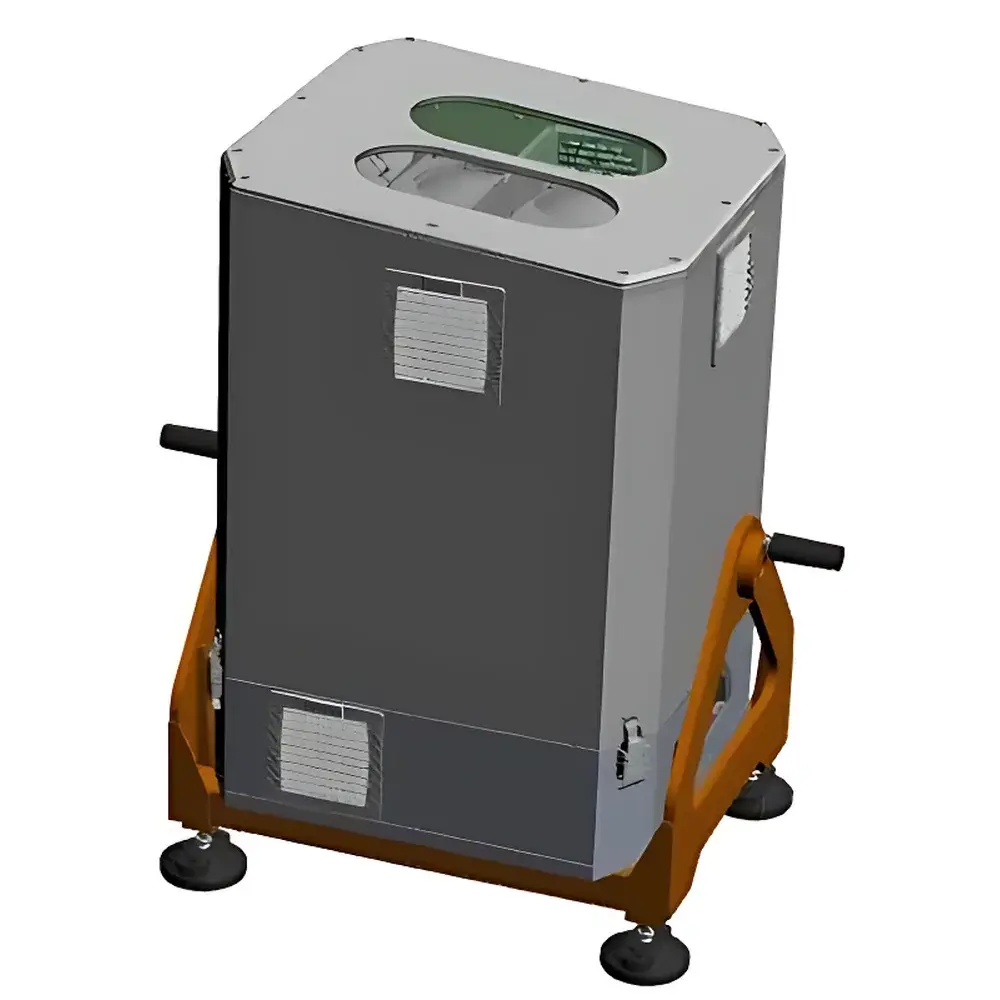
Cimel MINI MPL CE376 Compact Automated Aerosol Lidar
| Brand | Cimel |
|---|---|
| Origin | France |
| Model | CE376 |
| Laser Sources | Frequency-doubled Nd:YAG (532 nm), Pulsed Laser Diode (<850 nm) |
| Detectors | APD with QE 55% / 70% |
| Operating Wavelengths | 532 nm (green) and <850 nm (NIR) |
| Maximum Detection Altitude | 13 km |
| Pulse Repetition Rate | 5000 Hz |
Overview
The Cimel MINI MPL CE376 is a compact, fully automated micro-pulse lidar (MPL) system engineered for continuous, unattended vertical profiling of atmospheric aerosols, clouds, and planetary boundary layer (PBL) structure. It operates on the fundamental principle of elastic backscatter lidar: short-duration laser pulses at 532 nm (frequency-doubled Nd:YAG) and near-infrared wavelengths (<850 nm) are transmitted vertically into the atmosphere; photons scattered by atmospheric constituents—molecules, aerosol particles, and cloud droplets—are collected by a co-aligned or dual-axis telescope. The time-of-flight between pulse emission and photon detection determines the altitude-resolved range, while the intensity and polarization state of the returned signal encode information on particle concentration, size distribution, shape, and composition. Unlike scanning or Doppler lidars, the CE376 focuses on high-temporal-resolution vertical profiling with minimal infrastructure requirements—ideal for long-term monitoring networks, urban air quality stations, and remote field deployments where power efficiency, reliability, and low maintenance are critical.
Key Features
- Compact, turnkey design optimized for permanent outdoor installation—no climate-controlled shelter required.
- Low-power, high-repetition-rate lasers (5000 Hz) enable high signal-to-noise ratio (SNR) profiles with sub-minute temporal resolution.
- Dual-wavelength operation (532 nm + NIR) supports multi-parameter retrieval including extinction coefficient, backscatter coefficient, and lidar ratio.
- Integrated output power monitoring for each laser channel ensures stable calibration over extended operational periods (>1 year without intervention).
- Dual-axis optical architecture per wavelength minimizes near-range blind zone and improves overlap correction accuracy.
- Optional depolarization receiver channels enable quantitative discrimination of non-spherical particles (e.g., dust, volcanic ash, ice crystals) via depolarization ratio calculation.
- Photon-counting avalanche photodiodes (APDs) with quantum efficiency up to 70% provide high sensitivity across both spectral bands.
- Automated thermal and mechanical stabilization maintains optical alignment under varying ambient conditions.
Sample Compatibility & Compliance
The CE376 is designed for open-air, real-time atmospheric sampling—requiring no sample extraction, filtration, or conditioning. It measures naturally occurring atmospheric scatterers across altitudes from ~150 m AGL to 13 km, covering tropospheric aerosol layers, mixed-phase clouds, cirrus, and stratospheric events (e.g., volcanic plumes). Its measurement methodology aligns with ISO 17123-9 (optical remote sensing of atmospheric constituents) and supports traceable data generation compliant with GAW (Global Atmosphere Watch) and EARLINET (European Aerosol Research Lidar Network) protocols. While not a regulated medical or industrial safety device, its raw and processed outputs are suitable for regulatory reporting frameworks requiring aerosol optical depth (AOD), PBL height, and cloud base detection—consistent with EPA, EEA, and WMO observational standards.
Software & Data Management
The CE376 ships with Cimel’s proprietary MPLVIEW software suite, compatible with Windows OS (7/10/11, 64-bit). It provides end-to-end automation: real-time signal acquisition, onboard noise suppression, overlap correction, molecular backscatter subtraction, and reference-layer identification in clear-sky conditions. Data inversion routines apply Fernald/Klett-type algorithms to derive calibrated backscatter and extinction profiles. Software supports integration of external AOD (e.g., from sun photometers) and radar ratio constraints for improved extinction retrieval. All processing steps—including calibration coefficients, correction parameters, and metadata—are logged with timestamped audit trails. Export formats include NetCDF-4 (CF-compliant), ASCII, and HDF5—enabling interoperability with Python (PyLidar), MATLAB, and atmospheric modeling platforms (e.g., WRF-Chem, CAMS). Full data provenance complies with FAIR principles (Findable, Accessible, Interoperable, Reusable).
Applications
- Long-term aerosol climatology and source apportionment in urban, rural, and coastal environments.
- Planetary boundary layer height tracking for air quality forecasting and dispersion modeling.
- Volcanic ash and desert dust transport monitoring for aviation safety and health advisories.
- Cloud macrophysical property characterization (base/top height, phase detection, vertical extent) for climate model validation.
- Calibration and validation of satellite-based lidar missions (e.g., CALIPSO, ATLID on EarthCARE).
- Real-time support for field campaigns (e.g., ACEPOL, EUREC⁴A) requiring autonomous, high-cadence vertical profiling.
- Integration into national air quality monitoring networks (e.g., China’s CNEMC, U.S. IMPROVE, EU’s ACTRIS).
FAQ
What is the minimum detectable backscatter coefficient at 532 nm?
Instrument sensitivity is dependent on integration time and atmospheric conditions; typical detection limit is ~1×10⁻⁷ m⁻¹·sr⁻¹ for 1-hour averages at 532 nm under clear-sky conditions.
Does the CE376 require external calibration sources?
No—absolute calibration is performed using Rayleigh scattering from molecular atmosphere in clean, cloud-free conditions; no radioactive or lamp-based references are needed.
Can the system operate autonomously for extended periods?
Yes—designed for unattended operation with remote diagnostics, watchdog timers, and automatic recovery from power interruptions; typical field deployment duration exceeds 12 months without service intervention.
Is the depolarization channel mandatory?
No—it is an optional configuration; standard CE376 units include single-polarization reception, while depolarization-capable variants add orthogonal polarization detection for particle shape analysis.
How is data synchronization handled when integrating with other sensors (e.g., ceilometers, sun photometers)?
Precise GPS-synchronized timestamps (1 µs resolution) ensure temporal alignment; NTP and PTP support enables network-wide clock coherence across multi-instrument sites.
Related Products







