
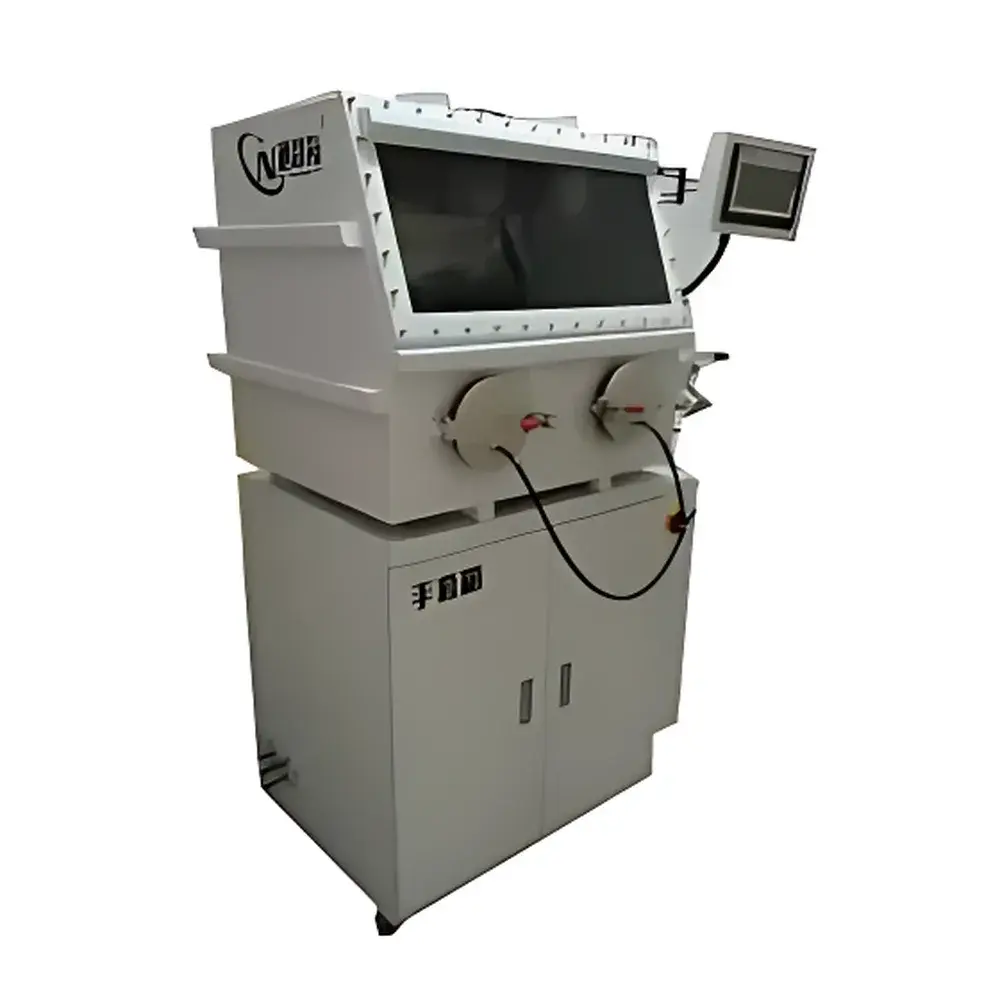
Cnonline ST-1 Research-Grade Inert Atmosphere Glove Box
| Brand | Cnonline |
|---|---|
| Origin | Hunan, China |
| Manufacturer Type | Authorized Distributor |
| Country of Origin | China |
| Model | ST-1 |
| Application Category | Research-Grade Glove Box |
| Chamber Material | 304 Stainless Steel |
| Dimensions (L×W×H) | 1200 × 640 × 1000 mm |
| Chamber Volume | 630 L |
| Antechamber Volume | 23 L |
| Number of Gloves | 1 pair |
| H₂O Content | <1 ppm |
| O₂ Content | <1 ppm |
| Leakage Rate | <0.05 vol%/h |
| Temperature Range | +4 to 42 °C |
| Relative Humidity Range | 35–100 %RH |
| Glove Material | Imported Butyl Rubber |
| Glove Diameter | 200 mm |
| Glove Thickness | 0.4 mm |
| Control Interface | Chinese-language HMI with intuitive human-machine interaction |
Overview
The Cnonline ST-1 Research-Grade Inert Atmosphere Glove Box is an engineered containment system designed for the precise manipulation and characterization of air- and moisture-sensitive materials under rigorously controlled inert gas environments. Utilizing a closed-loop recirculation architecture integrated with dual-stage purification—comprising catalytic oxygen removal and molecular sieve-based water adsorption—the ST-1 achieves and sustains ultra-low residual contamination levels (<1 ppm O₂ and <1 ppm H₂O) within its 630 L main chamber. Its structural integrity derives from a monolithic 304 stainless steel chassis with electrophoretic epoxy coating, ensuring long-term corrosion resistance and vacuum-tight performance. The system operates across a regulated ambient temperature range of +4 to 42 °C and supports adjustable relative humidity (35–100 %RH), enabling both anhydrous synthesis and controlled-humidity experiments without chamber modification. Designed in accordance with ISO 14644-1 Class 5 cleanroom-compatible sealing standards, the ST-1 serves as a foundational platform for reproducible experimentation in battery electrode development, organometallic chemistry, perovskite photovoltaics, and sterile microbiological handling.
Key Features
- Robust 304 stainless steel construction with powder-coated exterior finish for chemical resistance and mechanical durability
- Integrated dual-purification module: high-efficiency catalytic deoxygenation coupled with regenerable molecular sieve desiccant beds
- Low-leakage sealed architecture with verified leakage rate <0.05 vol%/h (per ASTM E493–20 standard test methodology)
- Dedicated antechamber (23 L volume) with interlocked dual-door mechanism to minimize inert gas consumption during sample transfer
- Ergonomic butyl rubber gloves (200 mm diameter, 0.4 mm thickness) offering superior flexibility, chemical resistance, and tactile sensitivity
- Onboard environmental monitoring with real-time digital display of O₂, H₂O, pressure differential, and temperature/humidity status
- Modular electrical infrastructure including multiple grounded AC outlets and LED task lighting compliant with IEC 61000-6-3 EMC requirements
Sample Compatibility & Compliance
The ST-1 accommodates a broad spectrum of sample types—including lithium metal foils, alkali metal reagents, transition metal catalysts, hygroscopic polymers, and anaerobic biological cultures—without cross-contamination risk. Its internal geometry supports standard labware (e.g., Schlenk flasks, crucibles, petri dishes) and integrates seamlessly with external instrumentation via standardized feedthrough ports (optional). All material contact surfaces comply with USP Class VI biocompatibility testing criteria. While not certified for GMP manufacturing, the system meets essential prerequisites for GLP-compliant research workflows, including audit-ready operational logs, configurable alarm thresholds, and traceable parameter history—facilitating alignment with FDA 21 CFR Part 11 data integrity expectations when paired with validated third-party data acquisition software.
Software & Data Management
The ST-1 employs an embedded Chinese-language HMI (Human-Machine Interface) built on ARM Cortex-A9 architecture, supporting intuitive touch-based navigation for gas purge cycles, regeneration scheduling, and alarm acknowledgment. System event logs—including door actuation timestamps, purification cycle durations, and sensor deviation alerts—are stored locally on non-volatile flash memory with 30-day rolling retention. For integration into centralized laboratory informatics systems, optional RS-485/Modbus RTU and Ethernet TCP/IP interfaces enable bidirectional communication with LIMS or ELN platforms. Raw sensor outputs (O₂/H₂O ppm, chamber pressure, RH %) are exportable in CSV format for post-acquisition statistical analysis using MATLAB, Python (Pandas), or JMP.
Applications
- Lithium-ion and solid-state battery R&D: electrode slurry preparation, coin-cell assembly, and post-cycling material analysis under argon
- Organometallic synthesis: Grignard, lithiation, and Ziegler–Natta reactions requiring sub-ppm O₂/H₂O conditions
- Perovskite solar cell fabrication: spin-coating, thermal annealing, and encapsulation testing in nitrogen-rich atmospheres
- Pharmaceutical stability studies: forced degradation of moisture-sensitive APIs under programmable RH profiles
- Agricultural seed physiology: hypoxia and controlled-humidity germination assays mimicking soil microenvironments
- Microaerophilic microbiology: cultivation of oxygen-sensitive strains (e.g., Clostridium, Bifidobacterium) without anaerobic jars
FAQ
What inert gases are compatible with the ST-1 glove box?
The system is optimized for argon and nitrogen; helium operation is possible but requires recalibration of flow sensors due to differing viscosity and thermal conductivity.
Can the ST-1 be upgraded to support solvent vapor management?
Yes—optional activated carbon or custom adsorbent cartridges can be installed in the recirculation loop to mitigate organic solvent breakthrough during glove changes or extended operations.
Is remote monitoring supported out-of-the-box?
Local HMI-only operation is standard; remote access requires installation of an external industrial IoT gateway and configuration of secure TLS 1.2 tunnels.
What maintenance intervals are recommended for the purification system?
Catalyst beds require regeneration every 3–6 months depending on usage intensity; molecular sieves should be thermally regenerated quarterly or after >1000 hours of continuous operation.
Does the ST-1 meet CE or UL safety certification requirements?
The base configuration complies with IEC 61010-1:2010 for laboratory electrical equipment; CE marking is available upon request with additional conformity assessment documentation.



