
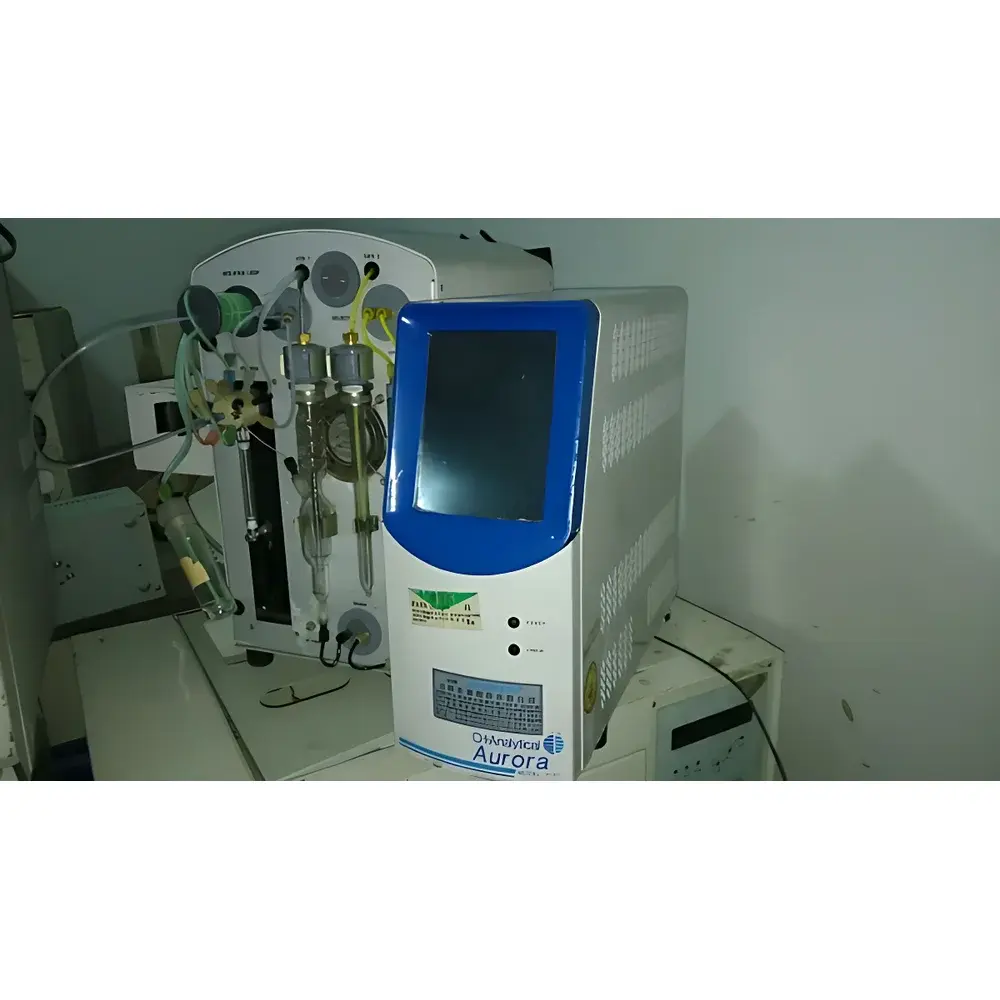
Shimadzu TOC-L Series 1030A Total Organic Carbon Analyzer
| Origin | Beijing, China |
|---|---|
| Manufacturer Type | Authorized Distributor |
| Origin Category | Domestic (China) |
| Model | 1030A |
| Price | USD 7,200 (FOB Beijing) |
Overview
The Shimadzu TOC-L Series 1030A Total Organic Carbon Analyzer is a high-precision, regulatory-compliant instrument engineered for quantitative determination of total organic carbon (TOC), total inorganic carbon (TIC), non-purgeable organic carbon (NPOC), and total carbon (TC) in aqueous matrices. It employs high-temperature catalytic oxidation (680 °C) coupled with persulfate UV/persulfate chemical oxidation—enabling reliable measurement across an exceptionally wide dynamic range: 2 ppb C to 30,000 ppm C. The system utilizes a dual-path NDIR (non-dispersive infrared) detector with temperature- and pressure-compensated signal processing to ensure long-term stability and inter-laboratory reproducibility. Designed for pharmaceutical, environmental, and industrial water quality laboratories, the 1030A meets the fundamental analytical requirements of pharmacopoeial monographs and regulatory guidance, including USP , EP 2.2.44, JP 2.59, and ISO 8245. Its architecture supports both batch-mode laboratory analysis and continuous process monitoring via optional integration into plant-wide SCADA or LIMS environments.
Key Features
- Multi-parameter capability: Simultaneous or sequential quantification of TC, TIC, TOC, NPOC, and POC (with optional purgeable organic carbon module)
- Dual oxidation methodology: High-efficiency wet chemical oxidation using acidified sodium persulfate under UV irradiation (for low-concentration samples) and high-temperature catalytic combustion (for complex, particulate-laden, or high-salinity matrices)
- Integrated acidification and sparging: Automated pH adjustment (<2) and CO2 stripping for precise TIC determination; programmable sparge time and flow rate
- FDA 21 CFR Part 11–compliant architecture: Role-based user access control, electronic signatures, full audit trail (including method parameters, calibration history, raw detector output, and operator actions), and data integrity safeguards
- Modular automation support: Optional 88-position rotary autosampler with magnetic stirring or 96-position XYZ robotic autosampler—both featuring priority sampling, random access, and vial-level tracking
- Embedded Windows CE OS with 7-inch resistive touchscreen interface: Local method execution, real-time chromatogram visualization, and on-device diagnostics
- Network-ready design: Ethernet connectivity supporting remote operation, data export (CSV, PDF, XML), and integration with laboratory information management systems (LIMS) or enterprise resource planning (ERP) platforms
Sample Compatibility & Compliance
The 1030A accommodates liquid samples ranging from ultrapure water (UPW) and water-for-injection (WFI) to highly turbid wastewater, seawater, and industrial process streams containing suspended solids up to 100 µm particle size. Its robust sample introduction system includes a self-cleaning peristaltic pump, ceramic syringe driver, and corrosion-resistant fluidic path (PTFE, PFA, quartz, and Inconel). Regulatory compliance extends across major international frameworks: ASTM D4839 and D4779 (petroleum and wastewater), Standard Methods 5310C (environmental water), USEPA Methods 415.1, 415.3, and 9060 (drinking and wastewater), DIN EN 1484 (water analysis), EU Directive 22.44/23 (pharmaceutical water), and USP . All methods are pre-configured and validated per ICH Q2(R2) guidelines for accuracy, precision, linearity, limit of detection (LOD), and robustness.
Software & Data Management
The TOC-L software suite provides full lifecycle data governance: method development, calibration (multi-point linear/non-linear), system suitability testing (SST), report generation (PDF/A-1a compliant), and secure archiving. Audit trails record all user-initiated events—including parameter modifications, calibration updates, and result overrides—with immutable timestamps and operator IDs. Electronic signatures comply with ALCOA+ principles (Attributable, Legible, Contemporaneous, Original, Accurate, Complete, Consistent, Enduring, Available). Data export supports CSV for statistical analysis, XML for LIMS ingestion, and encrypted PDF for regulatory submission. Optional 21 CFR Part 11 add-on enables biometric authentication and digital certificate integration.
Applications
- Pharmaceutical manufacturing: WFI, PW, and clean-in-place (CIP) rinse water validation per FDA and EMA GMP Annex 1
- Biotechnology: Cell culture media monitoring, buffer preparation QC, and downstream purification stream analysis
- Environmental compliance: Groundwater remediation verification, drinking water treatment optimization, and wastewater discharge reporting
- Power generation: Boiler feedwater and condensate TOC trending to prevent turbine fouling
- Semiconductor industry: UPW monitoring at point-of-use per SEMI F63 standards
- Academic and contract research laboratories: Method development for emerging contaminants (e.g., PFAS precursors, microplastic leachates)
FAQ
What oxidation methods does the 1030A support?
It offers dual oxidation: UV/persulfate for low-concentration, low-matrix samples (e.g., UPW), and high-temperature catalytic combustion (680 °C) for complex, saline, or particulate-rich samples.
Is the system suitable for GMP-regulated environments?
Yes—it ships with factory-installed 21 CFR Part 11 functionality, IQ/OQ documentation templates, and validation support packages aligned with ASTM E2500 and ISPE GAMP 5.
Can it analyze samples with suspended solids?
Yes—the integrated ceramic syringe pump and oversized reaction chamber enable direct analysis of samples with particles ≤100 µm without filtration, preserving representative TOC content.
What autosampler options are available?
Two configurations: an 88-position rotary autosampler with built-in magnetic stirrer for homogeneous mixing, or a 96-position XYZ robotic autosampler with vial-level priority queuing and barcode scanning.
Does it meet USP requirements for system suitability testing?
Yes—predefined SST protocols include %RSD of replicate injections, recovery of sucrose and 1,4-benzoquinone standards, and oxidation efficiency verification per USP Section 5.




