
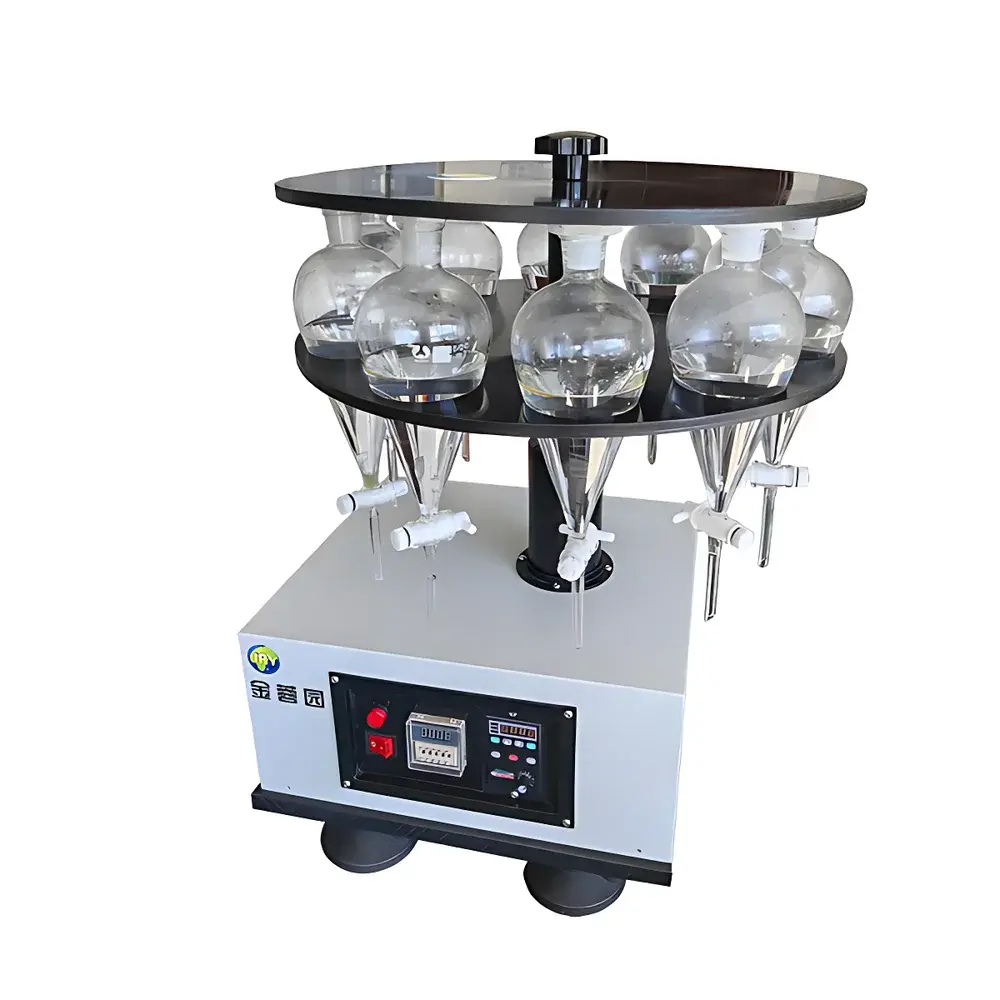
JRY L6/L10/L12 Vertical Liquid-Liquid Extraction Shaker
| Brand | JRY |
|---|---|
| Origin | Hunan, China |
| Manufacturer Type | Direct Manufacturer |
| Model | JRY-L6 / JRY-L10 / JRY-L12 |
| Extraction Time Range | 0–9999 min (adjustable in 0.01-min increments) |
| Oscillation Mode | Vertical reciprocating + 360° sample rack rotation |
| Simultaneous Extraction Capacity | 6 / 10 / 12 separatory funnels |
| Funnel Capacity | 1000 mL / 500 mL / 250 mL per position |
| Rated Voltage | 220 V, 50 Hz |
| Motor Power | 180 W |
| Oscillation Amplitude | 50 mm |
| Speed Range | 0–350 rpm (stepless adjustment) |
| Noise Level | <60 dB(A) |
| Net Weight | <30 kg |
| Construction Material | Cold-rolled steel with anti-corrosive epoxy powder coating |
| Compliance | Designed for ISO/IEC 17025-aligned laboratory workflows and GLP-compliant sample preparation |
Overview
The JRY L6/L10/L12 Vertical Liquid-Liquid Extraction Shaker is an engineered solution for reproducible, high-throughput liquid-liquid partitioning in analytical and environmental laboratories. Based on controlled vertical reciprocation combined with continuous 360° rotational motion of the sample carrier, this shaker ensures uniform agitation across all separatory funnels—minimizing phase stratification bias and maximizing interfacial contact area between immiscible solvents. Unlike horizontal or orbital shakers, its vertical oscillation architecture preserves funnel orientation during agitation, enabling in-situ phase separation post-extraction without manual repositioning—a critical advantage for trace-level analyte recovery in EPA Method 3510C, ASTM D3703, and ISO 11348-based protocols. The device operates within a precisely regulated mechanical envelope: 0–350 rpm speed range, 50 mm stroke amplitude, and programmable timing resolution down to 0.01 minute—supporting both rapid equilibrium extraction (e.g., pesticide residue in water) and extended dynamic equilibration (e.g., PAHs from soil leachates).
Key Features
- Three standardized configurations (L6, L10, L12) optimized for throughput scalability—from routine QC batches to multi-sample environmental screening.
- Vertical reciprocating motion synchronized with full 360° sample rack rotation ensures consistent vortex formation and interfacial shear across all funnel positions, independent of volume or density differential.
- Stepless speed control (0–350 rpm) and ultra-precise timer (0.01–9999 min) allow method-specific optimization for diverse solvent systems (e.g., dichloromethane/water vs. ethyl acetate/hexane).
- Integrated in-situ phase separation capability: after agitation, the rack remains stationary while funnels maintain vertical alignment—enabling direct decanting or pipetting without transfer-induced emulsion disruption.
- Low-noise operation (<60 dB[A]) achieved via balanced counterweight design and vibration-damped mounting—suitable for shared lab environments and ISO 17025-accredited facilities requiring acoustic stability.
- Robust structural integrity: cold-rolled steel frame with electrostatic epoxy powder coating resists corrosion from organic solvents, acids, and halogenated reagents commonly used in EPA SW-846 extractions.
Sample Compatibility & Compliance
The shaker accommodates standard ground-glass joint separatory funnels (1000 mL, 500 mL, and 250 mL), supporting both glass and PTFE-stoppered variants. Its vertical geometry maintains seal integrity under prolonged agitation and prevents solvent leakage during high-speed cycles. All models comply with electrical safety standards IEC 61010-1 and GB 4793.1. The mechanical design facilitates audit-ready documentation: time-stamped extraction logs (when integrated with optional RS-232/USB data export), user-accessible calibration certificates for speed and timer accuracy, and physical labeling of maintenance intervals—all aligned with GLP and GMP Annex 11 expectations for equipment qualification (IQ/OQ/PQ). It is routinely deployed in laboratories performing US EPA Methods 3510C (liquid-liquid extraction), 3540C (Soxhlet alternatives), and ISO 18238 (soil contaminant analysis).
Software & Data Management
While the base unit features a front-panel LCD interface with tactile keypad navigation, optional firmware upgrades enable USB or RS-232 connectivity for external logging. Extracted parameters—including start/stop timestamps, actual rpm (verified via optical tachometer feedback), and elapsed time—are exportable as CSV files for integration into LIMS or ELN platforms. Audit trails record operator ID (via optional RFID badge reader), method version, and parameter changes—meeting FDA 21 CFR Part 11 requirements when paired with validated software modules. No proprietary cloud service is required; all data remain on-premise unless explicitly configured by the end-user.
Applications
- Environmental monitoring: extraction of organochlorine pesticides (OCPs), polycyclic aromatic hydrocarbons (PAHs), and phthalate esters from aqueous matrices, soils, and sediments per EPA 3510C and ISO 10392.
- Food safety testing: isolation of mycotoxins (e.g., aflatoxin B1) and veterinary drug residues (e.g., sulfonamides) from milk, honey, and cereal extracts using acetonitrile/water or ethyl acetate/hexane biphasic systems.
- Pharmaceutical QC: purification of active pharmaceutical ingredients (APIs) from reaction mixtures via acid/base partitioning—particularly where thermal sensitivity precludes rotary evaporation.
- Forensic toxicology: cleanup of blood or urine samples prior to GC-MS analysis of cannabinoids or benzodiazepines using MTBE/water or chloroform/methanol systems.
- Academic research: kinetic studies of partition coefficients (log P) under controlled agitation intensity and duration—supporting QSAR model development.
FAQ
Is the shaker compatible with PTFE-coated stoppers and glass funnels rated for halogenated solvents?
Yes. The vertical orientation and low-vibration drive system preserve seal integrity with standard Class A borosilicate glass funnels and chemically resistant PTFE stoppers—even during extended agitation with chloroform or carbon tetrachloride.
Can extraction time be programmed independently for each batch, or is it fixed per run?
Time is set globally per run but supports sub-minute precision (0.01 min resolution), allowing fine-tuned adaptation to solvent viscosity and partition kinetics without hardware modification.
Does the device include validation documentation for ISO/IEC 17025 accreditation?
Factory-provided IQ/OQ templates, metrology-certified speed/timer verification reports, and material compliance statements (RoHS, REACH) are supplied—enabling seamless integration into accredited lab quality systems.
What maintenance is required to ensure long-term speed accuracy?
Annual verification of motor encoder response and mechanical linkage wear is recommended; no routine lubrication is needed due to sealed bearing design and maintenance-free DC brushless motor architecture.



