
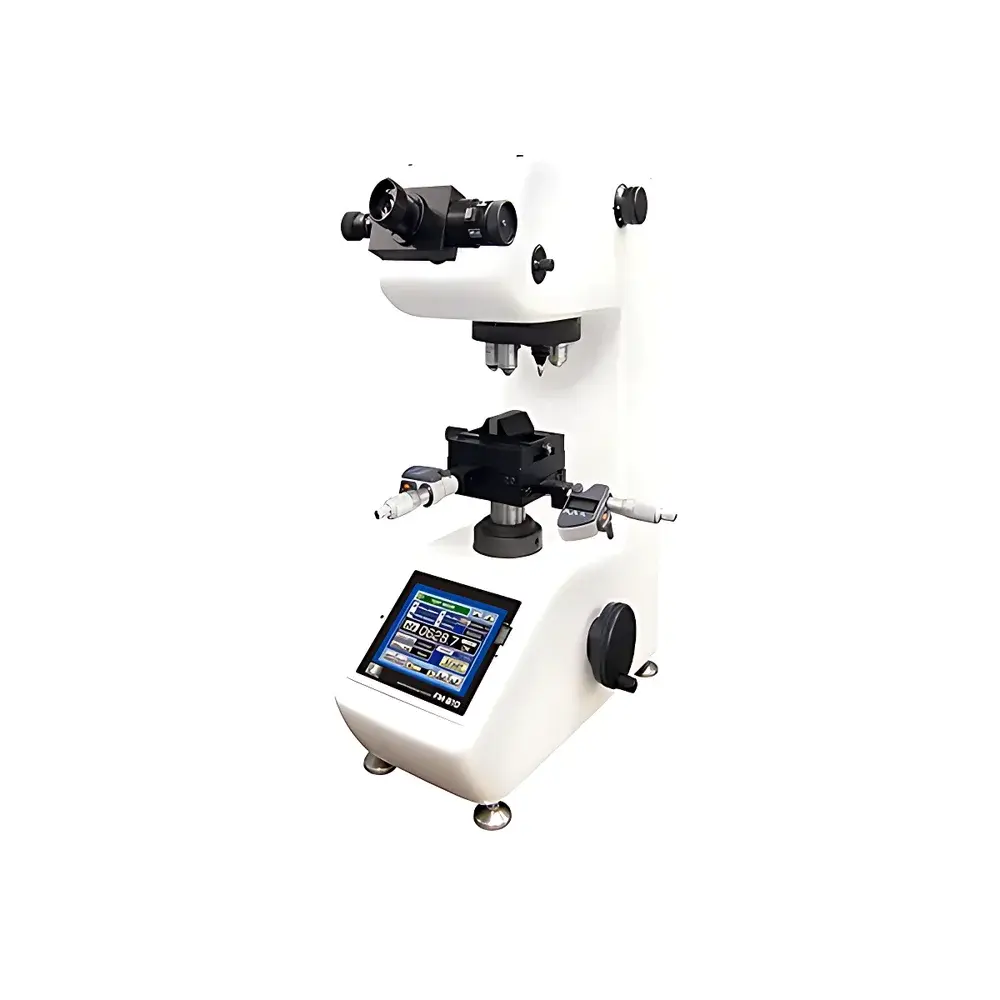
Future-Tech FM-810e Micro-Vickers Hardness Tester
| Brand | Future-Tech |
|---|---|
| Origin | Japan |
| Model | FM-810e |
| Indentation Load Range | 1 g to 2000 g (selectable combinations) |
| Maximum Test Load | 2000 g |
| Specimen Height Clearance | 95 mm (H) × 115 mm (D) |
| Optical System | Dual-standard objective lenses (10× & 50×), expandable up to four objectives (5×, 20×, 40×, 100×) |
| Measurement Accuracy | Compliant with JIS B7725, JIS B7734, ASTM E384, ISO 6507-2, and ISO 8507-2 |
| Display Interface | 7-inch full-color LCD touchscreen with integrated control logic |
| Data Output | USB and RS232C interfaces |
| X-Y Stage | Manual, 100 mm × 100 mm travel, 25 mm × 25 mm fine adjustment range |
| Weight | Approx. 40 kg (including tool case) |
Overview
The Future-Tech FM-810e Micro-Vickers Hardness Tester is a precision-engineered instrument designed for quantitative micro-hardness evaluation of metallic, ceramic, and thin-film materials at loads ranging from 1 g to 2000 g. Based on the Vickers indentation principle—where a diamond pyramid indenter (136° apex angle) is applied under controlled load and dwell time—the FM-810e delivers repeatable, traceable hardness values in HV (Vickers), HK (Knoop), HBW (Brinell), and KC (fracture toughness) scales. Its optical-mechanical architecture integrates high-stiffness cast-iron frame construction, vibration-damped base design, and Japanese-assembled optical train to ensure long-term dimensional stability and image fidelity. The system conforms to international metrological standards including JIS B7725 (accuracy verification), JIS B7734 (microhardness testing method), ASTM E384 (standard test method for Knoop and Vickers hardness), and ISO 6507-2 (verification of hardness testers). Designed for laboratory, R&D, and quality assurance environments, the FM-810e serves as a foundational platform for materials characterization where surface integrity, case depth analysis, coating adhesion, and heat-affected zone (HAZ) evaluation are critical.
Key Features
- 7-inch full-color LCD touchscreen interface with intuitive touch-based workflow navigation—supports real-time load display, dwell time adjustment (5–99 s), dual diagonal measurement (D1/D2), hardness value output, and pass/fail threshold classification (HI/OK/LOW).
- Multi-scale hardness calculation engine compliant with SAE J417b and ASTM E140, enabling automatic cross-conversion between HV, HK, HBW, HRC, HRB, and other standardized hardness scales.
- Advanced optical configuration: standard 10× and 50× objectives; optional expansion to four objectives (5×, 20×, 40×, 100×) for variable magnification and optimized field-of-view across diverse specimen geometries.
- Curvature compensation algorithms for cylindrical and spherical surfaces—enabling accurate hardness measurement on curved components without mechanical repositioning or manual correction factors.
- Integrated digital coordinate input: optional digital micrometer interface allows direct X-Y stage position readout synchronized with the main display panel for spatially referenced hardness mapping.
- Modular indenter head compatibility: supports HMV (Vickers), HK (Knoop), and HBW (Brinell) indenters—up to two heads mountable simultaneously for rapid method switching without recalibration.
- LED illumination system with auto-dimming during indentation cycle to reduce operator eye fatigue and improve contrast consistency across repeated measurements.
Sample Compatibility & Compliance
The FM-810e accommodates specimens up to 95 mm in height and 115 mm in depth, making it suitable for machined parts, cross-sectioned metallographic mounts, coated substrates, and small-volume research samples. Its rigid stage and low-center-of-gravity design minimize deflection under maximum 2000 g load application. All hardness measurements adhere to GLP-aligned documentation practices: timestamped test records, operator ID tagging, and audit-ready data export via USB or RS232C. The instrument meets requirements for ISO/IEC 17025-accredited laboratories and supports FDA 21 CFR Part 11 readiness when paired with validated FT-ZERO hardness analysis software (optional upgrade). Calibration traceability is maintained through NIST-traceable hardness reference blocks supplied with each unit and verified per JIS B7725 procedures.
Software & Data Management
The FM-810e operates natively with embedded firmware supporting local data storage (up to 1,000 test records), on-screen statistical summary (mean, SD, CV%), and graphical hardness profile plotting. For advanced analysis, the optional FT-ZERO hardness measurement software provides full PC integration—including automated indentation recognition (via 1.3 MP CMOS camera), multi-point hardness mapping, layer-thickness estimation based on load-dependent indentation response, and customizable report generation compliant with internal QA templates or external regulatory submissions. Data exports are structured in CSV and PDF formats, preserving metadata such as load, dwell time, operator ID, date/time stamp, and environmental conditions. Software validation packages—including IQ/OQ documentation—are available upon request for GMP-regulated environments.
Applications
- Case depth profiling of carburized, nitrided, or induction-hardened steel components.
- Thin-film hardness assessment (e.g., PVD/CVD coatings, DLC, TiN) using low-load indentation (1–10 g) with high-resolution optical detection.
- Fracture toughness (KC) evaluation of brittle ceramics and intermetallics via crack-length measurement from Vickers indentations.
- Quality control of weld joints, heat-affected zones (HAZ), and dissimilar metal interfaces in aerospace and power-generation alloys.
- Research-grade microstructural correlation studies linking hardness gradients to grain size, phase distribution, and precipitate density observed via SEM/EBSD.
- Calibration and verification of hardness reference materials in national metrology institutes and third-party testing labs.
FAQ
What standards does the FM-810e comply with for calibration and testing?
The FM-810e is verified per JIS B7725 (instrument accuracy), JIS B7734 (test method), ASTM E384 (microindentation), and ISO 6507-2 (verification of Vickers hardness testers). Calibration uses NIST-traceable reference blocks certified to ±0.5% uncertainty.
Can the FM-810e perform automatic indentation measurement?
Yes—when upgraded with the AR-Vickers Auto-Read System (1.3 MP CMOS camera + FT-ZERO software), it enables fully automated indentation detection, diagonal measurement, and hardness calculation without manual eyepiece reading.
Is curvature correction supported for cylindrical or spherical samples?
Yes—the built-in shape compensation function applies geometric correction algorithms for both cylindrical and spherical surfaces, eliminating systematic error due to sample curvature.
What is the maximum specimen height and depth the FM-810e can accommodate?
The machine accepts specimens up to 95 mm in vertical height and 115 mm in horizontal depth from the stage surface, accommodating most standard metallographic mounts and industrial components.
Does the FM-810e support multiple hardness scale conversions?
Yes—it includes embedded conversion tables per SAE J417b and ASTM E140, allowing real-time cross-referencing among HV, HK, HBW, HRC, HRB, and other widely used hardness scales.
Can the instrument be integrated into a LIMS or enterprise QA system?
Yes—via USB or RS232C serial output, raw test data (load, dwell time, D1/D2, hardness value, timestamp) can be streamed to external databases or LIMS platforms using configurable ASCII protocol.
Related Products



