
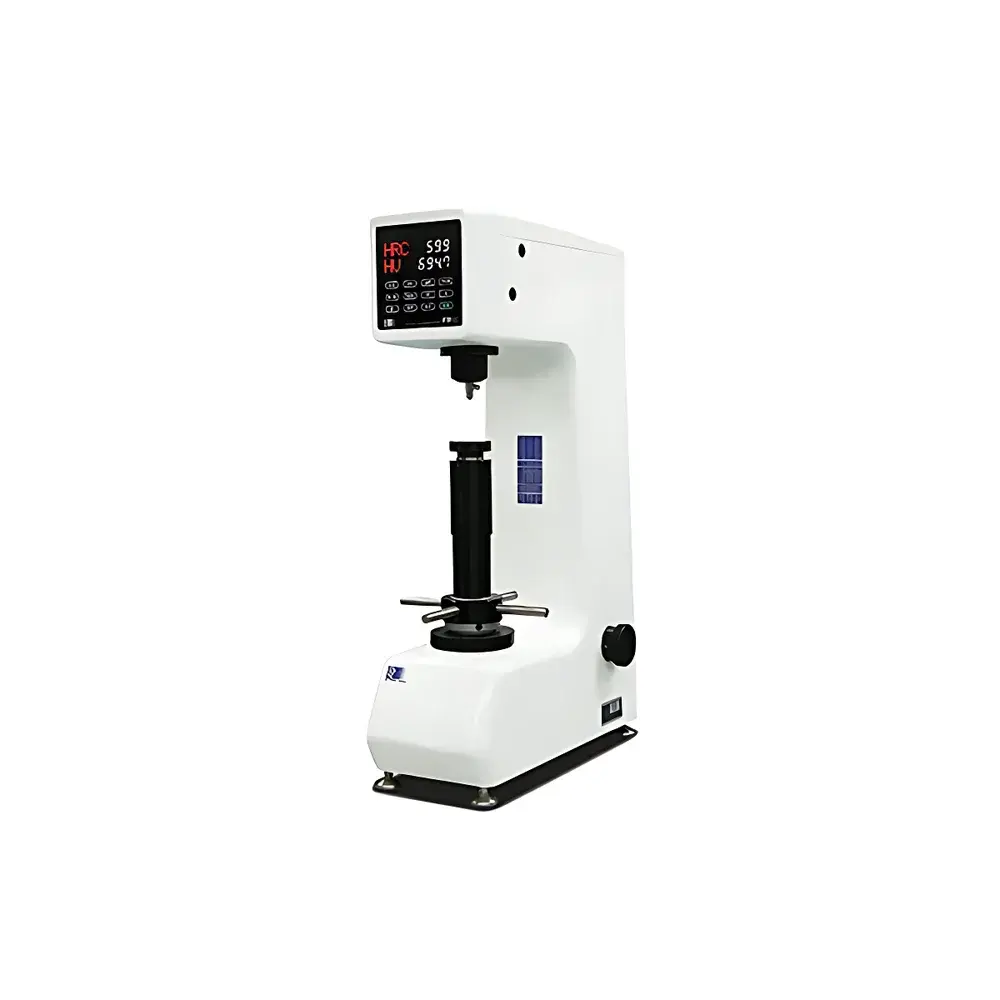
Future-Tech FR-X3 Rockwell Hardness Tester
| Brand | Future-Tech |
|---|---|
| Origin | Japan |
| Manufacturer Status | Authorized Distributor |
| Product Origin | Imported |
| Model | FR-X3 |
| Instrument Type | Rockwell Hardness Tester |
| Hardness Range | 20–88 HRC (typical scale) |
| Total Test Force | 150 kgf (1.471 kN) |
| Maximum Specimen Height | 255 mm |
| Vertical Travel | 255 mm |
| Load Axis Stability | Precision vertical guide rod with lateral displacement suppression |
| Indenter Penetration Depth Display | Yes, simultaneous with hardness value |
| Calibration Correction | Multi-point (low/mid/high) per JIS Z 2245 / ASTM E18 / ISO 6508 |
| Geometry Correction | Spherical & cylindrical specimen diameter input for curvature compensation |
| Data Output | RS-232C + USB via adapter |
| Power Supply | AC 100 / 115 / 220 V, 50 / 60 Hz |
| Net Weight | 83 kg |
| Dimensions (W×D×H) | 196 × 487 × 820 mm |
Overview
The Future-Tech FR-X3 Rockwell Hardness Tester is an engineered precision instrument designed for high-reproducibility Rockwell hardness measurements in quality control laboratories, metallurgical R&D facilities, and industrial manufacturing environments. Based on the proven FR-e platform and refined through rigorous metrological review, the FR-X3 implements a rigid monolithic frame architecture to minimize mechanical deflection during load application—critical for achieving ≤ ±0.5 HR repeatability across extended testing cycles. Its measurement principle adheres strictly to ASTM E18, ISO 6508-1, and JIS Z 2245 standards, utilizing the classical Rockwell method: preliminary minor load (10 kgf) establishes zero reference, followed by major load application (60/100/150 kgf depending on scale), with depth differential measured optically via high-resolution linear encoder. The FR-X3 operates primarily on the HRC scale (150 kgf total force, diamond cone indenter), covering the 20–88 HRC range typical for hardened steels, tool alloys, and case-hardened components.
Key Features
- Rigid structural chassis with reinforced base and vertically aligned load train—designed to suppress lateral drift and ensure consistent indenter alignment under full 150 kgf load.
- 255 mm maximum specimen height clearance (without screw cover), enabling evaluation of large forgings, shafts, and structural components without repositioning.
- Integrated geometry correction algorithm: user inputs specimen diameter (sphere or cylinder); instrument automatically applies curvature-based depth offset per ASTM E18 Annex A3 and ISO 6508-2.
- Multi-point reference calibration across low/mid/high hardness ranges—traceable to NIST-traceable certified reference blocks—ensuring linearity compliance across the full 20–88 HRC span.
- Real-time indenter penetration depth display synchronized with hardness value—facilitating empirical correlation between hardness and elastic modulus trends in material characterization workflows.
- Dual-mode status panel with LED backlighting: displays pass/fail judgment (HI/OK/LO), average of multi-point readings, and real-time load phase indicators (pre-load → major load → unload).
- Illuminated navigation system with audible tone feedback for precise preload positioning—reducing operator dependency and enhancing GLP-compliant procedural consistency.
Sample Compatibility & Compliance
The FR-X3 accommodates flat, convex, and concave specimens up to 255 mm in height and 165 mm in depth. Its vertical guide rod system ensures stable indentation on curved surfaces—including cylindrical shafts (≥6 mm diameter) and spherical bearings—when geometry correction is enabled. All hardness values are reported in accordance with ASTM E18-23 (Standard Test Method for Rockwell Hardness of Metallic Materials), ISO 6508-1:2016, and JIS Z 2245:2021. The instrument supports audit-ready operation under FDA 21 CFR Part 11 when paired with compliant data acquisition software, including electronic signature capability, operator-level access control, and immutable audit trail logging for each test record.
Software & Data Management
Data export is supported via RS-232C serial interface, with optional USB connectivity through a certified RS-232C-to-USB adapter (FT-USB-ADP). Raw test records—including hardness value, penetration depth, timestamp, operator ID, and geometry parameters—are transmitted in ASCII format for direct import into LIMS, MES, or Excel-based QA databases. Optional Future-Tech DataLink Pro software (sold separately) provides automated report generation (PDF/CSV), statistical process control (SPC) charting (X̄-R, Cp/Cpk), and batch-level compliance documentation aligned with IATF 16949 and ISO 9001 requirements.
Applications
- Hardness verification of heat-treated aerospace alloys (e.g., Ti-6Al-4V, Inconel 718) per AMS 2242 and ASTM B633.
- Quality gate inspection of automotive transmission gears and camshafts following OEM-specific Rockwell specifications (e.g., GMW14872, Ford WSK-M2G339-A2).
- Process validation of surface hardening treatments (carburizing, nitriding, induction hardening) where depth-profile correlation requires repeatable HRC measurement at defined case depths.
- Failure analysis labs performing comparative hardness mapping across fracture zones, weld HAZs, and base metal regions.
- Calibration laboratories maintaining secondary hardness standards traceable to national metrology institutes (NMI) under ISO/IEC 17025.
FAQ
What Rockwell scales does the FR-X3 support?
The FR-X3 is configured for standard Rockwell scales using 150 kgf total test force (e.g., HRC, HRB, HRA), with interchangeable indenters (120° diamond cone, 1.588 mm steel ball) and adjustable minor/major load selection per ASTM E18 Table 1.
Is geometry correction applicable to all Rockwell scales?
Curvature compensation is validated for HRC, HRB, and HRA scales on specimens with diameters ≥6 mm (cylindrical) or ≥10 mm (spherical), per ISO 6508-2 Clause 7.3.
Can the FR-X3 generate GLP-compliant test reports?
Yes—when used with Future-Tech DataLink Pro v3.2+ and configured with user authentication, electronic signatures, and audit trail activation, it satisfies core GLP requirements per OECD Principles of Good Laboratory Practice.
What maintenance is required to maintain ASTM E18 compliance?
Daily verification using certified reference blocks; quarterly mechanical inspection of guide rods and load train; annual recalibration by an ISO/IEC 17025-accredited service provider is recommended.



