
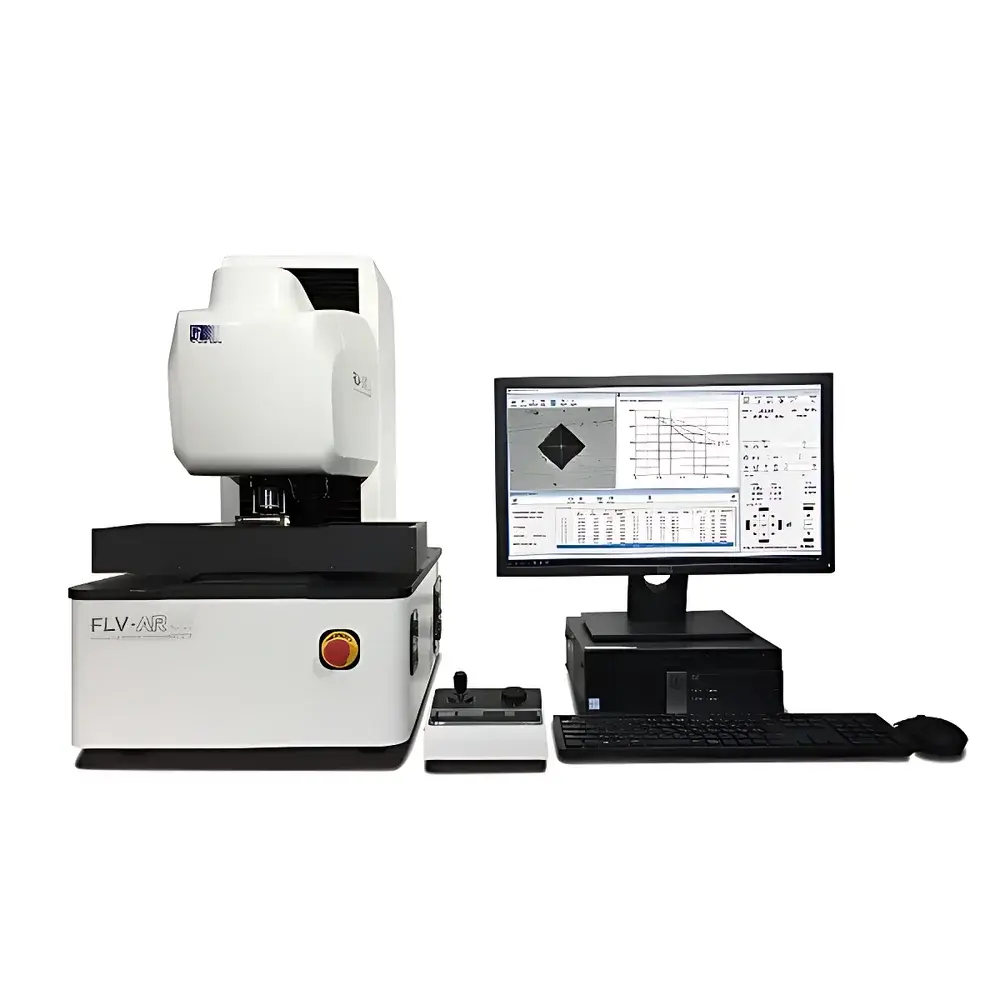
Future-Tech FLV-10ARS-F Fully Automated Vickers Hardness Tester
| Brand | Future-Tech |
|---|---|
| Origin | Japan |
| Model | FLV-10ARS-F |
| Hardness Range | 0–3000 HV |
| Test Force Range | 10 gf – 10 kgf |
| Specimen Stage Travel | 180 mm × 150 mm |
| Maximum Specimen Height | 210 mm |
| Maximum Specimen Depth | 180 mm |
| Load Application | Load Cell-Based Closed-Loop Force Control |
| Optical System | Long Working Distance Objective Lens |
| Optional Imaging | 5 MP CMOS Camera |
| Software Features | Auto-Contour Mapping, Z-Axis Tilt Compensation, Programmable Test Path, Dynamic Load Switching, Custom Report Generation |
Overview
The Future-Tech FLV-10ARS-F is a fully automated Vickers hardness testing system engineered for precision metrology in R&D laboratories, quality control environments, and metallurgical research facilities. It operates on the principle of diamond pyramid indentation under controlled static load, conforming to ISO 6507-1, ASTM E384, and JIS Z 2244 standards. Unlike conventional micro- or macro-Vickers testers constrained by mechanical load ranges or manual stage limitations, the FLV-10ARS-F integrates dual-load-cell force units and a high-stability electro-mechanical actuation architecture—enabling seamless transition across the full Vickers scale (10 gf to 10 kgf) without hardware reconfiguration. Its vertical head-lift mechanism and extended Z-axis travel accommodate bulky, unmounted specimens up to 210 mm in height, eliminating the need for sample sectioning or mounting in many industrial applications.
Key Features
- Load cell-based closed-loop force control ensures ±0.5% force accuracy across the entire 10 gf–10 kgf range, replacing legacy dead-weight systems and enabling traceable, repeatable indentation loading per ISO/IEC 17025 requirements.
- Motorized specimen stage with 180 mm × 150 mm XY travel and 210 mm vertical clearance supports large-format components—including castings, forgings, weldments, and additively manufactured parts—without pre-embedding.
- Long working distance optical path (≥12 mm at 10× magnification) maintains consistent focus depth across varying surface topographies; compatible with optional 5 MP CMOS imaging for high-fidelity indenter impression capture and sub-pixel edge detection.
- Intelligent contour mapping software automatically reconstructs specimen cross-sectional geometry from multi-point Z-scan data, generating a real-time coordinate frame for precise path planning—even on irregular or non-rectangular samples.
- Z-axis tilt compensation algorithm records local focal height variations across the test surface and dynamically adjusts objective position during measurement, mitigating errors caused by specimen warpage or grinding-induced inclination.
- One-click test execution allows users to recall saved test protocols—including load sequence, dwell time, indentation spacing, and image analysis parameters—with only the starting coordinate requiring manual input.
Sample Compatibility & Compliance
The FLV-10ARS-F accommodates diverse material forms: bulk metals, thin foils (with support fixtures), coated substrates, sintered ceramics, and heat-treated tool steels. Its large-stage design complies with ASTM E92 for macro-hardness testing and ASTM E384 for micro-hardness evaluation on the same platform. All mechanical and software functions are validated against ISO/IEC 17025 calibration traceability requirements. The system supports audit-ready operation under GLP and GMP frameworks, including full electronic record retention, user access controls, and 21 CFR Part 11-compliant electronic signatures when paired with validated software modules.
Software & Data Management
Equipped with Future-Tech’s proprietary VickersControl Suite v4.x, the system provides intuitive graphical workflow configuration, real-time force/depth monitoring, and automated post-indentation analysis—including diagonal length measurement, HV conversion, statistical reporting (mean, SD, Cpk), and spatial distribution mapping. Test data export adheres to ASTM E140 annex conventions and supports CSV, PDF, XML, and database (ODBC) outputs. Custom report templates can be designed using drag-and-drop field editors and embedded formulas, ensuring alignment with internal QA documentation standards or third-party LIMS integration.
Applications
- Heat treatment verification of aerospace alloys (e.g., Ti-6Al-4V, Inconel 718) across case depth profiles.
- Coating adhesion assessment via cross-sectional hardness gradients in PVD/CVD layers.
- Weldment HAZ (heat-affected zone) characterization in pressure vessel fabrication.
- Quality gate testing of powder metallurgy components where density gradients correlate with hardness variation.
- Failure analysis labs performing comparative hardness mapping before/after stress corrosion cracking or fatigue cycling.
FAQ
Does the FLV-10ARS-F meet ISO 6507 certification requirements for accredited hardness testing labs?
Yes—the instrument’s load application, optical resolution, and environmental stability have been verified per ISO 6507-2 Annex A for type approval, and its software includes built-in calibration verification routines aligned with ISO/IEC 17025 Clause 6.5.
Can the system perform sequential multi-load testing on a single indentation site?
No—per ASTM E384 Section 7.3, repeated loading on identical indentations is not permitted; however, the system supports automated multi-site testing with programmable load changes between positions.
Is remote diagnostics and firmware update supported?
Yes—via secure TLS-encrypted Ethernet connection; remote access requires prior authorization and complies with IEC 62443-3-3 cybersecurity guidelines.
What is the minimum resolvable diagonal length for HV calculation?
With the standard 10× objective and 5 MP camera, the system achieves ≤0.2 µm pixel resolution, supporting reliable HV determination down to 25 HV (10 gf load on soft annealed copper).
How is measurement uncertainty quantified in the software?
Uncertainty budgets follow EURACHEM/CITAC Guide CG4 methodology, incorporating contributions from force accuracy, optical magnification error, diagonal measurement repeatability, and environmental temperature drift (±0.5 °C tolerance).
Related Products



