
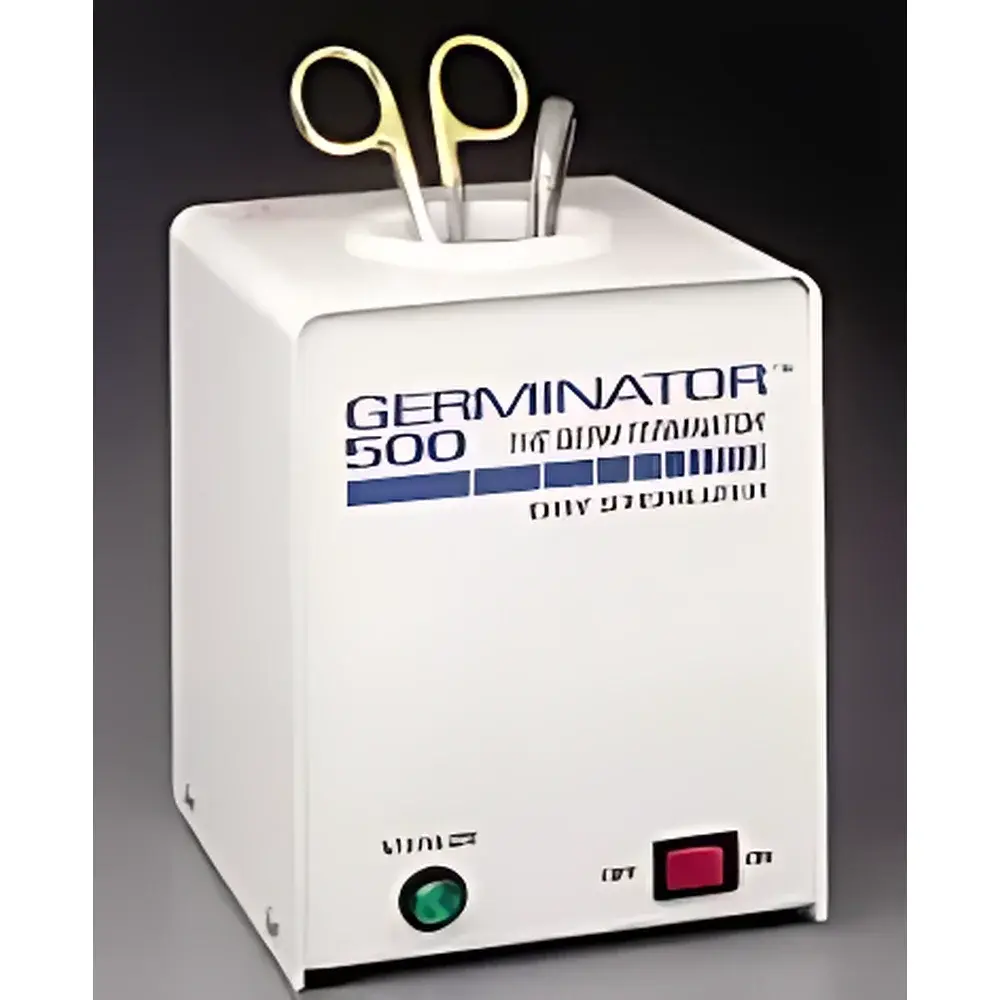
Harvard Apparatus Germinator 500 Glass Bead Sterilizer
| Brand | Harvard Apparatus |
|---|---|
| Origin | USA |
| Manufacturer Type | Authorized Distributor |
| Origin Category | Imported |
| Model | Germinator 500 |
| Warm-up Time | 20 min |
| Operating Temperature | 250 °C (≈500 °F) |
| Sterilization Time | 2–5 sec |
| Well Depth | 20 cm |
| Well Diameter | 5 cm |
| Unit Dimensions (H×W×D) | 6.75″ × 5.25″ × 5.25″ |
| Stainless Steel Well Internal Dimensions | 2.0″ diameter × 4.0″ depth |
| Weight | 4.5 lbs |
| Electrical Input | 230–250 V, 60 Hz, 0.85 A, 110 W |
| Glass Bead Size | 1.5 mm lead-free glass spheres |
| Compliance | CE Marked (Test Report No. 991004/GERM/EMC 041800/AC187/LVD) |
| Warranty | 1 year |
Overview
The Harvard Apparatus Germinator 500 is a compact, benchtop glass bead sterilizer engineered for rapid, chemical-free decontamination of heat-tolerant surgical instruments used in small animal and microsurgical procedures. It operates on the principle of dry-heat sterilization via convection-heated inert glass beads—providing immediate thermal lethality to microorganisms including spores, bacteria, and viruses upon contact. Unlike autoclaving or chemical immersion, the Germinator 500 delivers validated sterility within 2–5 seconds for instrument tips without exposing handles or user-accessible surfaces to elevated temperatures. Its design aligns with NIH guidelines for aseptic technique in rodent surgery and adheres to fundamental principles outlined in ISO 17664 (processing of medical devices) and USP (sterilization of thermolabile items), making it suitable for GLP-compliant laboratories requiring repeatable, traceable, flame-free instrument reprocessing between sequential interventions.
Key Features
- Dry-heat sterilization at 250 °C: Maintains precise, stable temperature in the stainless steel well using embedded heating elements and calibrated thermal feedback—no external calibration required during routine operation.
- Cool-to-touch chassis: Patented thermal isolation ensures surface temperatures remain below 45 °C even after continuous 8-hour operation, eliminating burn risk and enabling safe placement on shared lab benches.
- Rapid cycle time: Full microbial kill achieved in ≤5 seconds for instrument tips inserted to specified depth; instruments are cool enough for immediate handling within 30 seconds post-removal.
- Modular, serviceable architecture: Includes exclusive well collar for easy bead containment and tool insertion guidance; modular power cord simplifies replacement and compliance with regional electrical safety standards.
- Minimal footprint & low energy demand: Occupies less than 36 in² of bench space and draws only 110 W—ideal for laminar flow hoods, procedure rooms, and mobile surgical carts.
- CE-certified construction: Fully compliant with EU EMC Directive 2014/30/EU and Low Voltage Directive 2014/35/EU (Test Report No. 991004/GERM/EMC 041800/AC187/LVD).
Sample Compatibility & Compliance
The Germinator 500 is validated for use with stainless steel microsurgical instruments—including iris scissors, jeweler’s forceps, needle holders, and micro-dissectors—whose tip geometry permits full immersion to the recommended depth (≥3.5 cm). It is not intended for plastic, coated, or temperature-sensitive components (e.g., insulated handles, polymer-coated blades, or fiber-optic elements). The unit satisfies key requirements for aseptic processing as referenced in NIH Guide for the Care and Use of Laboratory Animals (2011), particularly Section IV.C.2 on instrument sterilization between subjects. While not classified as a medical device under FDA 21 CFR Part 820, its operational parameters support adherence to FDA-recommended practices for non-implantable surgical tool reprocessing (FDA Guidance for Industry: Reprocessing Medical Devices in Health Care Settings, 2022). Routine maintenance—including periodic bead replacement per manufacturer protocol—supports continued compliance with internal quality control SOPs and audit readiness for AAALAC-accredited facilities.
Software & Data Management
The Germinator 500 is a standalone analog device with no embedded firmware, software interface, or digital data logging capabilities. Its operational integrity relies on passive thermal stability and mechanical consistency—eliminating risks associated with software failure, cybersecurity vulnerabilities, or electronic validation burdens. For labs operating under 21 CFR Part 11 or Annex 11 requirements, manual logbook entries (date/time, operator ID, instrument type, cycle count) are sufficient to demonstrate procedural control when paired with scheduled preventive maintenance records. Optional accessories—including the GER-5289 certified glass bead refill kit—carry lot-specific documentation supporting material traceability and batch consistency across laboratory sites.
Applications
- Routine decontamination of microsurgical instruments between sequential rodent stereotaxic procedures
- Point-of-use sterilization in neurophysiology rigs where flame-based methods pose fire or electromagnetic interference hazards
- Field-deployable sterile technique support for mobile veterinary or field research units
- Teaching laboratories requiring rapid, observable sterilization demonstrations without hazardous chemicals or open flames
- Complementary use alongside autoclaves for high-turnover instrument subsets—reducing overall steam-cycle load and extending autoclave service intervals
FAQ
What types of instruments are compatible with the Germinator 500?
Stainless steel micro-dissecting tools with slender, uncoated tips—such as Dumont #5 forceps, Roboz RS-5135 iris scissors, and Fine Science Tools #11001-12 needle holders—are routinely validated. Avoid instruments with glued joints, rubber grips, or polymer coatings.
How often should the glass beads be replaced?
Replace beads when resistance to instrument insertion increases significantly or when fine powder accumulates at the bottom of the well—typically every 6–12 months under standard academic lab usage (≈20 cycles/day).
Is the Germinator 500 suitable for sterilizing dental or human surgical instruments?
No. It is designed and validated exclusively for research-grade microsurgical instruments used in non-clinical, non-implantable applications. Clinical use requires FDA-cleared devices meeting ISO 17665 and AAMI ST55 standards.
Does the unit require calibration or annual certification?
No formal calibration is mandated; however, users should verify operational temperature annually using a NIST-traceable thermocouple probe inserted to the center of the bead bath at working depth—per internal QA protocols or institutional biosafety office requirements.




