
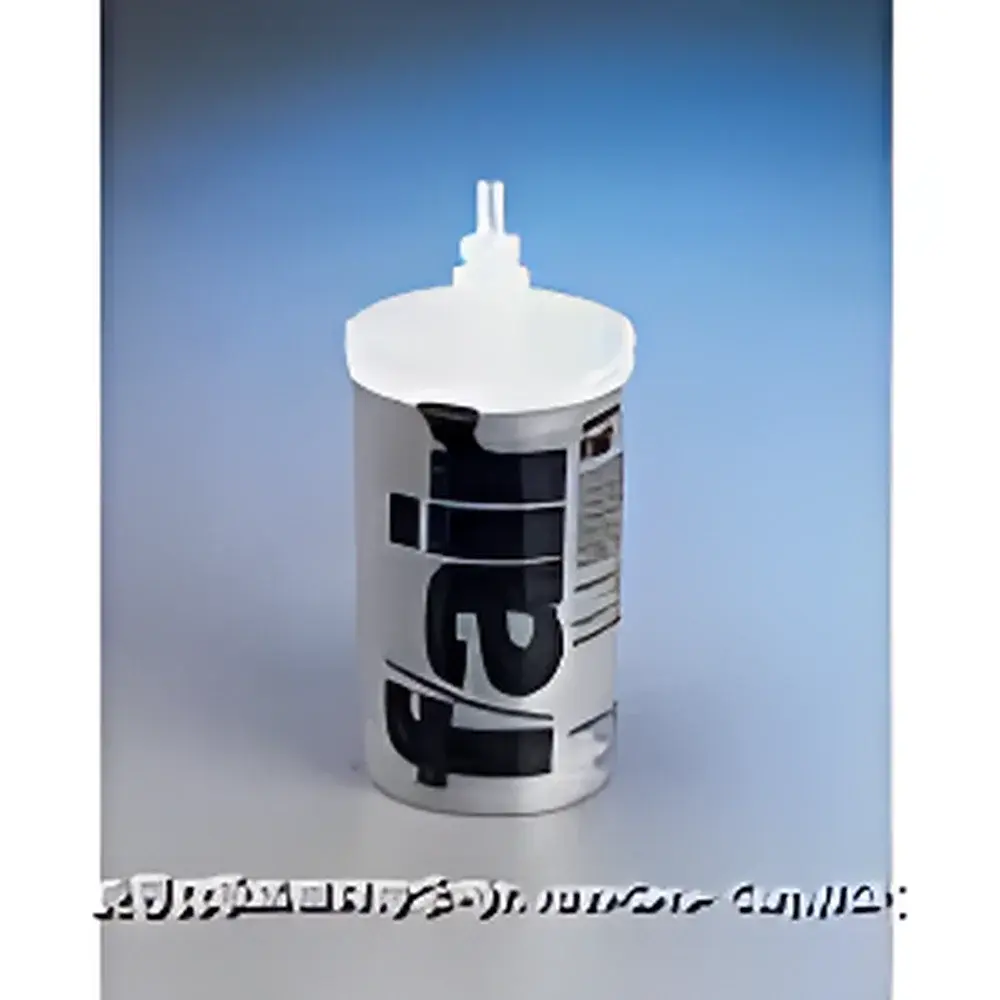
Harvard Apparatus f/air Anesthetic Gas Scavenging Canister
| Brand | Harvard Apparatus |
|---|---|
| Origin | USA |
| Manufacturer Type | Authorized Distributor |
| Import Status | Imported |
| Model | f/air |
| Capacity | 50 g (halogenated anesthetic gases) |
| Dimensions | 15.2 cm H × 8.3 cm D (6 in × 3.25 in) |
| Active Sorbent Mass | 200 g |
| Usage | Single-use, non-reusable |
| Accessories | Tubing connector sold separately |
Overview
The Harvard Apparatus f/air Anesthetic Gas Scavenging Canister is a single-use, passive adsorption device engineered for the safe and compliant removal of halogenated volatile anesthetic agents—such as isoflurane, sevoflurane, and desflurane—from exhaust gas streams in animal anesthesia systems. Designed in accordance with occupational health and safety guidelines—including OSHA PELs (Permissible Exposure Limits) and NIOSH recommendations—the f/air canister operates on the principle of chemisorption and physical adsorption via a proprietary granular sorbent medium. It is intended for integration into closed- or semi-closed-loop scavenging circuits downstream of animal anesthesia machines, where it captures exhaled anesthetic vapor before ambient release. Unlike active vacuum-based scavenging systems, the f/air canister requires no external power, plumbing, or ductwork, making it suitable for mobile setups, satellite procedure rooms, and field-based veterinary or preclinical research environments.
Key Features
- Fixed-capacity sorption: Rated for quantitative removal of up to 50 grams of total halogenated anesthetic mass under standard temperature and humidity conditions (22 °C, 50% RH), validated per ASTM D5277–22 for sorbent performance testing.
- Compact, self-contained geometry: Cylindrical aluminum housing (15.2 cm height × 8.3 cm diameter) with standardized 1/4″–28 UNF inlet/outlet ports; compatible with common Tygon® and silicone anesthesia tubing (connector sold separately).
- Pre-weighed sorbent core: Contains precisely 200 g of activated carbon–metal oxide composite media, thermally stabilized and pre-conditioned to minimize dust generation and maximize kinetic adsorption efficiency.
- No maintenance or regeneration required: Designed strictly for single-use deployment; eliminates risks associated with breakthrough, channeling, or desorption during extended operation.
- Regulatory-aligned labeling: Includes batch-specific expiration date, lot traceability, and hazard communication per GHS Annex VI and ANSI Z535.4; compliant with institutional biosafety office (IBO) and veterinary IACUC documentation requirements.
Sample Compatibility & Compliance
The f/air canister demonstrates consistent adsorption efficacy across clinically relevant concentrations of halogenated anesthetics delivered at typical animal ventilation flow rates (0.5–2 L/min). It has been verified for use with rodent, rabbit, and non-human primate anesthesia platforms operating within standard MAC (Minimum Alveolar Concentration) ranges. The device meets criteria outlined in ISO 8573-1:2010 (compressed air purity classes) for downstream gas purity when used with Harvard Apparatus VT Plus or LE500 series ventilators. While not a medical device per FDA 21 CFR Part 820, it supports adherence to GLP-environmental monitoring provisions (OECD 1998) and facility-level exposure control plans aligned with ACGIH TLVs® and EU Directive 2004/40/EC on electromagnetic fields and airborne contaminants.
Software & Data Management
This is a hardware-only, analog scavenging component with no embedded electronics, firmware, or data logging capability. Integration into digital workflow environments relies on external documentation: users are advised to record canister installation time, animal procedure duration, estimated anesthetic agent mass delivered (calculated from vaporizer settings, flow rate, and exposure time), and disposal timestamp in electronic lab notebooks (ELN) such as LabArchives or Benchling. For audit readiness, institutions may map f/air usage against IACUC protocol numbers and annual environmental monitoring reports, satisfying NIH OLAW and AAALAC International Standard 3.3.2 (waste management and exposure mitigation).
Applications
- Preclinical pharmacology studies requiring repeated or prolonged anesthesia exposure in longitudinal designs.
- Core facility shared-resource labs where centralized vacuum scavenging infrastructure is unavailable or cost-prohibitive.
- Mobile surgical units or field-deployable veterinary stations operating outside fixed HVAC constraints.
- Teaching laboratories conducting hands-on animal anesthesia training under ACU (Animal Care Unit) supervision.
- Validation support for ISO 14644-1 Class 7 cleanroom annexes used in neurobehavioral phenotyping suites.
FAQ
How is breakthrough monitored in practice?
Breakthrough is not directly detectable without inline gas chromatography or infrared spectroscopy. Therefore, strict adherence to the 50 g mass limit—and conservative estimation based on vaporizer output, fresh gas flow, and exposure duration—is mandatory. Institutions commonly implement time-based replacement (e.g., after ≤4 hours of continuous use at 1.5 MAC) as a procedural safeguard.
Can the canister be reused if weight gain is below 50 g?
No. The f/air canister is certified and validated exclusively for single-use. Reuse poses unacceptable risk of desorption, reduced adsorption kinetics, and non-uniform saturation—violating both manufacturer warranty and institutional EHS policy.
Is disposal regulated as hazardous waste?
Yes. Spent canisters must be managed as RCRA-listed hazardous waste (D001 ignitability, D018 halogenated organics) in accordance with 40 CFR 261. In the EU, they fall under EWC code 14 06 02* (halogenated solvent waste). Always consult local environmental health & safety officers prior to disposal.
What tubing connector is recommended?
Harvard Apparatus part #72-10201 (1/4″ barbed push-fit connector, stainless steel, autoclavable) ensures leak-tight attachment and pressure compatibility up to 30 kPa. Alternative third-party connectors must maintain ISO 5356-1 compliance for anesthesia gas pathways.
Does the canister meet UL or CE marking requirements?
It carries no UL listing or CE mark, as it is classified as an ancillary consumable—not an electrical or pressurized system component—under IEC 61010-1 and EU MDR 2017/745. Its conformity is defined solely by functional performance against published sorption capacity specifications.





