
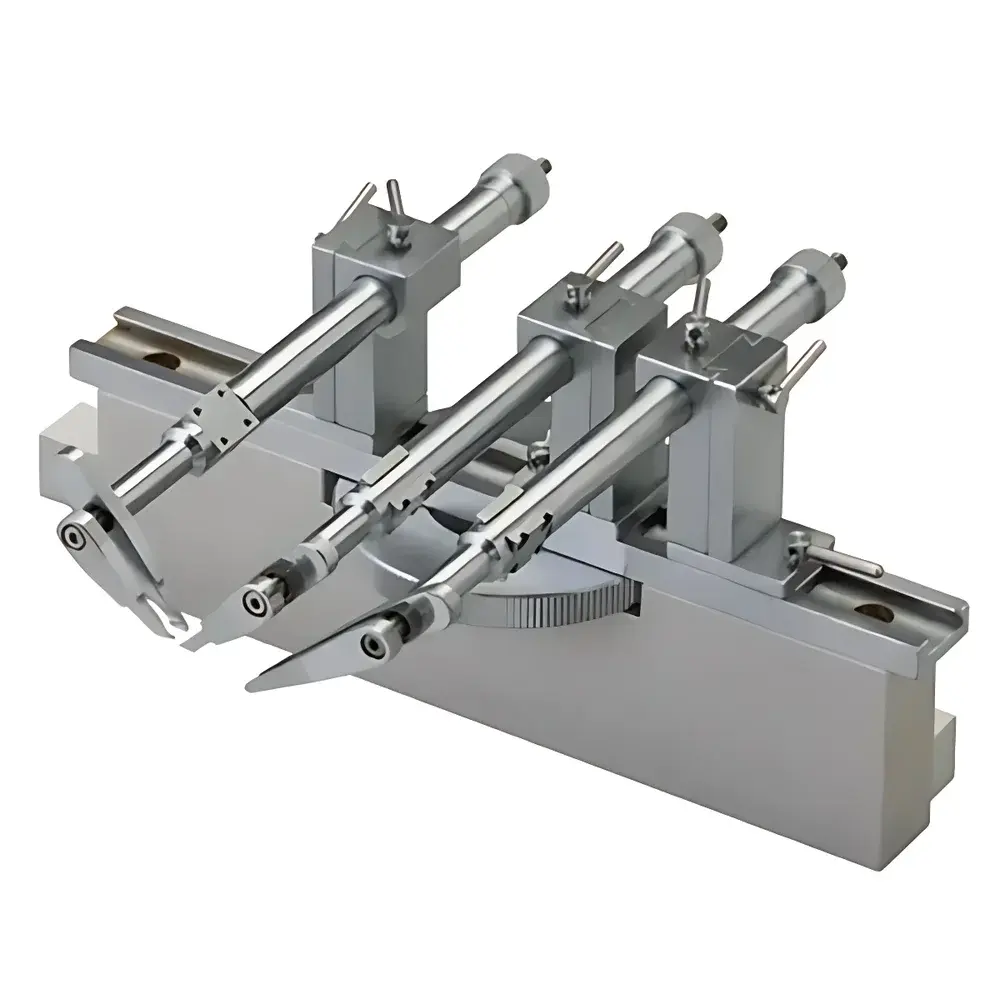
Narishige STS-A Mouse and Neonatal Rat Spinal Cord Clamp
| Origin | Japan |
|---|---|
| Manufacturer Type | Authorized Distributor |
| Origin Category | Imported |
| Model | STS-A |
| Pricing | Available Upon Request |
| Dimensions (W × D × H) | 170 × 115 × 82–112 mm |
| Weight | 80 g |
Overview
The Narishige STS-A Mouse and Neonatal Rat Spinal Cord Clamp is a precision microsurgical instrument engineered for stable, atraumatic immobilization of the spinal cord during in vivo neurophysiological or histological procedures in small rodents. Designed exclusively for integration with Narishige SR-series stereotaxic frames—particularly those equipped with AP (anterior–posterior) horizontal support rods—the STS-A leverages mechanical feedback transmission to enable tactile control over clamping force. Its operation relies on calibrated spring-loaded actuation and direct mechanical linkage between the user’s hand and the clamp’s jaw interface, ensuring that even sub-millimeter adjustments translate into perceptible haptic cues. This design principle addresses a critical challenge in spinal cord surgery: minimizing iatrogenic compression while maintaining sufficient stability for high-resolution imaging, electrophysiological recording, or targeted intraspinal injection. The device is not intended for standalone use; its functional integrity depends on rigid mounting to a vibration-damped, micrometer-adjustable stereotaxic platform compliant with ISO 13485-aligned laboratory infrastructure.
Key Features
- Human-centered tactile feedback mechanism: Transduces jaw displacement and contact resistance directly to the operator’s fingertips via a rigid lever arm and low-backlash pivot assembly.
- Ultra-low mass construction (80 g) minimizes inertial loading on the stereotaxic frame, preserving positional stability during fine motor manipulation.
- Modular attachment system featuring standardized 6-mm diameter mounting ring compatible with SR-1L, SR-2L, and SR-6M frame rods.
- Tool-inclusive hardware set: Includes M2.5 stainless steel fastening screws and a 1.5-mm hex key for repeatable, torque-consistent assembly.
- Adjustable vertical stroke range (82–112 mm height envelope) accommodates variable vertebral exposure depths across P0–P14 rodent developmental stages.
- Non-magnetic, autoclavable components (316 stainless steel jaws and aluminum alloy body) support sterile surgical workflows and MRI-compatible experimental setups.
Sample Compatibility & Compliance
The STS-A is validated for use with C57BL/6, CD-1, and Sprague-Dawley mice (adult and postnatal day 0–7), as well as neonatal Sprague-Dawley and Wistar rats (P0–P14). Jaw geometry and opening force profile (≤ 15 mN nominal closure load at full engagement) are optimized to conform to the dorsal surface curvature of thoracic and lumbar spinal segments without compromising dural integrity or local perfusion. The clamp conforms to ISO 14971:2019 (risk management for medical devices) in application context and supports GLP-compliant documentation when used within SOP-defined surgical protocols. While not a Class II medical device per FDA 21 CFR Part 860, its mechanical design aligns with ASTM F2023-20 standards for neurosurgical instrument ergonomics and force-limiting interfaces.
Software & Data Management
The STS-A operates as a purely mechanical, software-free component. It requires no firmware, drivers, or digital calibration—eliminating electromagnetic interference risks during simultaneous electrophysiology (e.g., patch-clamp or extracellular array recordings) or optical imaging (two-photon, light-sheet). All positional parameters (jaw angle, vertical offset, lateral alignment) are recorded manually in lab notebooks or integrated into electronic lab notebook (ELN) systems such as LabArchives or Benchling using standardized metadata templates (e.g., MIAME-compliant annotations for in vivo intervention records). Audit trails for clamp usage—including sterilization cycles, mounting configurations, and operator ID—are maintained per institutional GLP/GCP requirements.
Applications
- Intraspinal microinjection of viral vectors, tracers, or pharmacological agents under real-time visual guidance.
- Stabilization for in vivo two-photon calcium imaging of dorsal horn neuronal ensembles during sensory stimulation.
- Secure fixation during acute spinal cord slice preparation from neonatal tissue, reducing sectioning artifacts.
- Electrophysiological mapping of dorsal root entry zones using multi-electrode arrays or single-unit glass pipettes.
- Longitudinal surgical access in chronic implantation models requiring repeated laminectomy and re-exposure.
FAQ
Is the STS-A compatible with non-Narishige stereotaxic frames?
The STS-A mounting ring is dimensionally optimized for Narishige SR-series AP rods (6 mm OD). Adapters for other brands (e.g., David Kopf, Stoelting) require custom-machined bushings and are not supplied by Narishige.
Can the clamp be sterilized using ethylene oxide (EtO)?
Yes—full disassembly is recommended prior to EtO processing. Avoid autoclaving plastic hex keys; only metal components are rated for steam sterilization at 121°C for 20 minutes.
What is the maximum recommended clamping duration for neonatal rat spinal cords?
Continuous compression beyond 45 minutes is not advised without concurrent physiological monitoring (e.g., laser Doppler flowmetry). Experimental protocols should include intermittent release intervals per IACUC-approved guidelines.
Does Narishige provide torque specifications for the mounting screws?
No torque specification is published; however, empirical testing confirms optimal preload is achieved at 0.15–0.20 N·m using the supplied hex key—sufficient to prevent slippage without thread deformation.
Is there a version with motorized actuation or force feedback sensors?
No. Narishige maintains the STS-A as a passive, analog mechanical system to preserve signal fidelity in electromagnetically sensitive applications.




