
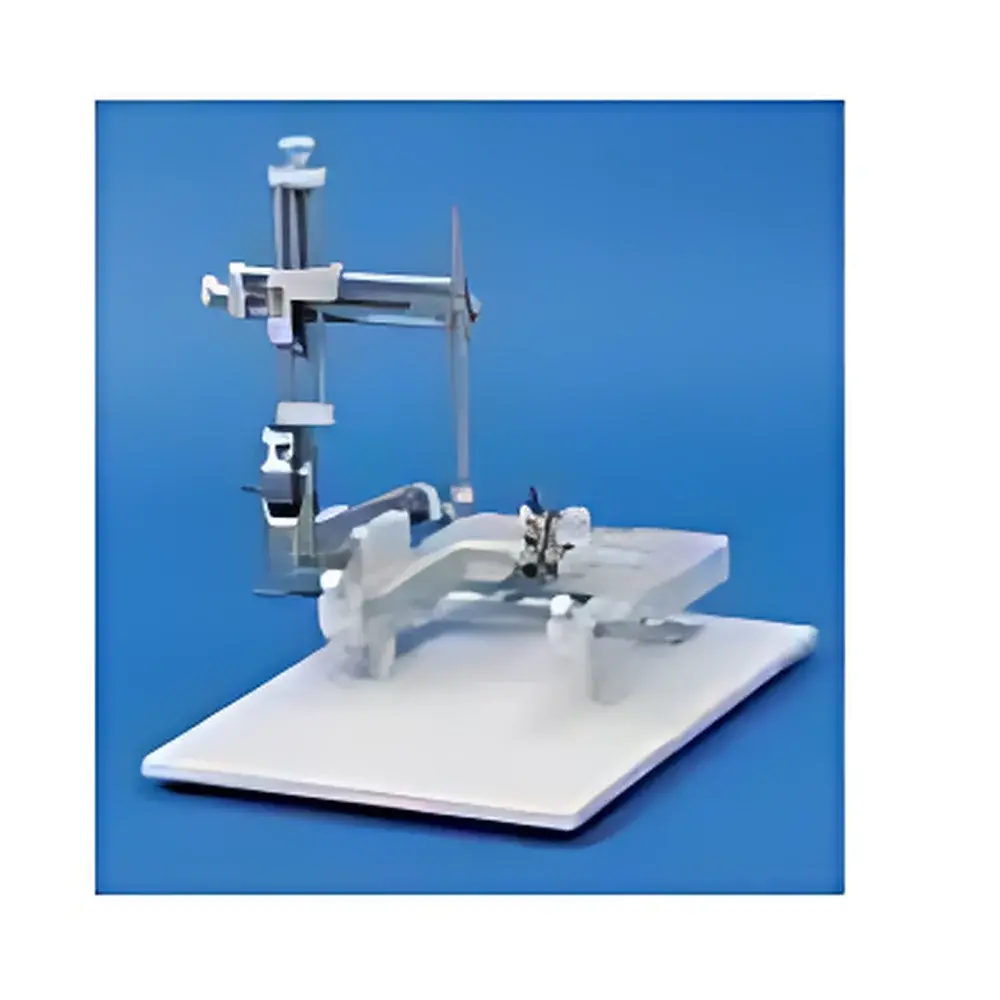
Stoelting 51600 Rat Stereotaxic Instrument
| Brand | Harvard Apparatus |
|---|---|
| Origin | USA |
| Manufacturer Type | Authorized Distributor |
| Origin Category | Imported |
| Model | 51600 |
| Pricing | Upon Request |
Overview
The Stoelting 51600 Rat Stereotaxic Instrument is a precision-engineered mechanical platform designed for reproducible, coordinate-based targeting of subcortical brain structures in laboratory rats. Based on the stereotaxic coordinate system—defined by standardized bregma–lambda landmarks and calibrated skull surface references—the instrument enables accurate placement of electrodes, microinjection cannulae, optical fibers, or lesioning probes without direct visual exposure of neural tissue. Its U-frame architecture, refined over five decades of neuroscientific application, provides mechanical stability and geometric fidelity essential for longitudinal electrophysiology, intracerebral drug delivery, and stereotactic surgery protocols. The device operates on manual micrometer-driven translation principles (not motorized or digital), delivering deterministic positional control through high-tolerance brass-on-brass threading and hardened steel guide rails. It is widely employed in preclinical models of Parkinson’s disease, ischemic stroke, epilepsy, glioma, neurodegeneration, and behavioral neuroscience studies involving learning and memory circuitry.
Key Features
- U-frame structural design with reinforced aluminum alloy base and stainless-steel uprights, engineered for long-term dimensional stability under repeated loading cycles
- Three-axis translational movement (anterior–posterior, medial–lateral, dorsal–ventral) with ±80 mm travel range per axis, enabled by precision-machined triple-start lead screws
- Vertical rotation capability of the manipulator arm up to 90°, secured via dual-stage locking mechanism—both fine-angle adjustment and absolute 90° orthogonal fixation are supported
- Laser-etched vernier scales with 0.1 mm resolution; all graduations positioned at the open U-end for ergonomic alignment and parallax-free reading
- Integrated brass grounding sleeve on the manipulator arm and optional grounding path to the holder, facilitating low-noise extracellular recording and minimizing electrical interference during electrophysiological experiments
- Modular accessory interface compatible with Stoelting’s full ecosystem: microdrive systems, hydraulic or syringe-based microinjectors (e.g., Quintessential Injector), stereotactic cranial drills, and high-magnification surgical cameras
Sample Compatibility & Compliance
The 51600 is specifically optimized for adult Sprague-Dawley and Wistar rat models (250–500 g). It includes 18° angled ear bars and a dedicated rat-specific head adapter, ensuring consistent skull orientation relative to the stereotaxic zero plane. While 45° ear bars are available as optional accessories for chronic implantation studies requiring reduced tympanic membrane stress, the standard configuration prioritizes acute procedural accuracy. All components comply with ISO 13485–aligned manufacturing practices for laboratory instrumentation. Though not a medical device, its mechanical repeatability supports GLP-compliant study execution when integrated into validated SOPs for CNS pharmacology and toxicology testing.
Software & Data Management
As a fully manual mechanical instrument, the 51600 does not incorporate embedded electronics, firmware, or proprietary software. Coordinate entry, trajectory planning, and depth calculation are performed externally using established atlases (e.g., Paxinos & Watson, 8th Edition) and third-party tools such as Stereotaxic Atlas Navigator (SAN) or BrainMap. Experimental metadata—including coordinates, injection volumes, electrode configurations, and timing logs—must be recorded manually or imported into LIMS-compatible electronic lab notebooks (ELNs) adhering to ALCOA+ principles. For labs operating under FDA 21 CFR Part 11 requirements, audit trails and electronic signatures must be managed at the ELN or study management system level—not within the instrument itself.
Applications
- Unilateral 6-OHDA lesioning for Parkinson’s disease modeling
- Intrahippocampal kainic acid or pilocarpine infusion to induce temporal lobe epilepsy
- Stereotactic implantation of C6 or GL261 glioma cells for brain tumor xenograft studies
- Targeted intracerebroventricular (ICV) or intraparenchymal delivery of AAV vectors in neurogenetic research
- Chronic multi-electrode array (MEA) or tetrode implantation for in vivo single-unit recording
- Photothrombotic or endothelin-1–mediated focal cerebral ischemia induction
- Transplantation of neural stem/progenitor cells into subventricular zone or striatal niches
FAQ
Is the 51600 compatible with mice or larger animals?
The 51600 is rat-specific. For mice, Stoelting recommends the 51700 series; for rabbits, ferrets, or non-human primates, the 51900 or 52000 platforms are required.
Does it support digital readout or motorized positioning?
No. The 51600 is a purely mechanical vernier-scale instrument. Digital readout and motorized versions (e.g., 51800, 51950) are separate product lines.
Can I use this instrument for chronic recordings lasting several weeks?
Yes—provided appropriate aseptic technique, cranioplastic sealing, and postoperative care are implemented. Use of 45° ear bars and titanium skull screws is recommended for long-term stability.
What calibration or maintenance is required?
Annual verification of scale linearity and screw backlash using NIST-traceable gauge blocks is advised. No routine lubrication is needed; periodic cleaning of rail surfaces with isopropyl alcohol suffices.
Is technical support available outside the US?
Harvard Apparatus provides global distributor-level support; service contracts and spare parts are accessible through authorized regional partners in EU, APAC, and EMEA.



