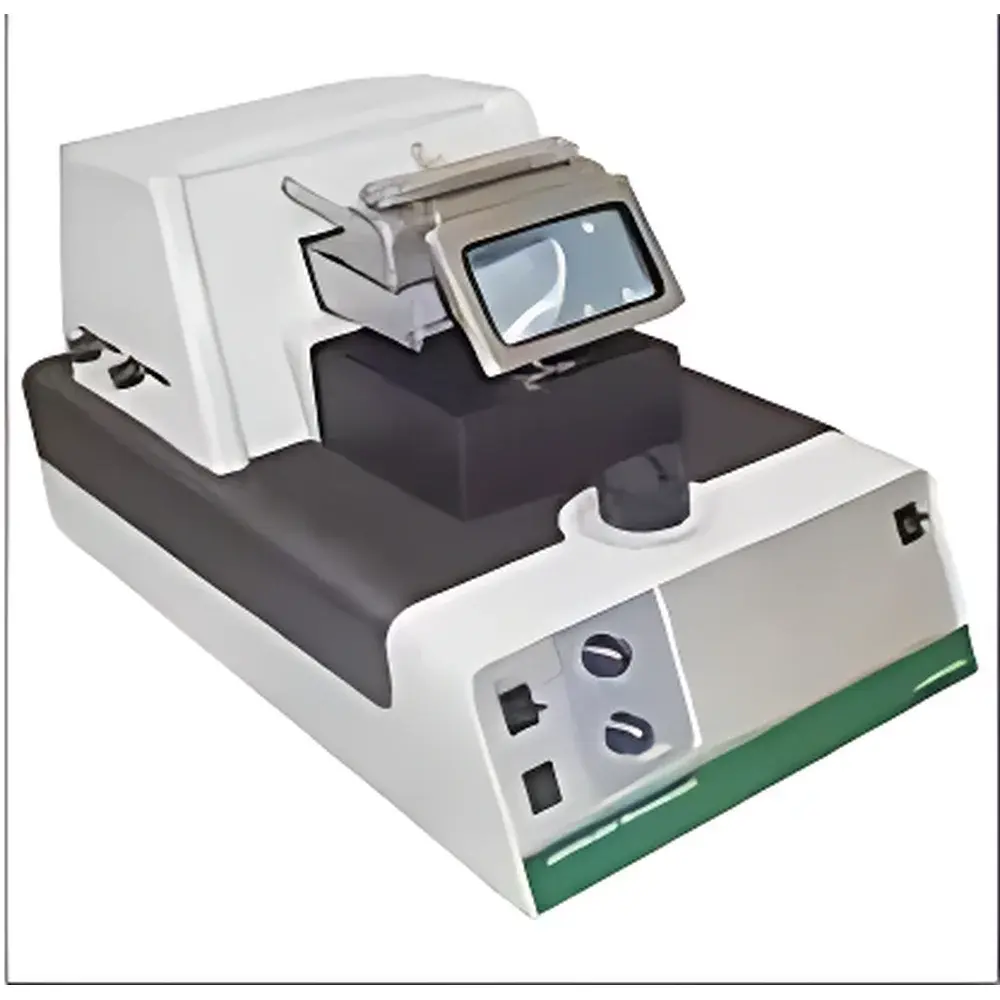
Vibratome 1000 Plus Vibrating Microtome
| Origin | USA |
|---|---|
| Manufacturer Type | Authorized Distributor |
| Origin Category | Imported Instrument |
| Model | Vibratome 1000 Plus |
| Pricing | Available Upon Request |
Overview
The Vibratome 1000 Plus is a second-generation vibrating microtome engineered for high-fidelity sectioning of unfixed, fresh, or chemically fixed biological tissues without cryopreservation or embedding. It operates on the principle of high-frequency lateral oscillation of a rigid stainless-steel blade—patented vibrational cutting technology—that minimizes shear stress and thermal damage while preserving native tissue architecture, antigenicity, and ultrastructural integrity. Unlike cryostats or rotary microtomes, the Vibratome 1000 Plus enables sectioning in aqueous buffer at physiological or near-physiological temperatures, making it indispensable for electrophysiology, live-cell imaging, immunohistochemistry (IHC), and ex vivo functional assays requiring preserved enzymatic activity and membrane integrity.
Key Features
- Patented high-stability vibrational blade drive system delivering consistent 50–1000 µm amplitude at 50–120 Hz, optimized for minimal compression artifact across soft neural, hepatic, cardiac, and embryonic tissues.
- Semi-automatic blade advancement mechanism with precision micrometer adjustment (0.1 µm resolution) for reproducible section thickness control within ±3% tolerance over extended runs.
- Integrated dual-mode specimen stage: magnetic base for rapid cassette mounting and adjustable tilt (±15°) for oblique sectioning; compatible with standard Leica, Thermo Fisher, and custom agarose-embedded sample holders.
- Real-time digital display of vibration frequency, section thickness setting, and blade travel position—calibrated and traceable to NIST-traceable reference standards.
- Robust aluminum alloy chassis with vibration-damping feet and ESD-safe housing, compliant with IEC 61000-6-2 (immunity) and IEC 61000-6-4 (emissions) for laboratory-grade electromagnetic compatibility.
Sample Compatibility & Compliance
The Vibratome 1000 Plus accommodates specimens up to 25 mm × 25 mm × 15 mm (L×W×H) and supports a broad range of tissue types—including but not limited to rodent brain slices, human surgical biopsies, zebrafish embryos, plant meristems, and bioengineered organoids—without prior fixation or infiltration. For formalin-fixed paraffin-embedded (FFPE) or OCT-embedded samples, optional low-temperature stage accessories are available. The instrument conforms to ISO 13485:2016 requirements for medical device quality management systems and meets essential safety requirements under FDA 21 CFR Part 11 for electronic records when paired with validated data acquisition software. All mechanical and electrical components are CE-marked per Directive 2014/30/EU (EMC) and 2014/35/EU (LVD).
Software & Data Management
While the Vibratome 1000 Plus operates as a standalone hardware platform, it interfaces seamlessly with third-party acquisition systems via TTL trigger output and analog voltage signal (0–5 V) for synchronized recording of slice timing and position metadata. Optional integration with LabChart (ADInstruments), Spike2 (CED), or custom Python-based acquisition pipelines enables GLP-compliant audit trails, timestamped slice logs, and automated QC flagging based on real-time vibration amplitude deviation (>±5% from setpoint). Raw operational parameters—including frequency, thickness setting, total slices counted, and runtime—are stored locally in non-volatile memory and exportable as CSV for traceability in regulatory submissions.
Applications
- Preparation of acute brain slices (200–400 µm) for patch-clamp electrophysiology and calcium imaging in neuroscience research.
- Sectioning of perfusion-fixed spinal cord and retina for high-resolution confocal microscopy and spatial transcriptomics.
- Generation of viable tumor slices for ex vivo drug response profiling and immune cell infiltration assays.
- Routine histology of delicate tissues—e.g., pancreatic islets, placental villi, or fetal lung—where freezing artifacts compromise morphological interpretation.
- Teaching laboratories requiring robust, intuitive instrumentation for undergraduate and graduate-level physiology and pharmacology curricula.
FAQ
Can the Vibratome 1000 Plus cut frozen tissue?
No—it is specifically designed for hydrated, non-frozen specimens. Frozen tissue requires a cryostat; attempting to section frozen blocks may damage the blade and compromise vibration stability.
What blade types are compatible?
Standard disposable stainless-steel blades (e.g., Leica VT1200 S-compatible) and reusable tungsten-carbide blades (model #VB-TC-1000) are supported; blade geometry must conform to ISO 8601-2:2017 dimensional tolerances.
Is routine calibration required?
Yes—annual calibration by an authorized service provider is recommended to maintain traceability of section thickness and vibration frequency; calibration certificates include uncertainty budgets per ISO/IEC 17025.
Does it support Good Laboratory Practice (GLP) documentation?
When used with validated software and controlled access protocols, the system supports ALCOA+ data integrity principles—including attributable, legible, contemporaneous, original, and accurate records—as required for preclinical study submissions to regulatory agencies.
What maintenance is needed between experiments?
Rinsing the specimen chamber and blade holder with deionized water followed by 70% ethanol wipe-down; weekly inspection of blade clamping torque and vibration motor coupling alignment per the Maintenance Log (Ref. VM-1000P-ML-Rev.4).