
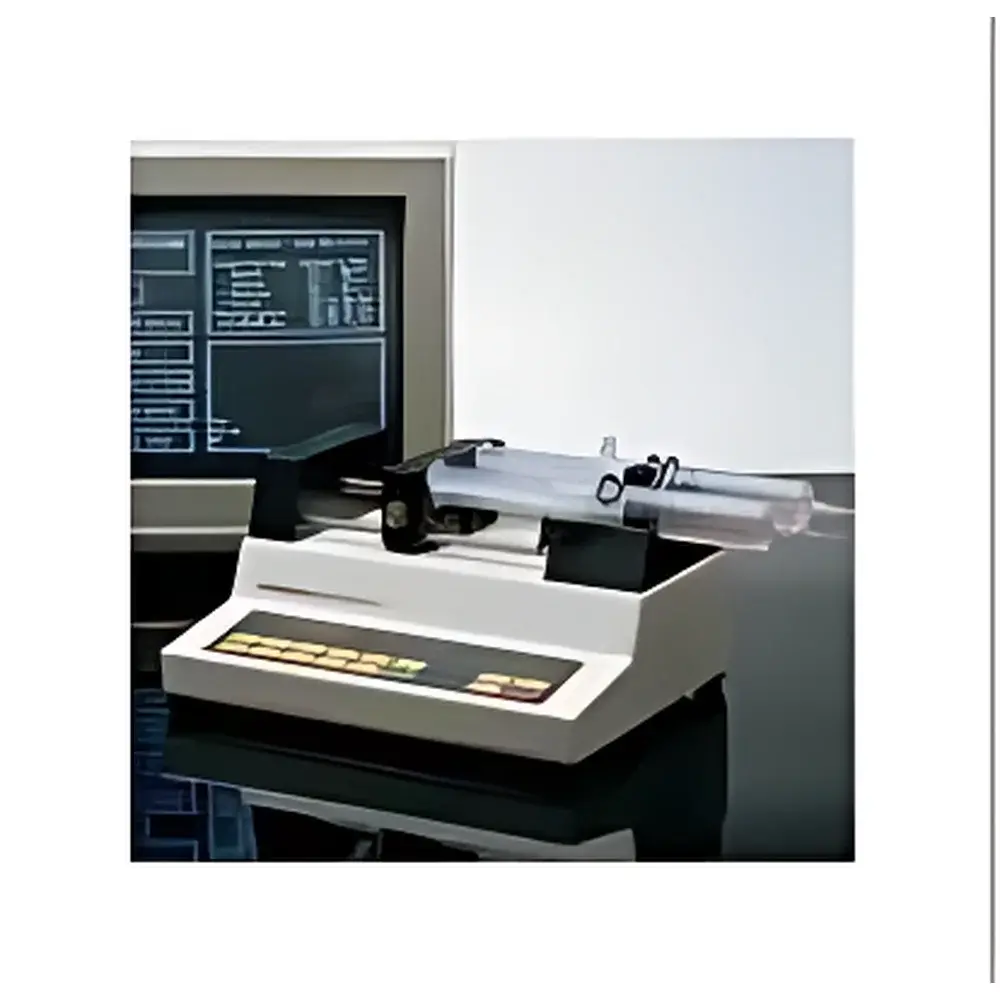
Harvard Apparatus Pump 22 Precision Syringe Pump
| Brand | Harvard Apparatus |
|---|---|
| Origin | USA |
| Model | Pump 22 |
| Drive Motor | 0.9° step angle stepper motor |
| Microstepping Resolution | 1/4-step |
| Encoder Feedback | Optical encoder for lead screw rotation monitoring |
| Accuracy | ±0.35% (stability), ±0.05% (repeatability) |
| Syringe Volume Range | 0.5 µL – 140 mL |
| Flow Rate Range | 0.002 µL/hr – 55.1 mL/min |
| Flow Units | µL/hr, µL/min, mL/hr, mL/min |
| Max Linear Force | 21.36 kg (47 lbf) |
| Power Input | 95–130 VAC, 60 Hz / 220–260 VAC, 50 Hz (selectable) |
| Dimensions (H×W×D) | 28 × 22.2 × 14 cm |
| Weight | 4.5 kg |
| Interface | RS-232 (25-pin connector), TTL-compatible shared port |
| Max Addressable Units in Daisychain | 100 (address range 0–99) |
| Standard Rack | Dual-syringe rack (0.5 µL–140 mL) |
| Optional Racks | 4×140 mL, 6/10-position (0.5 µL–20 mL or 30–60 mL), micro-syringe (0.5–10 µL, 4-channel) |
Overview
The Harvard Apparatus Pump 22 is a microprocessor-controlled, single- or dual-channel syringe pump engineered for high-precision fluid delivery and withdrawal in demanding laboratory environments. Operating on the principle of linear displacement via a precision-ground lead screw driven by a 0.9° full-step stepper motor with 1/4-step microstepping, the Pump 22 achieves sub-micron positional resolution (0.33 µm per microstep) and maintains flow stability across an exceptionally wide dynamic range—from nanoliter-per-hour infusion rates to >55 mL/min. Its closed-loop optical encoder continuously monitors lead screw rotation, enabling real-time verification of plunger advancement and ensuring traceable, repeatable volumetric delivery independent of syringe material or backpressure fluctuations. Designed for integration into automated workflows—including chromatography sample introduction, mass spectrometry infusion, in vivo pharmacokinetic dosing, and microfluidic system priming—the Pump 22 complies with fundamental mechanical and electrical safety standards applicable to Class I laboratory equipment (IEC 61010-1). Its modular rack architecture supports scalable multi-syringe configurations without sacrificing individual channel control fidelity.
Key Features
- High-resolution digital LED display with numeric keypad for intuitive entry of syringe inner diameter (ID), target flow rate, and volume parameters
- Optical encoder-based position feedback ensures flow accuracy of ±0.35% (stability) and repeatability of ±0.05%—validated per ASTM E2656 for volumetric delivery systems
- Dual-syringe standard rack accommodates glass, plastic, or stainless-steel syringes from 0.5 µL to 140 mL capacity
- Expandable multi-rack options: 4×140 mL rack (for high-volume infusion), 6/10-position rack (supports mixed syringe sizes: 0.5–20 mL or 30–60 mL), and dedicated micro-syringe rack (four 0.5–10 µL syringes)
- RS-232 serial interface (25-pin D-sub) with TTL-compatible shared port enables bidirectional command communication and remote scripting using ASCII-based protocol
- Daisy-chain topology supports up to 100 independently addressable units (addresses 0–99) for synchronized multi-pump operation in complex fluid-handling platforms
- Programmable operational modes: infusion-only, infusion/withdrawal, and continuous reciprocating cycles with user-defined dwell times
- Integrated status indicators: LED flash alerts upon plunger stall detection or end-of-run condition
Sample Compatibility & Compliance
The Pump 22 accepts standard Luer-lock and Luer-slip syringes manufactured from borosilicate glass, polypropylene, polyethylene, or medical-grade stainless steel—ensuring chemical compatibility with aqueous buffers, organic solvents (e.g., acetonitrile, methanol), viscous polymer solutions, and biological matrices including plasma and cell suspensions. Its non-contact drive mechanism eliminates contamination risk and preserves syringe integrity during extended operation. The device meets essential requirements of ISO 13485 for medical device-related R&D instrumentation and supports audit-ready data integrity when paired with compliant software environments. While not certified as a medical device itself, its performance characteristics align with USP Analytical Instrument Qualification guidelines for critical parameter verification (flow rate, volume delivery, linearity, and repeatability).
Software & Data Management
The Pump 22 operates natively via front-panel controls but is fully programmable through ASCII command sets transmitted over RS-232. Each unit ships with a built-in command interpreter supporting functions such as START, STOP, PAUSE, SET FLOW, SET VOLUME, and QUERY STATUS. When integrated into larger systems, it interfaces seamlessly with LabVIEW, MATLAB, Python (pySerial), or custom C/C++ applications. For regulated environments, third-party middleware solutions can be configured to enforce 21 CFR Part 11-compliant electronic signatures, audit trails, and user access controls—recording timestamps, operator IDs, parameter changes, and execution logs. All firmware updates are performed via serial download without hardware modification, preserving calibration history and validation state.
Applications
- In vivo pharmacological studies requiring precise intravenous, intracerebroventricular, or subcutaneous dosing regimens across rodent and large-animal models
- Mass spectrometry sample introduction, particularly nanoESI and MALDI-infusion protocols where nanoliter-level consistency directly impacts signal-to-noise ratio
- Automated liquid handling in analytical chemistry workflows—including HPLC fraction collection triggering, GC sample loop filling, and sequential reagent addition in kinetic assays
- Microfluidic device characterization, including pressure-driven flow calibration, droplet generation synchronization, and perfusion culture maintenance
- Environmental and industrial QC testing involving controlled dilution series preparation, standard curve generation, and spiked recovery experiments
- Materials science applications such as controlled precursor delivery in sol-gel synthesis or electrospinning feed systems
FAQ
What syringe materials are compatible with the Pump 22?
Glass (borosilicate), polypropylene, polyethylene, and stainless-steel syringes with standard Luer fittings are fully supported.
Can the Pump 22 perform bidirectional (infuse/withdraw) operations?
Yes—infusion-only and infusion/withdrawal modes are both programmable via front-panel or RS-232 commands.
Is the Pump 22 suitable for GLP/GMP-regulated laboratories?
While the hardware itself does not carry formal GLP/GMP certification, its deterministic behavior, encoder-based feedback, and support for electronic audit trails make it suitable for use within validated systems when properly qualified.
How many pumps can be daisy-chained together?
Up to 100 Pump 22 units can be connected in series using RS-232, each assigned a unique address (0–99).
Does the Pump 22 require recalibration after changing syringe size?
No—syringe ID is entered digitally before operation; the firmware computes displacement per step based on input dimensions, eliminating mechanical recalibration.
What is the minimum resolvable flow rate?
0.002 µL/hr—achievable using a 0.5 µL syringe at lowest speed setting, with encoder-verified positional fidelity.
Related Products



