
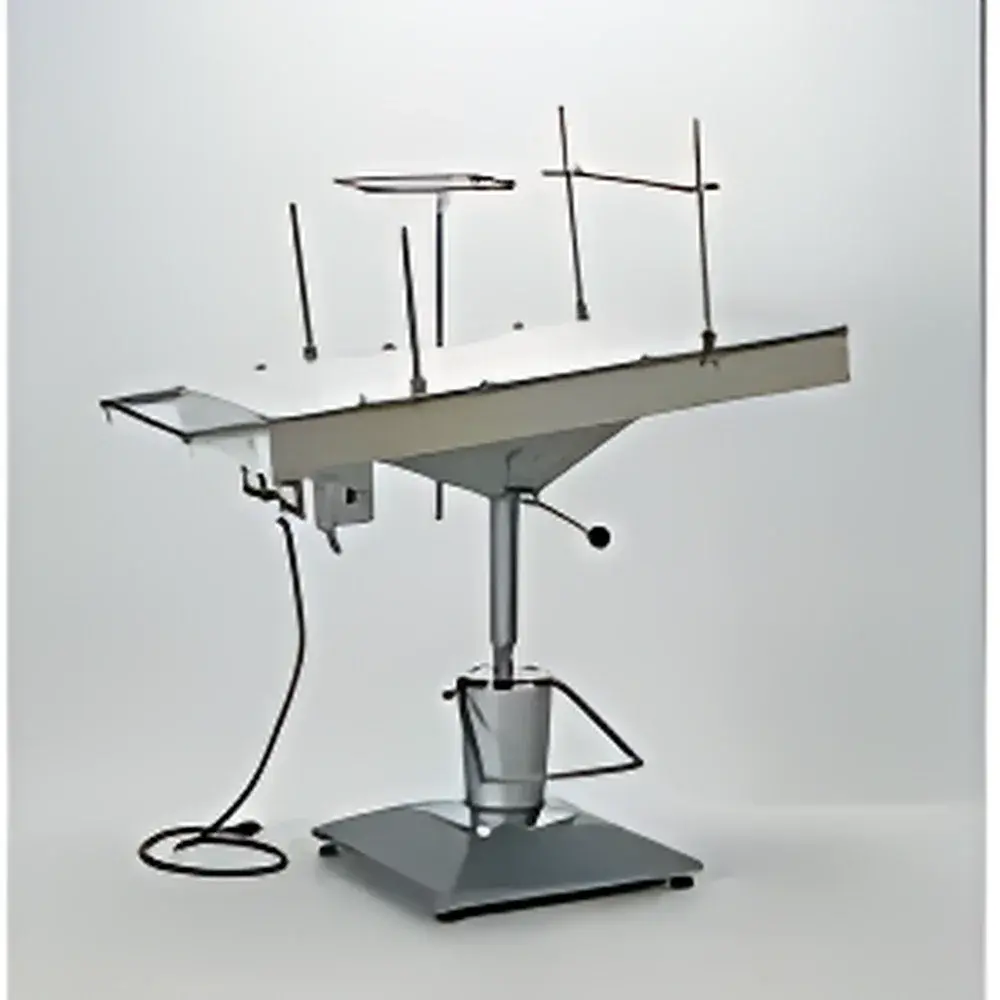
Harvard Apparatus Model 5013xx Medium-Size Heated Animal Surgical Table
| Brand | Harvard Apparatus |
|---|---|
| Origin | USA |
| Manufacturer Type | Authorized Distributor |
| Import Status | Imported |
| Model Series | 5013xx |
| Heating Element | 250 W, 31 cm × 51.5 cm (12 in × 20 in) stainless steel surface |
| Max Animal Weight Capacity | 40 kg (88 lb) |
| Temperature Rise | +4.4°C above ambient (no load) |
| Base Options | Hydraulic or Fixed Stand |
| Electrical Configurations | 115 VAC/60 Hz or 230 VAC/50 Hz |
| Instrument Tray | 30 cm × 22.5 cm × 61 cm (L×W×H), vertical rod Ø12.5 mm |
| Cross Rods | Ø12.5 mm × 53.3 cm (0.5 in × 21 in) |
Overview
The Harvard Apparatus Model 5013xx Medium-Size Heated Animal Surgical Table is an engineered platform designed for controlled, repeatable, and physiologically stable surgical and experimental procedures on medium-sized laboratory animals—primarily dogs, non-human primates, pigs, and large rodents weighing up to 40 kg (88 lb). Unlike passive support surfaces, this table integrates active thermal regulation via a precisely embedded resistive heating element beneath a seamless 31 cm × 51.5 cm (12 in × 20 in) 304 stainless steel work surface. The heating system delivers uniform thermal output at 0.156 W/cm² (1 W/in²), enabling maintenance of core body temperature during prolonged interventions—a critical requirement for minimizing hypothermia-induced physiological drift in cardiovascular, neurological, and metabolic studies. Its modular architecture supports integration with stereotaxic frames, electrophysiology rigs, and imaging accessories while conforming to institutional animal care standards under AAALAC-accredited facilities.
Key Features
- Stainless steel surgical surface (31 cm × 51.5 cm) with recessed 250 W resistive heater, optimized for thermal uniformity and ease of decontamination
- Two base configurations: hydraulic lift base (Model 501361/501320) for adjustable height during necropsy, dissection, and general surgery; fixed-height stand base (Model 501387/501346) for vibration-sensitive applications such as intracranial electrophysiology and electromyography
- Instrument tray assembly featuring vertically adjustable 61 cm (24 in) support rods (Ø12.5 mm / 0.5 in), accommodating standard clamps, micromanipulators, and light sources
- Cross rods (53.3 cm / 21 in length, Ø12.5 mm) pre-installed for rapid attachment of restraint systems, limb holders, or respiratory monitors
- Dual-voltage compatibility: 115 VAC/60 Hz (North America) and 230 VAC/50 Hz (EU/UK/Asia) variants, CE-marked and UL-listed for laboratory use
- No external controller required—the heating circuit operates passively with built-in thermal cutoff at 45°C to prevent surface overheating
Sample Compatibility & Compliance
The Model 5013xx is validated for use across species requiring stable thermoregulation during acute in vivo procedures—including canine cardiovascular models, porcine ischemia-reperfusion studies, and non-human primate neurosurgical preparations. Its load-bearing frame supports dynamic positioning without flexure, meeting ASTM F2222-22 requirements for mechanical stability of veterinary surgical equipment. All materials comply with ISO 10993-5 (cytotoxicity) and ISO 10993-10 (irritation/sensitization) standards. The stainless steel surface resists corrosion from common disinfectants (e.g., 70% ethanol, 0.5% sodium hypochlorite, peracetic acid), facilitating adherence to GLP-compliant cleaning protocols. No software or digital control interface is included; therefore, the system does not fall under FDA 21 CFR Part 11 regulatory scope but remains fully compatible with audit-trail-enabled data acquisition systems used in GCP and ICH-E6(R3)–aligned studies.
Software & Data Management
This surgical table operates as a standalone hardware platform with no embedded firmware, touchscreen interface, or proprietary software dependency. Temperature regulation is purely analog and self-limiting—no calibration, firmware updates, or cybersecurity validation are required. Integration with third-party data systems (e.g., PowerLab, Spike2, LabChart, or custom MATLAB/Python acquisition pipelines) occurs exclusively through auxiliary sensor inputs (e.g., rectal or esophageal thermistors connected to external DAQ units). All mechanical adjustments—height (hydraulic base), tray position, and rod orientation—are manually executed using calibrated locking mechanisms, ensuring traceability and repeatability without digital logs. Documentation packages include full mechanical schematics, RoHS/REACH declarations, and electrical safety test reports per IEC 61010-1.
Applications
- Acute terminal and survival surgeries in medium-sized mammals under inhalational or injectable anesthesia
- Intraoperative neurophysiological monitoring (EEG, EMG, evoked potentials) where minimal electromagnetic interference and mechanical stability are essential
- Cardiovascular instrumentation—including carotid cannulation, femoral artery catheterization, and echocardiographic imaging—requiring precise animal positioning and thermal continuity
- Pharmacokinetic and toxicology studies involving serial blood sampling, tissue biopsy, and organ harvesting under sterile conditions
- Training platforms for veterinary surgical residency programs accredited by AVMA or ECVS
FAQ
Does the table include temperature feedback control or digital readout?
No. The heating element operates open-loop with fixed power delivery and passive thermal cutoff. External temperature monitoring must be performed using independent probes interfaced with a separate data acquisition system.
Can the instrument tray be repositioned laterally or only vertically?
The tray mounts to two vertical rods and allows only vertical translation and rotation. Lateral repositioning requires loosening the base clamp and relocating the entire tray assembly along the cross rods.
Is the hydraulic base compatible with MRI or shielded electrophysiology suites?
The hydraulic mechanism contains no ferromagnetic components and generates no RF emissions; however, users must verify compatibility with local magnetic field constraints (e.g., ≤5 Gauss at 1 m distance) prior to installation in MRI-adjacent labs.
What is the maximum static load rating of the stainless steel surface?
The surface is rated for continuous static loads up to 120 kg (265 lb) with even distribution; the 40 kg animal weight limit reflects optimal thermal performance and ergonomic handling—not structural failure threshold.
Are replacement heating elements or service manuals available directly from Harvard Apparatus?
Yes. Authorized service partners provide OEM-certified spare parts (P/N 5013-HEAT-ASM) and technical bulletins covering torque specifications, grounding verification, and thermal validation procedures per ISO/IEC 17025–accredited calibration labs.
Related Products



