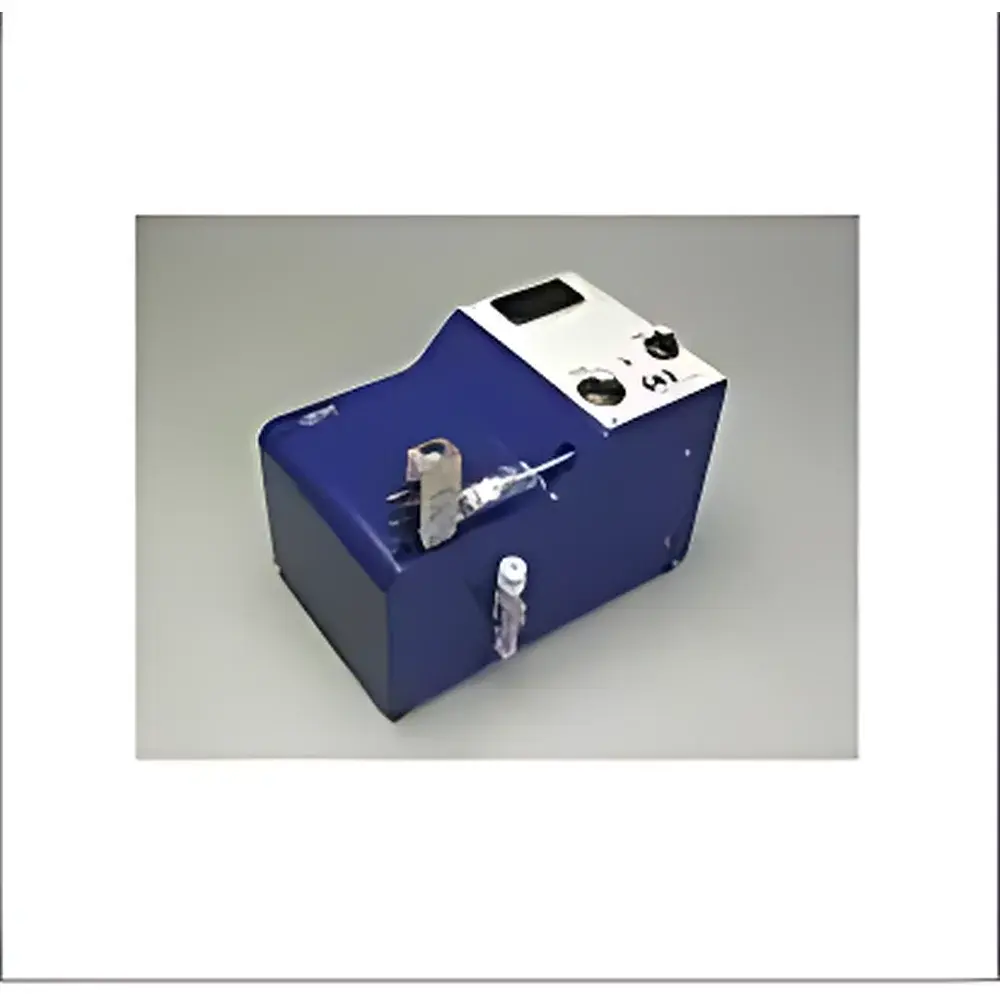
Harvard Apparatus Model 687 Small Animal Ventilator
| Brand | Harvard Apparatus |
|---|---|
| Origin | USA |
| Manufacturer Type | Authorized Distributor |
| Origin Category | Imported |
| Model | 687 |
| Price | Upon Request |
| Tidal Volume Range | 0.05–1 mL/stroke (0.1 mL increments) |
| Respiratory Rate | 18–150 breaths/min (adjustable during operation) |
| PEEP Control | Yes |
| Dead Space Minimization | Dual-piston cylinder design with end-stroke termination |
| Cylinder Stroke Calibration | Permanent laser-etched volume scale |
| Flow Path Interface | Four-port configuration (Instrument In, Animal In, Animal Out, Instrument Out) |
| Port Dimensions | ID 2.2 mm (0.086 in), OD 4 mm (5/32 in) and ID 3.5 mm (1/8 in), OD 5 mm (3/16 in) |
| Dimensions (H×L×W) | 25 × 32.5 × 15 cm (10 × 13 × 6 in) |
| Weight | 8 kg (18 lb) |
| Power Input | 115/230 VAC, 50/60 Hz |
Overview
The Harvard Apparatus Model 687 Small Animal Ventilator is a precision-engineered positive-pressure ventilator designed specifically for acute and subchronic respiratory support in rodents and other small laboratory mammals weighing up to 200 g—including mice, hamsters, gerbils, and juvenile rats. Based on a robust single-cylinder, dual-piston mechanical architecture, the Model 687 delivers highly reproducible tidal volumes via linear displacement control, eliminating reliance on pressure-based feedback loops that introduce variability in low-mass ventilation scenarios. Its operating principle centers on volumetric displacement: each piston stroke directly corresponds to a defined tidal volume, calibrated via permanent laser-etched markings on the cylinder wall—ensuring long-term metrological stability without drift or wear-related calibration loss. Unlike pneumatically modulated systems, this direct-drive mechanism provides intrinsic compliance with GLP-compliant experimental protocols requiring traceable, operator-independent volume delivery. The device operates within a physiologically relevant respiratory rate range (18–150 breaths/min), fully adjustable in real time during active ventilation—a critical capability for dynamic challenge studies such as hypoxia-reoxygenation or pharmacologic respiratory depression assays.
Key Features
- Linear, mechanically indexed tidal volume control from 0.05 to 1.0 mL/stroke in precise 0.1 mL increments—set manually via calibrated cylinder stroke positioning
- Dual-piston design ensures both pistons reach full cylinder stroke termination, minimizing system dead space and enhancing CO2 washout efficiency
- Integrated positive end-expiratory pressure (PEEP) regulation—essential for maintaining alveolar recruitment during prolonged ventilation and preventing atelectasis in anesthetized preparations
- Four independent gas pathway ports: instrument inlet (gas supply), animal inlet (to tracheal cannula), animal outlet (exhaled gas return), and instrument outlet (exhaust or scavenging)—enabling flexible integration with CO2 absorbers, humidity traps, or inline analyzers
- Digital LED display showing real-time respiratory rate; all parameters adjustable without interrupting ventilation cycle
- Interchangeable tubing connectors with dual-standard port geometry (ID 2.2 mm / OD 4 mm and ID 3.5 mm / OD 5 mm) for compatibility with common rodent airway cannulas and breathing circuits
- Compact benchtop footprint (25 × 32.5 × 15 cm) and 8 kg mass optimized for shared vivarium instrumentation carts and surgical rig integration
Sample Compatibility & Compliance
The Model 687 is validated for use with intubated or tracheostomized murine models under terminal anesthesia or conscious head-fixed paradigms (with appropriate analgesia and institutional approval). It supports standard rodent tracheal cannulation techniques using stainless steel or polyethylene tubing (e.g., PE-90, PE-50). All wetted surfaces are constructed from medical-grade anodized aluminum and chemically inert elastomers compliant with USP Class VI biocompatibility requirements. The ventilator meets IEC 61000-6-3 (EMC emission) and IEC 61000-6-1 (immunity) standards. While not FDA-cleared for human use, its design aligns with principles outlined in NIH Guide for the Care and Use of Laboratory Animals and adheres to AAALAC International accreditation expectations for mechanical ventilation endpoints. Documentation packages include factory calibration certificates traceable to NIST standards—supporting audit readiness for GLP-regulated toxicology or PK/PD studies.
Software & Data Management
The Model 687 operates as a standalone analog-controlled ventilator with no embedded microprocessor or proprietary software stack—eliminating cybersecurity concerns and firmware update dependencies. All operational parameters are set manually and verified visually via engraved scales and digital LED readouts. This architecture ensures deterministic behavior, full transparency of control logic, and seamless compatibility with third-party data acquisition systems (e.g., ADInstruments PowerLab, National Instruments DAQmx) via optional analog voltage output modules (0–5 V proportional to rate or volume, available separately). Audit trails are maintained externally through synchronized video recording, lab notebook entries, or timestamped electronic logbooks—fully satisfying 21 CFR Part 11 requirements when implemented within a validated institutional documentation framework.
Applications
- Acute pulmonary physiology: measurement of respiratory mechanics (compliance, resistance) via occlusion techniques combined with plethysmography
- Neurorespiratory integration studies: phrenic nerve recording, brainstem slice–intact animal bridging experiments
- Toxicology endpoints: assessment of ventilatory depression following opioid, sedative, or neuroactive compound administration
- Ischemia-reperfusion modeling: controlled hypoxic challenge with rapid reoxygenation while maintaining stable minute ventilation
- Transgenic phenotype screening: longitudinal respiratory phenotyping in models of cystic fibrosis, Rett syndrome, or spinal muscular atrophy
- Surgical support: maintenance of normoventilation during stereotaxic, thoracic, or cranial procedures under inhalational or injectable anesthesia
FAQ
What species and weight ranges is the Model 687 validated for?
The ventilator is intended for small mammals ≤200 g, including C57BL/6 and BALB/c mice (adult and weanling), Syrian hamsters, and neonatal or juvenile rats. Performance validation data are provided for mice (18–30 g) and hamsters (60–120 g).
Can PEEP be titrated independently of tidal volume and rate?
Yes—PEEP is adjusted via a dedicated rotary valve upstream of the animal interface, allowing continuous modulation from 0 to 12 cm H2O without affecting stroke volume or respiratory frequency settings.
Is the device compatible with volatile anesthetics like isoflurane?
Yes—the entire gas path is constructed from anesthetic-resistant materials; however, vaporizer placement must precede the ventilator’s instrument inlet to avoid elastomer degradation.
Does the Model 687 support sigh breaths or inspiratory hold functionality?
No—this is a fixed I:E ratio (1:1) ventilator with square-wave flow profile. For advanced waveform modulation, consider the Harvard Apparatus VentElite series.
What maintenance is required to ensure long-term accuracy?
Annual verification of piston seal integrity and cylinder scale alignment is recommended; lubrication is not required—piston movement relies on precision-ground aluminum-on-aluminum contact with dry-film solid lubricant coating.