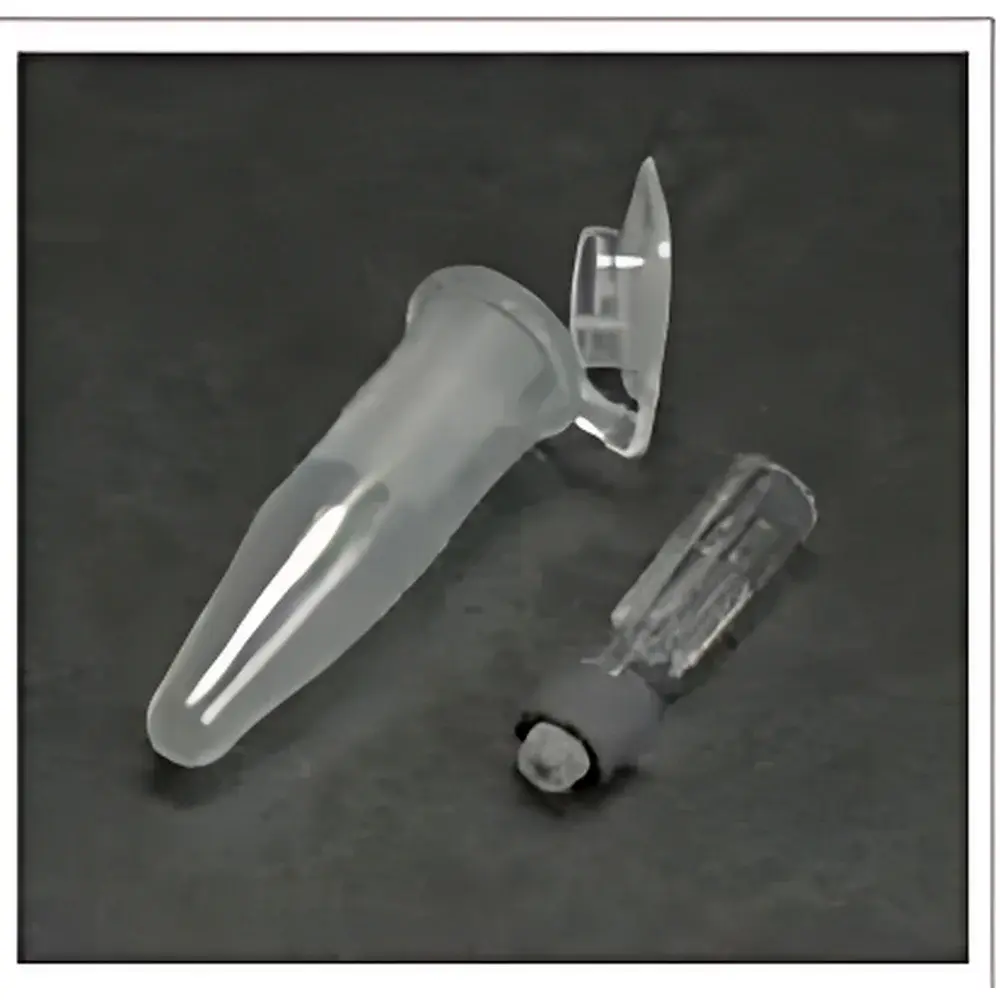
Fast Macro Dispo DIALYZERTM
| Origin | USA |
|---|---|
| Manufacturer Type | Distributor |
| Origin Category | Imported |
| Model | Fast Macro Dispo DIALYZERTM |
| Pricing | Upon Request |
Overview
The Fast Macro Dispo DIALYZERTM is a single-use, gravity-driven macro-dialysis device engineered for rapid and reproducible sample desalting, buffer exchange, and removal of low-molecular-weight contaminants in clinical and pre-analytical laboratory workflows. Unlike traditional stirred-cell or membrane-based dialysis systems requiring external pumps or vacuum manifolds, this device operates via passive diffusion across a regenerated cellulose membrane with a nominal molecular weight cutoff (NMWCO) of 5,000–10,000 Da—optimized for efficient retention of proteins, antibodies, nucleic acid complexes, and other macromolecules while permitting rapid equilibration of small solutes (e.g., salts, detergents, unincorporated dyes, or free nucleotides). Its design adheres to fundamental principles of Fickian diffusion and membrane permeability kinetics, enabling predictable mass transfer rates under standardized ambient conditions (20–25 °C), without reliance on mechanical agitation or temperature control.
Key Features
- Single-use, sterile, pyrogen-free disposable construction minimizes cross-contamination risk and eliminates cleaning validation requirements—critical for GLP-compliant clinical laboratories and diagnostic assay development.
- Macro-scale capacity supports sample volumes from 0.5 mL to 5.0 mL, accommodating high-concentration biological fluids (e.g., serum, CSF, tissue homogenates) and purified biomolecule preparations.
- Pre-hydrated regenerated cellulose membrane (NMWCO 5–10 kDa) ensures consistent pore geometry and low nonspecific binding—validated per ISO 10993-5 for cytocompatibility and USP for extractables testing.
- Integrated sample chamber with tapered inlet and vented cap enables bubble-free loading and facilitates complete sample recovery (>95% typical recovery rate using low-retention pipette tips).
- No external power, pumps, or consumable accessories required—reducing operational complexity and total cost of ownership in high-throughput clinical QC/QA environments.
Sample Compatibility & Compliance
The Fast Macro Dispo DIALYZERTM is validated for use with human plasma, serum, cerebrospinal fluid (CSF), urine, cell lysates, and purified recombinant proteins (e.g., IgG, albumin, enzymes). It maintains structural integrity and functional performance in common aqueous buffers including PBS, Tris-HCl (pH 6.5–8.5), HEPES, and ammonium bicarbonate—without membrane swelling or leaching. Device sterility is certified per ISO 11737-1 (bioburden and sterilization validation), and packaging complies with ASTM D4169 for distribution integrity. For regulated clinical applications, the device supports audit-ready documentation packages aligned with FDA 21 CFR Part 11 (electronic records), CLIA, and CAP checklist requirements for specimen preparation traceability.
Software & Data Management
As a passive, non-instrumented device, the Fast Macro Dispo DIALYZERTM does not incorporate embedded electronics or firmware. However, its integration into digital laboratory workflows is supported through compatibility with LIMS and ELN platforms via standardized SOP templates (e.g., PDF or XML-based protocols) that include batch-specific lot traceability, expiration tracking, and user-defined dialysis duration logging. Each unit bears a unique serialized barcode compliant with GS1 standards, enabling full chain-of-custody documentation during clinical trial sample processing per ICH-GCP Annex 5 guidelines.
Applications
- Routine desalting of enzymatic digests prior to MALDI-TOF or LC-MS/MS analysis in clinical proteomics.
- Buffer exchange of monoclonal antibody formulations prior to size-exclusion chromatography (SEC-HPLC) or dynamic light scattering (DLS).
- Removal of free fluorescent dyes (e.g., Cy3/Cy5) following labeling reactions in molecular diagnostics probe development.
- Pre-analytical cleanup of serum samples for therapeutic drug monitoring (TDM) assays involving immunoaffinity capture.
- Stabilization of labile analytes (e.g., cytokines, exosomal RNA) by eliminating chelating agents or reducing agents prior to downstream qRT-PCR or ELISA.
FAQ
What is the recommended dialysis time for optimal buffer exchange?
Typical equilibration requires 2–4 hours at room temperature with gentle end-over-end rotation; full exchange (≥95% salt removal) is achieved within 16 hours for 1× PBS into 50 mM ammonium bicarbonate.
Can the device be used for heat-sensitive samples?
Yes—no external heating or agitation is required, preserving thermolabile epitopes, enzyme activity, and nucleic acid integrity.
Is the membrane compatible with organic solvents?
No—regenerated cellulose is hydrophilic and incompatible with >5% v/v methanol, acetonitrile, or DMSO; aqueous-only solutions are recommended.
How is lot-to-lot consistency ensured?
Each production lot undergoes NMWCO verification via dextran rejection assays (ASTM D5892), membrane integrity testing (bubble point per ASTM F316), and endotoxin quantification (<0.03 EU/mL).
Does the device meet regulatory requirements for IVD use?
While classified as a general-purpose lab consumable, it supports IVD assay development under ISO 13485 quality system requirements when used within validated protocols.