
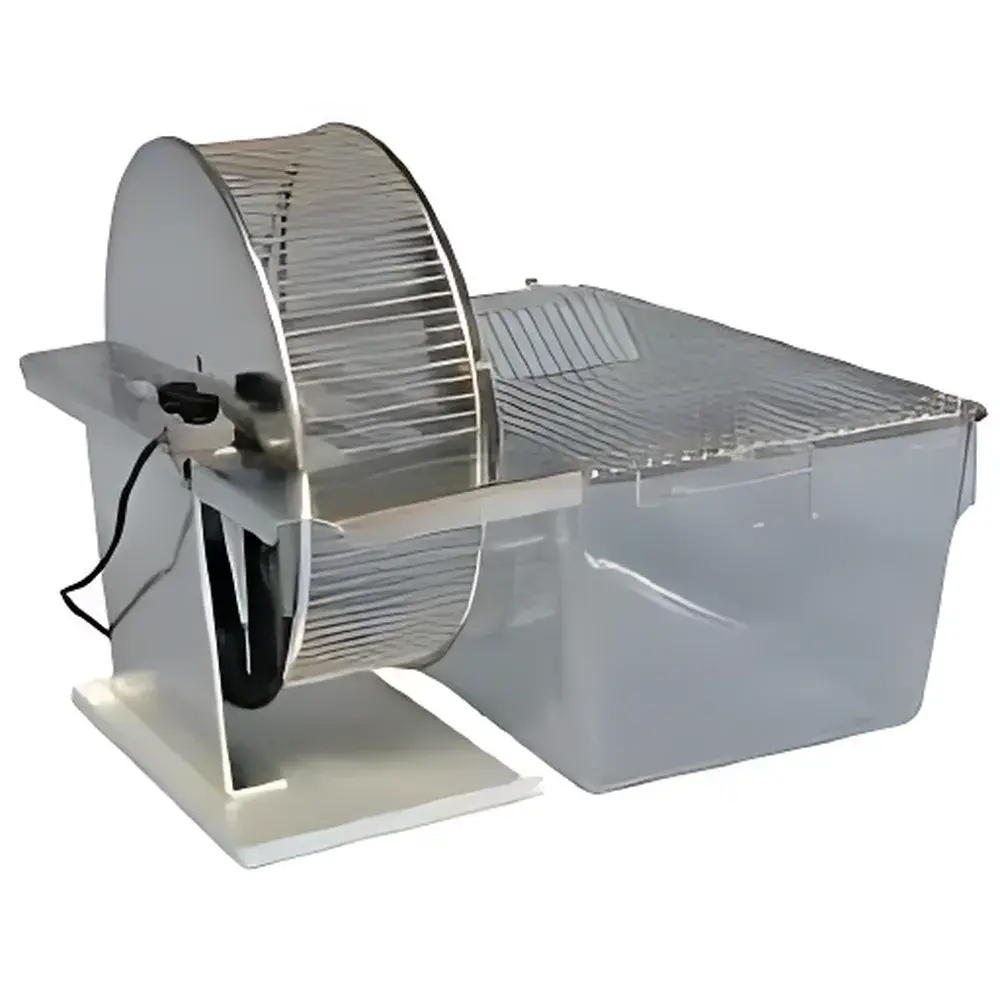
Panlab LE904/LE905 Rodent Running Wheel Housing System
| Brand | Harvard Apparatus |
|---|---|
| Origin | USA |
| Model | LE904 (rat), LE905 (mouse) |
| Wheel Position | External |
| Cage Material | Stainless Steel |
| Time Resolution | 0.01 s |
| Angular Resolution | 30° per detection |
| Sampling Interval | Configurable (e.g., 10 s) |
| Max Simultaneous Cages | 30 |
| Data Export Format | Excel-compatible CSV |
| Compliance | GLP-supporting data audit trail (software-configurable) |
Overview
The Panlab LE904 (rat) and LE905 (mouse) Running Wheel Housing Systems are purpose-engineered, externally mounted activity monitoring enclosures designed for longitudinal, non-invasive assessment of spontaneous locomotor behavior in rodent models. These systems operate on the principle of optoelectronic interruption detection: an infrared emitter-detector pair registers each 30° angular increment of wheel rotation, enabling high-fidelity temporal reconstruction of running events. Unlike internal-wheel configurations, the external mounting preserves full cage floor area—critical for ethologically valid housing conditions during circadian or behavioral phenotyping studies. The stainless-steel construction ensures compatibility with autoclaving (non-electrical components only), supporting rigorous sanitation protocols required in multi-use vivaria and GLP-compliant preclinical facilities. Each system integrates seamlessly with Harvard Apparatus’ validated data acquisition architecture, providing time-stamped, timestamp-aligned metrics including total revolutions, cumulative active time, instantaneous angular velocity, acceleration profiles, and circadian phase distribution of activity onset/offset.
Key Features
- External wheel design: Eliminates intra-cage spatial competition—wheel occupies no floor area inside the ACE-standard housing (LE904: 42 × 26 × 47.5 cm; LE905: 36 × 20 × 35 cm).
- High-resolution motion capture: 0.01-second temporal resolution and 30° angular step detection enable precise derivation of velocity and acceleration parameters.
- Scalable multi-cage operation: Up to 30 independently monitored cages synchronized via a central control unit with user-defined sampling intervals (e.g., 10 s, 60 s, or custom windows).
- Autoclavable stainless-steel frame and wheel assembly (non-electronic parts only), compliant with IACUC-mandated sanitation standards.
- Modular counter options: Standalone single-cage counters or multi-channel rack-mounted units with real-time LED display and buffered memory for offline retrieval.
- Software-controlled experimental paradigms: Supports scheduled light-dark transitions, drug administration timestamps, and conditional activity gating (e.g., activity only during subjective night).
Sample Compatibility & Compliance
The LE904/LE905 systems accommodate standard laboratory rat (Sprague-Dawley, Wistar, Long-Evans) and mouse (C57BL/6, BALB/c, FVB/N) strains without modification. Cage dimensions conform to NIH Guide for the Care and Use of Laboratory Animals and EU Directive 2010/63/EU space requirements for group-housed rodents. All electronic modules meet IEC 61000-6-3 (EMC emissions) and IEC 61000-6-2 (immunity) standards. Software supports ALCOA+ principles (Attributable, Legible, Contemporaneous, Original, Accurate) and enables configuration of audit trails, electronic signatures, and 21 CFR Part 11–compliant user access controls when deployed in regulated neuropharmacology or toxicology studies.
Software & Data Management
Data acquisition is managed through Harvard Apparatus’ dedicated WheelMonitor software (v4.2+), which runs on Windows-based acquisition stations. The software provides real-time visualization of wheel revolutions per minute (RPM), cumulative distance (km), and binned activity histograms aligned to ZT (Zeitgeber Time). Raw event logs are stored in ASCII-encoded, tab-delimited files compatible with Microsoft Excel, MATLAB, R, and Python pandas workflows. Batch processing tools allow automated extraction of peak activity windows (e.g., ZT12–ZT16), interdaily stability, intradaily variability, and relative amplitude—key circadian parameters defined by the Chronobiology Society. Exported datasets include metadata headers specifying cage ID, animal ID, protocol name, start timestamp, and hardware calibration flags.
Applications
- Circadian rhythm phenotyping: Quantification of free-running period (tau), phase shifts following light pulses or scheduled feeding, and arrhythmicity scoring in ClockΔ19 or Bmal1⁻/⁻ models.
- Neurodegenerative disease modeling: Longitudinal tracking of hypoactivity onset in R6/2 Huntington’s disease mice or progressive bradykinesia in α-synuclein overexpression models.
- Psychostimulant response profiling: Dose-dependent analysis of wheel-running hyperactivity induced by methylphenidate, amphetamine, or cocaine—used in ADHD and addiction translational research.
- Nutritional neuroscience: Assessment of activity suppression in food-restricted or diet-induced obesity models, including compensatory hyperactivity during refeeding phases.
- Pharmacokinetic-pharmacodynamic (PK-PD) correlation: Alignment of plasma drug concentration curves with acute changes in wheel-running velocity or bout duration.
FAQ
Can the LE904/LE905 system be used for long-term chronic studies exceeding 8 weeks?
Yes—the stainless-steel wheel and housing are rated for repeated autoclaving (121°C, 20 min), and the optical sensors exhibit stable performance across >6-month continuous operation under standard vivarium lighting conditions.
Is synchronization with EEG/EMG or telemetry systems supported?
Yes—via TTL pulse output from the control unit, enabling hardware-triggered recording initiation in compatible physiological monitoring platforms (e.g., DSi PhysioTel, TSE Systems).
Does the software support automated detection of running bouts versus sporadic rotations?
Yes—configurable minimum bout duration (default: 2 s) and inter-bout interval (default: 30 s) parameters allow discrimination between sustained locomotion and exploratory pawing, with bout-level statistics exported alongside aggregate metrics.
Are replacement wheels and optical sensor modules available as spare parts?
Yes—Harvard Apparatus maintains full OEM part numbers for LE904/LE905 wheel assemblies (P/N: WH-LE904-RAT), sensor kits (P/N: OPTO-LE-SK), and cage frames (P/N: ACE-LE904-SS), all backed by a 2-year limited warranty.
Can data from multiple independent experiments be merged into a single longitudinal database?
Yes—WheelMonitor includes a project management module that enforces consistent metadata tagging (strain, sex, age, treatment group), enabling cross-experiment cohort analysis using built-in statistical templates (ANOVA, cosinor regression, Rayleigh test).





