
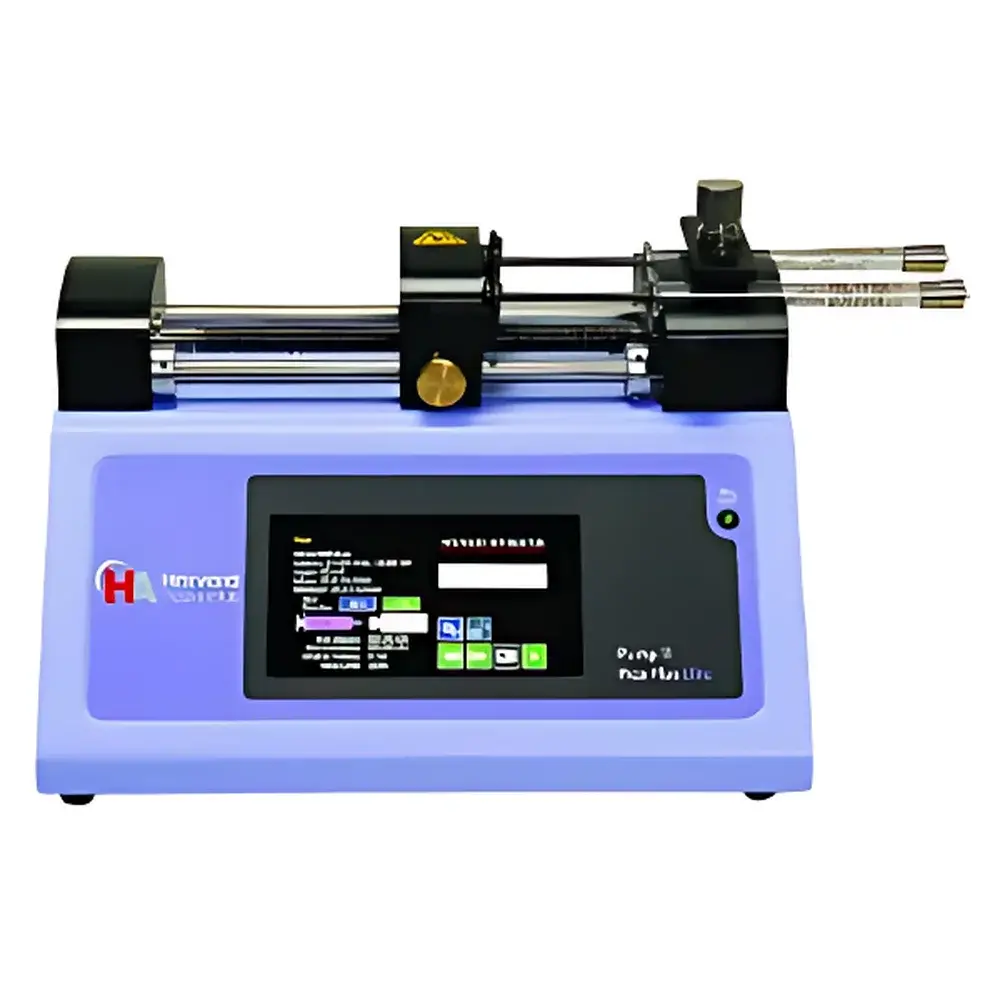
Harvard Apparatus Pump 11 Pico Plus Elite Dual-Channel Programmable Syringe Pump
| Brand | Harvard Apparatus |
|---|---|
| Origin | USA |
| Model | Pump 11 Pico Plus Elite 704506 |
| Flow Rate Range | 0.54 pL/min – 11.7 mL/min |
| Accuracy | ±0.5% |
| Syringe Capacity | 0.5 µL – 10 mL |
| Display | 4.3" WQVGA TFT color touchscreen |
| Interfaces | RS-232, USB, RS-485, TTL digital I/O, footswitch input, IEEE-1394, 15-pin D-sub, mini phono jack |
| Linear Force | 16 kg (35 lbs) |
| Step Resolution | 0.031 µm/step |
| Input Power | 12–30 VDC |
| Dimensions (H×W×D) | 22.6 × 17.78 × 15 cm |
| Weight | 2.1 kg |
| Certifications | CE, ETL (UL/CSA), WEEE, EU RoHS, CB Scheme |
Overview
The Harvard Apparatus Pump 11 Pico Plus Elite is a dual-channel, microprocessor-controlled syringe pump engineered for ultra-low-flow precision delivery and withdrawal in demanding life science and analytical applications. Based on high-resolution stepper motor actuation and closed-loop positional feedback, it delivers exceptional volumetric accuracy across an industry-leading flow range—from 0.54 picoliters per minute to 11.7 milliliters per minute—without requiring external computers or software. Its core architecture eliminates mechanical backlash and minimizes pulsation through optimized lead-screw design and real-time position monitoring, enabling stable, laminar fluid displacement essential for microinjection, microdialysis, and nanoliter-scale chromatographic elution. Designed for integration into automated workflows and manual benchtop protocols alike, the Pump 11 Pico Plus Elite meets the stringent reproducibility requirements of GLP-compliant laboratories and regulated research environments.
Key Features
- Dual-channel independent programming supports simultaneous infusion and withdrawal, expanding dynamic range and enabling bidirectional fluid manipulation (e.g., push-pull microdialysis or closed-loop perfusion).
- High-resolution 4.3-inch WQVGA color touchscreen with intuitive icon-driven interface allows full parameter configuration—including flow rate, volume, direction, acceleration, and pause conditions—without PC dependency.
- Sub-picoliter resolution control: programmable down to 0.0073 pL/sec (0.54 pL/min), validated by gravimetric calibration traceable to NIST standards.
- Integrated TTL-compatible digital I/O and footswitch input enable hands-free start/stop and synchronization with electrophysiology rigs, imaging systems, or environmental chambers.
- Multi-protocol communication stack includes RS-232, USB virtual COM port, RS-485 daisy-chaining capability (up to 32 pumps), IEEE-1394 FireWire, and analog/digital trigger lines for deterministic timing in time-critical experiments.
- Robust mechanical design delivers 16 kg linear force and sub-micron positional repeatability (0.031 µm/step), compatible with glass, plastic, and metal syringes from 0.5 µL to 10 mL capacity.
Sample Compatibility & Compliance
The Pump 11 Pico Plus Elite accommodates standard Luer-lock and small-bore syringes used in neurophysiology, single-cell injection, capillary electrophoresis, and nanofluidic HPLC coupling. Its chemically inert drive mechanism and optional solvent-resistant seals support aqueous, organic, and mildly corrosive media. The device complies with ISO 13485-aligned manufacturing practices and carries CE marking for medical device interoperability, ETL certification to UL 61010-1 and CSA C22.2 No. 61010-1 for electrical safety, and full conformance with EU RoHS, WEEE, and CB Scheme directives. It supports audit-ready operation under FDA 21 CFR Part 11 when paired with compliant host software—enabling electronic signatures, change tracking, and secure data archiving for regulated preclinical studies.
Software & Data Management
While fully functional as a standalone instrument, the Pump 11 Pico Plus Elite integrates seamlessly with Harvard Apparatus’ Pump Control Software (v5.0+) and third-party platforms via ASCII command protocol (SCPI-compliant). All operational parameters—including timestamped flow logs, error codes, and syringe plunger position—are accessible via USB or RS-232 for real-time streaming or batch export in CSV/TSV format. Firmware updates are delivered via signed binary packages with SHA-256 verification. Audit trail functionality records user login events, method changes, and execution history—supporting GLP/GMP documentation requirements without proprietary lock-in.
Applications
- Single-cell microinjection and embryonic manipulation in developmental biology
- Continuous microdialysis sampling in awake, freely moving rodent models
- Nanoliter-range mobile phase delivery in nano-HPLC and capillary LC-MS interfaces
- Controlled reagent infusion in microfluidic organ-on-chip platforms
- Calibration fluid delivery for mass spectrometry internal standard introduction
- Long-term intracerebral or intrathecal drug administration in chronic toxicity studies
FAQ
What is the minimum programmable flow rate, and how is it achieved?
The lowest flow rate is 0.54 pL/min, attained using a 0.5 µL syringe at maximum step resolution (0.031 µm/step) and optimized acceleration profiling to suppress start-stop artifacts.
Can the pump operate in withdrawal-only mode for reverse microdialysis?
Yes—each channel supports independent infusion, withdrawal, or alternating bidirectional sequences via user-defined program steps.
Is the device compatible with ISO/IEC 17025-accredited calibration protocols?
Yes—the pump’s ±0.5% volumetric accuracy specification is verified using gravimetric methods per ASTM E2700 and ISO 8655-3, with optional factory calibration certificates available upon request.
Does the RS-485 interface support Modbus RTU for PLC integration?
No—RS-485 operates exclusively in Harvard’s native ASCII command mode; however, protocol translation gateways are commercially available for Modbus mapping.
What syringe materials are recommended for organic solvent handling?
Glass syringes with PTFE-tipped plungers or stainless-steel barrels are advised for acetonitrile, methanol, or DMSO; avoid polypropylene syringes above 40°C or with chlorinated solvents.



